
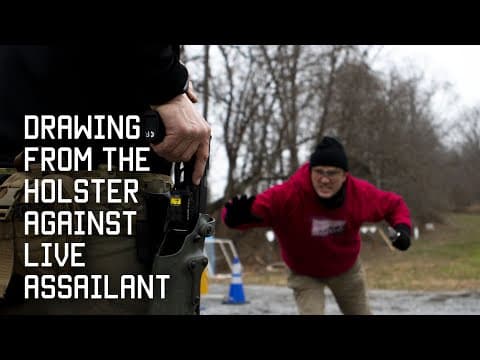
This blog post explores the 21-foot rule in self-defense, emphasizing the importance of incorporating motion and hand-to-hand skills into firearm training. It discusses practical demonstrations of drawing from a holster against an assailant and the necessity of creating distance to effectively use a weapon.
In the realm of self-defense, the 21-foot rule has been a topic of much discussion and debate. This blog post aims to clarify some misconceptions surrounding this rule and provide practical insights into effective self-defense strategies when faced with an armed assailant.
The 21-foot rule suggests that an assailant armed with a knife can cover a distance of 21 feet in the time it takes a person to draw a firearm and fire. This concept highlights the critical importance of understanding the distance between you and a potential attacker when considering your response options.
One of the key takeaways from tactical training is the necessity of incorporating motion into your draw. Simply standing still while attempting to draw your weapon can be detrimental. Instead, it is crucial to integrate hand-to-hand skills into your self-defense repertoire. This combination allows you to create space and time to effectively draw your weapon when necessary.
In a recent demonstration, a tactical expert utilized a UTM (Ultimate Training Munitions) gun to simulate a real-life scenario. The expert stood at the standard distance of 21 feet while an assailant, played by a training partner, charged with a knife. The initial attempts involved standing still, which resulted in the expert being stabbed multiple times despite firing shots. This highlighted the risks of remaining stationary during an attack.
After the initial demonstration, the expert began to incorporate lateral movement into the draw. By moving to the side or at a diagonal angle, the expert was able to create distance from the assailant, allowing for a more effective response. In this scenario, the expert successfully fired multiple shots while avoiding being stabbed, demonstrating that motion can significantly enhance your chances of survival.
In addition to drawing a firearm, the expert emphasized the importance of hand-to-hand techniques when an assailant is within close range. The demonstration included verbal commands to the assailant, attempting to de-escalate the situation before resorting to physical action. The expert illustrated how creating distance is essential; without it, the risk of being injured while trying to access a weapon increases dramatically.
Self-defense is a complex skill that requires practice and understanding of various techniques. The 21-foot rule serves as a reminder of the importance of distance and movement in a confrontation. By incorporating motion and hand-to-hand skills into your training, you can enhance your ability to respond effectively in dangerous situations. Remember, the goal is to create distance and time to safely access your weapon if necessary. Stay safe and keep training.