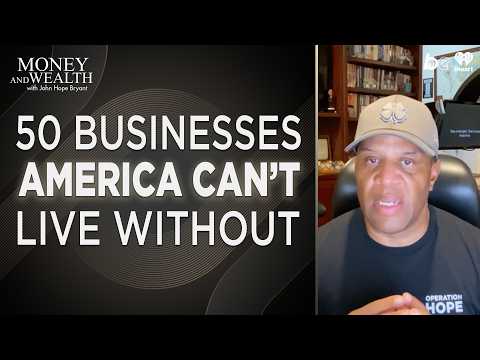
John Hope Bryant explores the 50 essential businesses that every American city relies on, explaining why these businesses are recession-proof and often AI-resistant. He breaks down capitalism as a negotiation between producers and consumers, emphasizing the importance of ownership, trust, and smart entrepreneurship in building wealth and sustaining communities.
John Hope Bryant, host of the Money and Wealth podcast series on the Black Effect Network iHeart Radio, dives deep into the realities of capitalism and the critical businesses that keep American cities running. As he embarks on the third season of his podcast, Bryant aims to unpack capitalism in a way that is practical, accessible, and empowering for listeners.
Bryant's goal is to provide listeners with tangible knowledge that can help them send their kids to college, raise a family, and reset their lives economically. He promises to move beyond theory and hype to deliver the substance of capitalism, focusing on real-world applications and opportunities.
In previous episodes, Bryant discussed how cities function not just as places but as economic machines. Today, he focuses on the 50 businesses every city cannot live without—businesses that provide essential services that do not disappear during recessions, elections, or technological shifts like AI.
Bryant distinguishes between optional and nonoptional demand:
Cities operate almost entirely on nonoptional demand, making the businesses that serve these needs some of the safest and most durable in America.
Bryant categorizes these essential businesses into five groups:
These are backbone businesses that keep cities functioning:
Many of these services are contracted out to private companies, providing stable and profitable business opportunities.
Every city owns buildings that require ongoing maintenance:
These services provide continuous revenue streams and are essential for city operations.
This category includes businesses that ensure safety and regulatory compliance:
These niches are profitable and often protected by regulation, making them stable business opportunities.
As cities grow, complexity increases, creating demand for knowledge-based services:
These businesses scale with expertise rather than physical assets.
Cities manage people as well as assets, creating demand for services such as:
These services often blend purpose with profit and are vital to community well-being.
Bryant highlights four protective characteristics that make these businesses resilient:
These opportunities are especially suited for:
Bryant emphasizes that opportunity is not hidden but often overlooked.
Ownership changes everything. Bryant encourages listeners to:
He stresses that no one takes care of rental cars like owners do, illustrating the power of ownership.
Bryant breaks down capitalism as a negotiation between producer (capitalist) and consumer:
This dynamic tension is the essence of capitalism, where fair exchange occurs without robbery.
Bryant warns about the importance of understanding contracts and having legal counsel. He shares examples where lack of formal agreements led to misunderstandings and lost opportunities.
He advises entrepreneurs to:
Bryant encourages listeners to pick one business from the 50 essential ones and focus on becoming excellent at it. Success requires commitment, trust-building, and delivering more than expected.
He concludes by reminding us that capitalism is about fair exchange and negotiation, and with the right mindset and preparation, anyone can thrive.
This comprehensive overview provides a practical guide to understanding the backbone of American cities' economies and how individuals can leverage capitalism to build wealth and serve their communities effectively.