
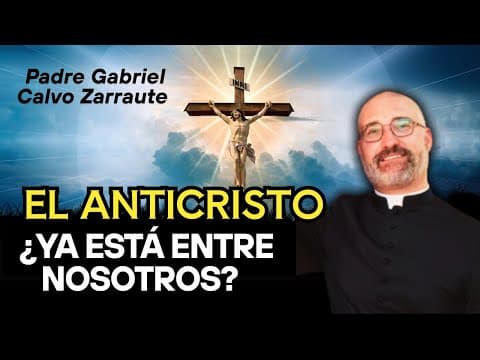
Padre Gabriel Calvo discusses the concept of the Antichrist, the role of the catechon as an obstacle to its manifestation, and the historical context of authority and law in relation to the Antichrist, drawing from biblical texts and historical interpretations.
In a recent discussion, Padre Gabriel Calvo delves into the complex topic of the Antichrist, referencing biblical texts and historical interpretations. This exploration sheds light on the nature of the Antichrist and the concept of the catechon, which serves as an obstacle to its manifestation.
The Antichrist is mentioned in the Book of Revelation, also known as the Apocalypse. Padre Gabriel highlights the significance of this figure and suggests that understanding it requires a look at various theological works. He recommends reading the four letters of Cardinal John Henry Newman and Vladimir Soloviev's brief narrative on the Antichrist, which, despite being over a century old, resonates with contemporary issues.
The term "catechon" is derived from Greek, meaning "obstacle." According to Padre Gabriel, this concept is crucial in understanding what prevents the Antichrist from fully manifesting. He cites Saint Paul’s Second Letter to the Thessalonians, specifically Chapter 2, where it is stated that there is an obstacle to the revelation of the Antichrist, which is associated with lawlessness and chaos.
Padre Gabriel emphasizes that God is a creator and an organizer, establishing order through the law. The biblical narrative begins with God creating and ordering the universe, separating light from darkness and land from water. This divine order is contrasted with the chaos represented by the Antichrist, who embodies lawlessness (anomia).
Historically, the catechon has been understood as the Roman Empire, not merely as a political entity but as a representation of authority and law. Padre Gabriel explains that the Roman legal system provided a framework for justice and order, which the Church later adopted and adapted.
When the Roman Empire officially converted to Christianity in 380 AD under Emperor Theodosius, the Church began to assume the organizational structure of the Empire. This transition allowed the Church to maintain its influence and authority, even as the Empire fell. The Church became a stabilizing force amidst the chaos of barbarian invasions, using the Roman legal framework to evangelize and convert new peoples.
Padre Gabriel critiques the evolution of Church law, particularly the introduction of the Code of Canon Law by Pope Benedict XV in 1917. He argues that this codification represented a departure from the traditional, customary law that had been rooted in Roman legal principles. The subsequent Code of Canon Law in 1983 further distanced itself from these foundations, leading to a loss of the structured authority that had characterized the Church for centuries.
The discussion culminates in the recognition that the struggle against the Antichrist is not merely a cultural battle but a spiritual one. Padre Gabriel asserts that this conflict involves not just human adversaries but spiritual forces. He emphasizes the importance of understanding this struggle in the context of faith and the teachings of the Church.
Padre Gabriel Calvo’s insights into the Antichrist and the catechon provide a profound understanding of the spiritual and historical dimensions of this topic. By examining biblical texts and historical interpretations, he invites readers to reflect on the nature of authority, law, and the ongoing spiritual battle against chaos and lawlessness in the world today.



















