
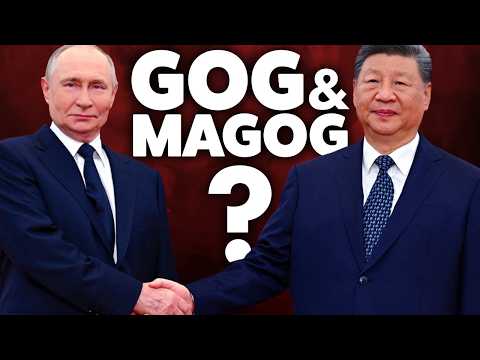
Gog and Magog are mysterious figures from biblical prophecy, often interpreted as symbolic enemies of God in the final battle before the end of the world. Originating in Ezekiel's oracles and later appearing in apocalyptic literature like Revelation, their identities have been debated for centuries, with interpretations evolving alongside historical and geopolitical contexts, especially within Christian evangelical thought.
For centuries, Christians have sought to identify two enigmatic enemies mentioned in the final chapters of the Book of Revelation: Gog and Magog. These names symbolize the nations of the world in rebellion against God, and their identities have been the subject of much theological debate and speculation.
One notable interpretation came from Ronald Reagan in 1971, when he was governor of California. Reagan, reflecting the views of many American evangelicals of his time, suggested that Gog must be Russia, reasoning that no other powerful nation lies to the north of Israel. This interpretation was rooted in a passage from Revelation describing Satan deceiving the nations, including Gog and Magog, to gather them for a final battle against Jerusalem. The armies are described as numerous as the sands of the sea, but ultimately destroyed by fire from heaven, leading to the judgment of the dead and the creation of a new heaven and earth.
Throughout the Cold War, this interpretation gained traction due to the ideological conflict and nuclear threat posed by the Soviet Union. Prophecy books and televangelist broadcasts connected Gog and Magog with nations like Iran, Libya, Ethiopia, and Eastern Europe, forming a coalition against Israel. Even in the 21st century, discussions continue about whether Russia or China might represent these prophetic nations.
However, a critical issue with Reagan's interpretation is that Russia is never explicitly mentioned in the Bible.
The earliest biblical mention of Gog appears in chapters 38 and 39 of Ezekiel, a prophetic book dated to Judah's exile in Babylon (circa 590s-570s B.C.E.). Ezekiel's writings focus on the catastrophe of Jerusalem's fall and the trauma of exile, but also pivot toward restoration and God's presence returning to His people.
The Gog oracle addresses a mysterious figure named Gog from the land of Magog, described as the chief prince of Meshek and Tubal. Gog leads a vast coalition including Persia, Kush, Libya, Gomer, and Beth Togarmah, among others. These names correspond to historical peoples and regions, many identifiable in the ancient Near East, particularly around Anatolia and the Black Sea.
Gog's army is depicted as a massive mounted horde spreading like a cloud over the earth, intending to plunder Israel. Yet, this invasion is part of God's plan to demonstrate His power through natural disasters and divine judgment, culminating in the defeat of Gog's forces and the secure restoration of Israel.
While many coalition members can be historically identified, Gog himself remains elusive. Some scholars link Gog to King Gajis of Lydia (western Anatolia, 600s B.C.E.), but the fit is imperfect. Others suggest Gog is a symbolic or mythic figure, possibly connected to Babylonian deities or created from the name Magog.
The oracle's apocalyptic tone and lack of clear historical identity make Gog a flexible symbol, reshaped by later interpreters to represent contemporary enemies.
After Ezekiel, Gog and Magog appear together in the Syline oracles (2nd century B.C.E.), where they are treated as two entities rather than a person and a land. The Greek translation of the Hebrew Bible (Septuagint) also expands Gog's presence, inserting the name into other passages as a symbol of ultimate enemies.
Jewish texts like the Dead Sea Scrolls incorporate Gog and Magog into apocalyptic scenarios involving cosmic battles between good and evil, often linked to the coming of the Messiah. These texts portray Gog as part of a final conflict, with God's intervention leading to victory and messianic rule.
In Christian apocalyptic literature, particularly Revelation, Gog and Magog become fully developed symbols of evil nations gathered for a final war against God's people. Revelation 19 depicts a battle reminiscent of Ezekiel's oracle, with enemies destroyed by fire and birds feasting on their corpses.
Revelation 20 explicitly names Gog and Magog as the nations deceived by Satan after his release from a thousand-year imprisonment, gathering for a final assault on Jerusalem before being destroyed by divine fire.
Unlike Ezekiel, Revelation uses Gog and Magog as symbolic names for the nations of the world rather than specific historical places or persons.
Throughout history, Gog and Magog have been reinterpreted to fit contemporary geopolitical fears. Martin Luther identified them with the Ottoman Turks during their expansion into Europe and the Middle East.
In the 20th century, American evangelicalism popularized premillennial dispensationalism, interpreting biblical prophecies as literal predictions of future geopolitical events. Hal Lindsey's 1970 bestseller, "The Late Great Planet Earth," linked Gog and Magog to a Soviet-led coalition invading Israel, a scenario that resonated during the Cold War.
This interpretation was supported by linguistic arguments, such as the Hebrew phrase "Nessi Rosh" (chief prince) being misread as "prince of Ro," thought to be an early form of "Russia." Although modern scholars largely reject this, the idea became entrenched in evangelical culture through figures like John Nelson Darby and Cyrus Scofield.
Despite the collapse of the Soviet Union in 1991, the prophecy framework remains adaptable. New global crises continually inspire fresh interpretations of Gog and Magog as symbolic enemies of God. Events such as the Ottoman conquest of Constantinople, the 1967 Six-Day War, 9/11, Russia's 2022 invasion of Ukraine, and hypothetical future conflicts have all been linked to these figures.
Popular culture reflects this ongoing fascination. The "Left Behind" series features a charismatic Romanian Antichrist, drawing parallels to real historical figures and contemporary fears.
Gog and Magog originated as complex prophetic symbols in Ezekiel, representing a coalition of nations opposing Israel and God's plan. Over time, they evolved into archetypal enemies in Jewish and Christian apocalyptic literature, embodying the forces of evil in the final cosmic battle.
Their identities have never been fixed, allowing successive generations to project their fears and geopolitical realities onto these enigmatic figures. Whether historical, symbolic, or mythic, Gog and Magog continue to captivate imaginations and shape eschatological thought across centuries.



















