
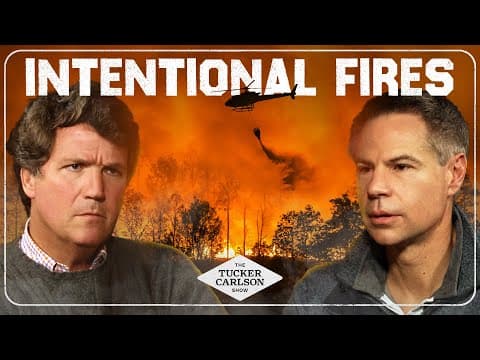
Tucker Carlson and Michael Shellenberger discuss the recent California fires, emphasizing the failures of local government in preparation and response, the role of homelessness and drug use in fire ignitions, and the broader implications of a nihilistic ideology affecting public safety and governance.
In a recent discussion, Tucker Carlson and Michael Shellenberger explored the devastating California fires, shedding light on their causes, the failures of local governance, and the broader implications of societal ideologies. This blog post summarizes their insights, providing a comprehensive overview of the situation.
Carlson and Shellenberger began by addressing the immediate context of the fires, noting that there are currently five active fires in California. These fires are classified as ignition-driven, primarily affecting chaparral and scrub areas rather than the Sierra forests. This distinction is crucial as it highlights that the fires are not merely a result of forest conditions but are influenced by specific ignition sources and environmental factors.
The fires are primarily driven by two factors: ignition sources and strong winds. Shellenberger pointed out that the National Weather Service had issued fire warnings well in advance, indicating that the conditions were ripe for fire outbreaks. Despite these warnings, local leadership failed to mobilize effectively, leading to catastrophic consequences.
One of the most alarming aspects discussed was the apparent lack of proactive measures taken by local officials. Shellenberger criticized the mayor's decision to travel abroad during a critical time, arguing that immediate action should have been taken to prepare for the fires. He suggested that the governor should have called for assistance from neighboring states and even Canada and Mexico, mobilizing resources to combat the impending disaster.
A significant point raised in the conversation was the role of homelessness in the ignition of these fires. Shellenberger noted that a substantial portion of fires in Los Angeles County is attributed to homeless individuals, many of whom are struggling with drug addiction, particularly methamphetamine. This connection between homelessness, drug use, and fire ignitions underscores a complex social issue that has been neglected by policymakers.
Carlson and Shellenberger delved into the ideological factors contributing to the current crisis. They argued that a nihilistic worldview has permeated local governance, leading to a lack of accountability and responsibility. This ideology, they contend, manifests in a failure to prioritize public safety and effective governance.
The discussion highlighted how this nihilistic perspective has resulted in a dangerous environment where the government fails to protect its citizens. Shellenberger emphasized that the basic social contract—where citizens pay taxes in exchange for safety and public services—has been violated. The consequences of this ideological shift are evident in the destruction wrought by the fires and the inability of local leaders to respond effectively.
Both Carlson and Shellenberger expressed hope that the current crisis could serve as a wake-up call for the residents of California. They argued that the fires are not merely a natural disaster but a reflection of deeper systemic failures that need to be addressed.
The conversation concluded with a call for accountability among local leaders. Shellenberger stressed that anyone who claims that the destruction caused by the fires was inevitable should be removed from positions of power. The need for a shift in governance, prioritizing public safety and effective management, is paramount to prevent future disasters.
The discussion between Tucker Carlson and Michael Shellenberger provides a critical examination of the California fires, emphasizing the interplay between environmental factors, social issues, and ideological failures. As California grapples with the aftermath of these fires, it is essential for citizens and leaders alike to reflect on the lessons learned and work towards a more accountable and effective governance model.



















