
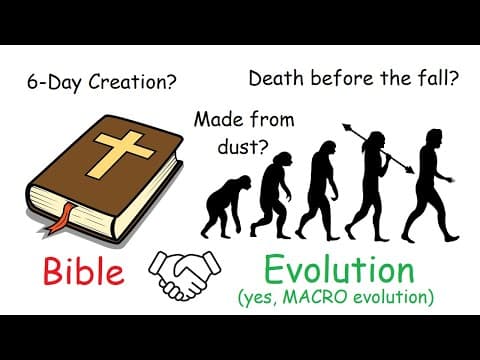
This article explores the relationship between evolution and the biblical account of creation, arguing that both can coexist without contradiction. It discusses interpretations of Genesis, the nature of God's creation, and the implications of evolution on the understanding of humanity's spiritual status.
The debate between fundamentalists and atheists often centers around the belief that evolution contradicts the Bible. However, this perspective is flawed. Many people assume that if life developed through the natural process of evolution, it means that God did not create it. This article argues that evolution and biblical creation can coexist harmoniously, as both can be understood through the lens of divine providence.
In the Bible, God operates in two primary ways: supernaturally and providentially. Supernatural acts, such as the parting of the Red Sea, involve God suspending the laws of nature. In contrast, providential actions, as seen in the stories of Esther and Joseph, demonstrate God arranging events in history to fulfill His purpose. For instance, Genesis 50:20 illustrates this duality, where Joseph's brothers intended harm, but God used it for good.
God can be likened to an author, with the universe as the story He is writing. Just because events in the story cause other events does not negate the author's overarching control. Creationists often view the creation of life as a supernatural event, while this perspective suggests that the creation of the world was providential, with evolution being part of the divine narrative.
One common objection to evolution is the interpretation of the six days of creation in Genesis 1. Moses, the author of Genesis, also wrote in Psalm 90 that a day for the Lord is like a thousand years. This flexible understanding of time aligns with modern scientific views that recognize time as relative. The ancient Near Eastern culture that produced Genesis had a different concept of time, which was not strictly defined by 24-hour periods.
If we adopt a more flexible definition of a day, Genesis 1 aligns well with the biological timeline of Earth's development. The sequence of events—light appearing, land emerging, and life evolving—mirrors scientific findings about the history of life on Earth. For example, the Bible states that the sun, moon, and stars appeared on the fourth day, which corresponds to the emergence of a clearer atmosphere due to photosynthetic life.
Genesis 1 mentions the creation of "man" and later specifies "the man" (Adam), suggesting a general creation of human-like creatures followed by a specific creation of Adam. While some argue that Adam's creation from dust implies he had no ancestors, the Bible acknowledges that humans have ancestors, and thus Adam could have had them as well.
A significant question arises regarding the image of God in humanity. If humans evolved from animals, at what point did they become made in God's image? The traditional interpretation holds that the image of God is primarily spiritual, not physical. While humans share DNA with other species, the rational soul, which distinguishes humans from animals, is what constitutes being made in the image of God.
Another objection concerns the existence of death before Adam's fall. The Bible states that death reigned from Adam to Moses, suggesting that death existed prior to Adam. This interpretation allows for the understanding that death was part of the natural order before humanity's fall, which aligns with evolutionary theory.
The presence of evil and imperfection in creation raises questions about God's intentions. The reformed interpretation suggests that God allows evil to glorify Himself through Christ's victory over it. This theme is consistent throughout the Bible, where good emerges from evil. Evolution, which involves death and natural selection, can be seen as part of this divine narrative.
The Garden of Eden was described as very good but not perfect, indicating that work was still needed. Genesis 1:4 implies that darkness existed alongside light, suggesting a world that was not entirely good. The fall of humanity was not the introduction of evil but rather a choice to side with evil over eternal life with God.
Some argue that the genealogies in Genesis indicate a young Earth, but many scholars believe these ages are symbolic rather than literal. The ancient Hebrew culture often imbued numbers with symbolic significance, suggesting that the genealogies serve a theological purpose rather than a strict historical account.
Many early church fathers did not interpret Genesis as a literal six-day creation, indicating that this view predates Darwin. John Calvin, while advocating for a literal interpretation, also acknowledged the importance of scientific findings. The Bible often accommodates human understanding, and Moses may have simplified complex truths for clarity.
The purpose of the Bible is not to provide a scientific account of creation but to reveal Christ. The narrative of creation is an oversimplified story meant to convey spiritual truths. Understanding evolution as part of God's providential plan allows for a harmonious relationship between faith and science, affirming that both the biblical account and evolutionary theory can coexist without contradiction.



















