
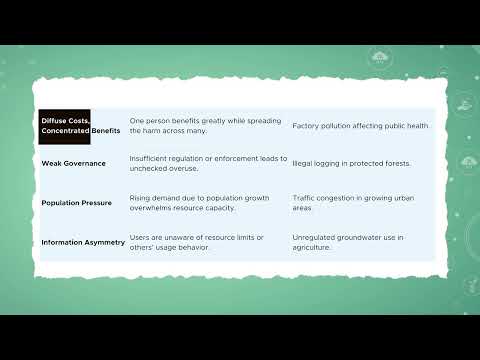
The tragedy of the commons occurs when individuals overuse shared finite resources due to factors like lack of property rights, short-term self-interest, poor coordination, fear of missing out, diffuse costs, weak governance, population growth, and information asymmetry. These drivers lead to resource depletion and degradation, highlighting the need for effective management and cooperation.
The tragedy of the commons is a critical concept that explains why shared finite resources often become depleted or degraded. This phenomenon occurs when individuals, acting independently according to their own self-interest, overuse a common resource despite knowing that this behavior is ultimately harmful to the group's long-term interests.
Several underlying conditions and incentives contribute to this tragedy. Understanding these drivers is essential for developing strategies to manage and preserve shared resources effectively.
When resources are non-excludable, meaning no individual or group holds clear rights or responsibilities over them, accountability diminishes. Everyone feels entitled to use as much as they can without restriction. For example, the oceans are open to all fishers, leading each to catch as many fish as possible. This lack of ownership results in overexploitation.
Individuals often prioritize immediate personal gain over the sustainability of the resource. They operate under the assumption that if they do not use the resource, someone else will. A typical example is cutting down more trees now to maximize timber profits, disregarding the future scarcity of trees and timber.
Without systems for collaboration or negotiation, users act independently rather than collectively. Social norms or institutions that could regulate resource use may be weak or absent. For instance, farmers drawing water from a shared aquifer without coordination can lead to overuse and depletion.
People may fear that others will take more than their fair share, prompting defensive overuse. This behavior leads to a race to the bottom, such as overgrazing on common pastures due to the fear that others will do the same.
The benefits of overusing a resource are immediate and personal, while the costs, such as pollution or depletion, are delayed and spread across many years and individuals. For example, a factory may profit from emitting pollution, but the health costs are borne by the public at large.
Weak institutions mean that rules governing resource use are either not enforced or do not exist. Monitoring, sanctions, and dispute resolution mechanisms may be inadequate or missing. Illegal logging in state forests due to weak oversight by forest departments exemplifies this issue.
An increasing number of users competing for the same resource accelerates degradation. Even responsible use can become unsustainable as the scale of demand grows. Shrinking freshwater lakes in densely populated regions illustrate this challenge.
Users may not be aware of the resource limits or the usage patterns of others, leading to uninformed overuse. Tourists visiting a fragile coral reef without understanding its ecological sensitivity serve as an example.
These drivers combine insights from economic logic, including incentive structures and game theory, institutional analysis focusing on governance and property rights, and real-world case examples. Together, they explain why the tragedy of the commons occurs and persist.
The key factors include:
The tragedy of the commons highlights the complex interplay of human behavior, institutional frameworks, and resource characteristics that lead to the overuse and degradation of shared resources. Addressing these drivers through effective governance, clear property rights, improved communication, and sustainable practices is crucial to preserving common resources for future generations.



















