
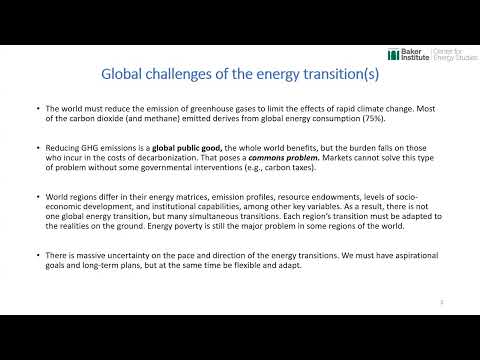
Professor Francisco Monaldi discusses the complexities of the energy transition, focusing on Latin America. He highlights the challenges of decarbonization, energy poverty, and the need for tailored solutions in different regions. Monaldi emphasizes the importance of addressing inequalities in energy consumption and the role of critical minerals in the transition.
In a recent masterclass, Professor Francisco Monaldi, a prominent figure in Latin American energy policy, shared his insights on the energy transition, particularly focusing on Latin America. Monaldi's extensive background in energy economics and policy provides a unique perspective on the challenges and opportunities that lie ahead in the global energy landscape.
Monaldi began by illustrating the stark contrasts in energy consumption around the world, using a famous NASA photo showing the Earth at night. This image highlights the disparity in energy access, with wealthier nations glowing brightly while many regions remain dark. He emphasized that economic growth and well-being are closely tied to energy consumption, and that significant inequalities exist in energy access and usage.
Monaldi outlined two primary goals for the upcoming century:
Monaldi discussed the concept of global public goods, explaining that while the benefits of reducing emissions are shared globally, the costs are borne by those who implement the changes. He highlighted the need for government intervention to address this market failure, often through mechanisms like carbon taxes, although political challenges make such measures difficult to implement.
Monaldi emphasized that the energy transition is not uniform across the globe. Each region has unique energy matrices, emission profiles, and resource endowments that influence their transition strategies. For instance:
A significant part of the energy transition involves the demand for critical minerals, particularly lithium, copper, and nickel, which are essential for renewable energy technologies and electric vehicles. Monaldi pointed out that while the demand for these minerals is increasing, the pace of production may not keep up, posing a risk to the transition.
Monaldi highlighted the stark reality of energy poverty, particularly in developing regions. He shared a poignant example of how the energy consumption of a household appliance in a wealthy country can exceed the total energy consumption of entire nations in Africa. This disparity underscores the urgent need to address energy access as part of the transition.
Monaldi provided insights into Latin America's energy profile, noting that the region contributes less than 4% of global emissions, primarily due to its reliance on renewable energy sources like hydropower. However, he cautioned that the region also faces challenges, such as:
Countries like Chile, which have abundant renewable resources and critical minerals, are well-positioned to benefit from the energy transition. However, Monaldi warned that countries heavily reliant on fossil fuels, like Venezuela, may face significant economic challenges as the world shifts towards cleaner energy.
Professor Francisco Monaldi's masterclass provided a comprehensive overview of the complexities surrounding the energy transition, particularly in Latin America. His insights into the interplay between economic growth, energy consumption, and environmental sustainability highlight the need for tailored solutions that address regional disparities and promote equitable access to energy. As the world navigates this critical transition, understanding these dynamics will be essential for policymakers, businesses, and communities alike.



















