
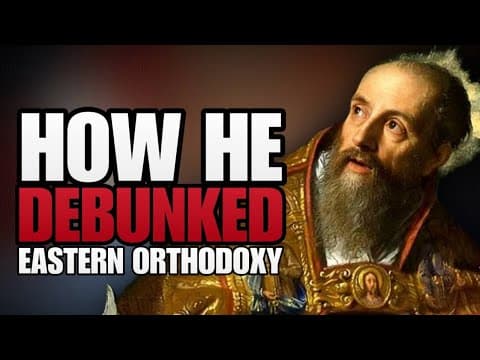
This blog post delves into the theological debate surrounding the Filioque, a critical doctrine in Christianity that addresses the procession of the Holy Spirit. It explores the historical context, key arguments from St. Augustine, and the implications for Eastern Orthodoxy, highlighting the agreement and disagreements between Eastern and Western Church Fathers. The post aims to clarify misconceptions and present a thorough understanding of the Filioque's significance in Christian theology.
The Filioque controversy has been a significant theological debate between Eastern Orthodoxy and Western Christianity for centuries. This post aims to clarify the doctrine of the Filioque, particularly through the lens of St. Augustine's teachings, and to explore its implications for the understanding of the Holy Trinity.
The term "Filioque" translates to "and the Son" in Latin. It refers to the phrase added to the Nicene Creed by the Western Church, stating that the Holy Spirit proceeds from both the Father and the Son. This addition has been a point of contention between Eastern Orthodox and Roman Catholic theologians, primarily concerning the nature of the Holy Spirit's procession.
To understand the Filioque, one must first grasp the concept of the Trinity. The Trinity consists of three persons: the Father, the Son, and the Holy Spirit, who share one divine essence. The distinction between these persons is made through what is known as processions:
Historically, the Filioque debate has roots in the early Church's understanding of the Trinity. St. Augustine, a pivotal figure in Western theology, articulated the Filioque doctrine in various writings, emphasizing the unity of the Father and the Son in the procession of the Holy Spirit.
St. Augustine's teachings on the Filioque are crucial for understanding the Western perspective. He argued that the Holy Spirit proceeds from both the Father and the Son, a view supported by several passages in his works. For instance, in his Tractate 99 on John, Augustine states:
"The Holy Spirit... shall hear of him from whom he proceeds. To him hearing is knowing."
This assertion indicates that the Holy Spirit's knowledge and being are intrinsically linked to both the Father and the Son.
Eastern Orthodox theologians, however, argue that the Holy Spirit proceeds solely from the Father. They often cite St. Maximus the Confessor, who emphasized the Father as the sole principle of the Holy Spirit's procession. This perspective raises questions about the interpretation of key texts and the implications of the Filioque for the unity of the Trinity.
A significant point of contention arises from St. Maximus's Letter to Morinus, where he suggests that the East and West agree on the principle of the Holy Spirit's procession. Eastern Orthodox apologists argue that this letter supports their view, while Western theologians interpret it differently, asserting that it aligns with the Filioque doctrine.
One of the central arguments in favor of the Filioque is the consensus among Western Church Fathers post-Augustine. Figures such as St. Fentius and Pope St. Gregory also affirm the Filioque, suggesting a continuity of thought in the Western tradition.
Eastern Orthodox theologians often argue that St. Augustine and his successors misinterpret the nature of the Holy Spirit's procession. They contend that the Western interpretation introduces a dual principle, which contradicts the Eastern understanding of the Father as the sole source.
St. Augustine's doctrine of divine simplicity plays a crucial role in his understanding of the Filioque. He posits that the essence of God is simple and indivisible, meaning that the Holy Spirit's procession cannot be separated from the divine nature shared by both the Father and the Son.
Several objections have been raised against the Filioque, particularly from Eastern Orthodox theologians:
The Filioque controversy remains a significant theological divide between Eastern Orthodoxy and Western Christianity. St. Augustine's teachings provide a robust defense of the Filioque, emphasizing the unity of the Father and the Son in the procession of the Holy Spirit. Understanding this doctrine is essential for engaging in meaningful dialogue between the two traditions and appreciating the complexities of Trinitarian theology.
In summary, the Filioque is not merely a theological nuance but a profound statement about the nature of God and the relationships within the Trinity. As such, it invites ongoing exploration and discussion among Christians seeking to understand their faith more deeply.



















