
This blog post explores the HRA portion from the Shemot Hebrew teachings, focusing on the interpretation of key verses, the prophetic implications regarding the Messiah, and the significance of Israel's land in relation to divine intentions.
In this blog post, we delve into the HRA portion from the Shemot Hebrew teachings, particularly focusing on the interpretation of key verses and their implications for understanding the Messiah and the significance of Israel's land.
The HRA portion begins with the word "Hab" in Yesah 27:6, which is often translated in English as "in the days to come". However, this translation may not fully capture the essence of the Hebrew text. The term "Hab" actually means "they that came", indicating a focus on the people who arrived, rather than a specific time period. This interpretation aligns with the beginning of the Torah portion, which discusses those who came with Yov to Egypt, emphasizing the significance of these individuals.
Verse 10 of the HRA portion states, "For a fortified city is solitary; a dwelling is forsaken and abandoned like a pasture; there a calf shall graze and there he shall lie and consume its branches." This verse is rich in poetic and prophetic imagery. The sages of the Talmudic era applied these verses to their contemporary context, suggesting that the interpretation of scripture can evolve to reflect current events. This practice continues today, as rabbis interpret biblical texts in light of modern circumstances.
The sages also draw connections between the HRA portion and the Messiah. They interpret the fortified city as Rome and the calf that grazes there as the Messiah. This interpretation suggests that just as Moshe overturned the power of Egypt, the Messiah will one day bring retribution against Rome. The Talmud mentions that the Messiah is likened to a leper, an outcast of Israel, which resonates with the life of Yeshua, who faced rejection during his time.
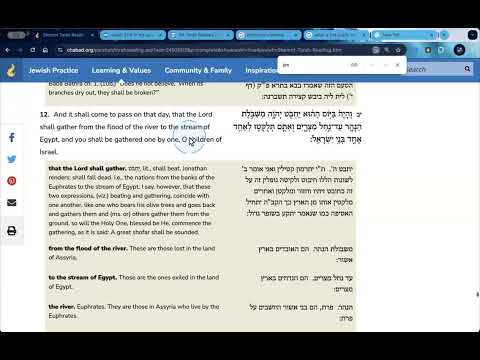
Isaiah 27:12 speaks of a future gathering of the children of Israel: "And it shall come to pass on that day that the Lord shall gather from the flood of the river to the stream of Egypt, and you shall be gathered one by one, oh children of Israel." This prophecy is significant in Orthodox Judaism and certain branches of Christianity, as it foretells a time when the lost will return to Jerusalem. The imagery of the great chofar being sounded signifies the heralding of the Messiah and the gathering of both the living and the dead.
The chofar, mentioned in verse 13, is linked to the ram caught in the thicket during Abraham's sacrifice of Isaac. This ram's horns are believed to be used to announce the coming of the Messiah and to call for the gathering of the faithful. This gathering is not merely a spiritual ascent but a physical return to the holy mount in Jerusalem, emphasizing the importance of the land.
In Zechariah 10:8-10, the Lord promises to gather His people from the lands where they have been scattered. This restoration is echoed in contemporary discussions about Israel's borders and the importance of maintaining the land as a divine inheritance. Recent sentiments among some in the Israeli Defense Forces (IDF) reflect a desire to restore ancient borders, highlighting the ongoing relevance of these biblical prophecies.
The teachings from the HRA portion of Shemot Hebrew provide profound insights into the nature of the Messiah, the significance of Israel's land, and the prophetic vision for the future. As we reflect on these interpretations, it becomes clear that the scriptures offer a blueprint for understanding humanity's relationship with the divine and the land that has been entrusted to us. The call to honor and protect this land is not just a matter of politics but a spiritual obligation to fulfill Hashem's intentions for Israel.



















