
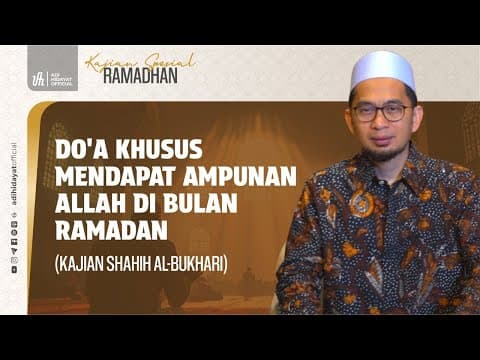
This blog post explores the significance of seeking forgiveness from Allah during Ramadan, as discussed by Ustadz Adi Hidayat. It emphasizes the importance of sincere intentions in fasting, the opportunities for forgiveness, and the recommended prayers to seek Allah's mercy.
In this enlightening session, Ustadz Adi Hidayat emphasizes the importance of seeking forgiveness from Allah during the holy month of Ramadan. As we gather in the early hours of the day, we express our gratitude to Allah for granting us the opportunity to witness another day in this blessed month. This post aims to delve into the teachings of Prophet Muhammad (Sallallahu Alaihi Wasallam) regarding the significance of Ramadan and the immense opportunities for forgiveness it presents.
Ramadan is not just a month of fasting; it is a time for spiritual reflection, self-improvement, and heightened devotion. Ustadz Hidayat reminds us that the essence of fasting during Ramadan is to cultivate a sincere intention (iman) and to seek Allah's pleasure (ihtisab). The Prophet Muhammad (Sallallahu Alaihi Wasallam) stated that anyone who fasts during Ramadan with faith and seeking reward from Allah will have their past sins forgiven. This highlights the unique opportunity that Ramadan provides for believers to cleanse their souls and seek redemption.
Ustadz Hidayat references a hadith documented by Imam Al-Bukhari, which emphasizes the importance of fasting during Ramadan. The Prophet (Sallallahu Alaihi Wasallam) said:
"Whoever fasts Ramadan with faith and seeking reward from Allah, his past sins will be forgiven."
This hadith underscores that the act of fasting should be performed with genuine faith and the intention of seeking Allah's mercy. It is crucial to approach fasting not merely as a ritual but as a profound act of worship that can lead to spiritual renewal.
The concept of forgiveness in Islam is profound. Ustadz Hidayat explains that Allah's mercy is vast and encompasses all believers, regardless of the magnitude of their sins. The Prophet (Sallallahu Alaihi Wasallam) reassures us that Allah is always ready to forgive those who sincerely repent and strive to improve themselves. This is particularly relevant during Ramadan, where the potential for forgiveness is heightened.
In addition to fasting, Ustadz Hidayat highlights the significance of night prayers (qiyam) during Ramadan. Engaging in nightly prayers, especially during the last ten nights of Ramadan, increases the chances of encountering Laylat al-Qadr (the Night of Decree), a night that holds immense blessings and forgiveness. The Prophet (Sallallahu Alaihi Wasallam) stated that anyone who stands in prayer during Laylat al-Qadr with faith and seeking reward will have their past sins forgiven.
Ustadz Hidayat shares a powerful supplication taught by the Prophet (Sallallahu Alaihi Wasallam) for those seeking forgiveness:
"Allahumma innaka afuwwun tuhibbul afwa fa'fu anni."
This translates to: "O Allah, You are Most Forgiving, and You love forgiveness; so forgive me." This prayer encapsulates the essence of humility and the recognition of Allah's mercy. Ustadz Hidayat encourages believers to recite this prayer with sincerity and a deep sense of need for Allah's forgiveness.
Seeking forgiveness is not merely about verbalizing our regrets; it is also about making tangible changes in our lives. Ustadz Hidayat emphasizes that true repentance (tawbah) should lead to self-improvement. The Quran often links forgiveness with reform, indicating that those who are forgiven should strive to better themselves.
The signs of accepted repentance include a genuine desire to change and improve one’s character and actions. Ramadan serves as a training ground for believers to cultivate these qualities, aiming to emerge as better individuals.
As we navigate through the days of Ramadan, let us embrace the opportunities for forgiveness that this month offers. Ustadz Hidayat's teachings remind us that fasting, prayer, and sincere supplication are pathways to attaining Allah's mercy. By committing to these practices with a pure heart, we can hope to achieve forgiveness for our past transgressions and emerge from Ramadan renewed and transformed.
May Allah grant us the strength to seek His forgiveness and the wisdom to improve ourselves during this blessed month. Let us strive to embody the teachings of the Prophet Muhammad (Sallallahu Alaihi Wasallam) and make the most of this sacred time.



















