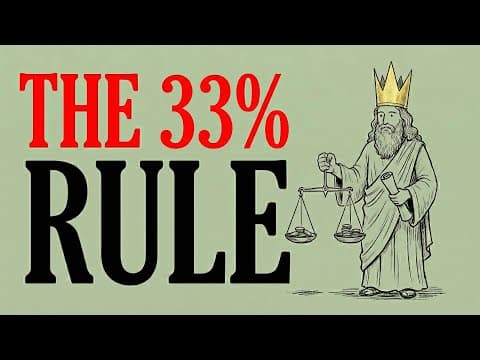
The Jewish wealth ratio, known as the Rule of Thirds, divides resources into three equal parts: land, business, and liquid capital. This ancient strategy, rooted in the wisdom of King Solomon, provides a balanced approach to wealth preservation and growth, ensuring resilience against economic downturns and opportunities for investment. This blog explores the significance of this allocation system and its practical applications in modern finance.
Jewish families represent less than 2% of the global population, yet they appear on the Forbes billionaires list at a rate 10 to 20 times higher than statistical probability suggests. This phenomenon is not due to luck, conspiracy, or accident; rather, it is the result of a 3,000-year-old allocation system known as the Rule of Thirds, derived from the wisdom of King Solomon and refined through centuries of rabbinical teaching.
The Rule of Thirds advocates dividing resources into three equal parts:
The Rule of Thirds is not merely about division; it recognizes that wealth exists in three incompatible states that must be balanced:
Many individuals make the mistake of hoarding cash, overcommitting to real estate, or gambling everything on a single business venture. This misallocation can lead to financial suffocation when opportunities arise or when economic conditions worsen.
King Solomon understood the concept of a margin of safety, which Benjamin Graham later articulated. Solomon built this margin into the structure of wealth management itself. For instance, when Solomon's fleet returned from Ofer with over 16 tons of gold, he did not store it all in the temple treasury. Instead, he followed the advice from Ecclesiastes 11:2, which instructs to give portions to seven or eight, as one cannot predict future disasters.
This was not merely advice for charity; it was a principle of portfolio construction. Solomon maintained diversified investments across multiple ventures while keeping reserves to seize new opportunities if existing ones failed or new markets emerged.
The Talmud later formalized this wisdom into explicit teachings:
This allocation strategy was developed as a survival protocol over centuries of displacement, confiscation, and economic warfare.
Many families fall into the trap of viewing cash as sleeping money and real estate as working money. Consequently, they allocate 70 to 90% of their resources into property and businesses, believing they are being aggressive and wise. However, when a recession occurs or an opportunity arises, they often find themselves without the necessary liquidity to act.
For example, a family may own multiple rental properties but lack the cash to cover six months of vacancy. Similarly, they might have equity in a business but cannot expand when a competitor fails. Solomon warned against this in Proverbs 21:5, stating that the plans of the diligent lead to profit, while haste leads to poverty. Here, haste refers to overcommitment and moving faster than liquidity can support.
The Jewish wealth system is taught as a covenant rather than a mere strategy. Fathers do not simply advise their sons to diversify; they teach the Rule of Thirds as a divine boundary established through Solomon and the sages to protect against greed and fear. By maintaining 1/3 liquid, individuals cannot be forced to sell at the bottom of a market downturn. Deploying 1/3 into land and 1/3 into business protects against inflation and single-point failures.
Solomon's wealth was not a static accumulation; it was a dynamic circulation structured around diversified deployment with maintained liquidity. His annual revenue reached 666 talents of gold, approximately $1 billion in modern purchasing power, supported by extensive trade networks and partnerships.
The liquidity trap can be invisible to those caught in it. Many feel secure with cash reserves, but as inflation compounds, their purchasing power diminishes. For instance, if inflation is at 7% while savings yield only 2%, individuals are effectively losing 5% annually in purchasing power. This scenario illustrates that cash can lead to slow confiscation rather than safety.
Conversely, entrepreneurs who invest 100% into business expansion or families that allocate all equity into real estate can face dire consequences when credit contracts. They may not be wrong about the assets they choose, but they are often wrong about their allocation. Ecclesiastes 11:1 advises to ship your grain across the sea, indicating that one should not gamble all resources at once but rather invest with protection.
Maintaining the thirds means that losing one entire leg of the investment does not lead to total financial ruin. For example, one can weather a real estate crash if their business and liquidity remain intact. Similarly, one can survive a business failure if their land and cash protect them. This approach is not conservative; it is aggressive with built-in protection.
Charlie Munger, a renowned investor, has spent decades observing how overconfidence and overleveraging can destroy investors. His core teaching, to never interrupt compounding unnecessarily, aligns with Solomon's balanced structure. Munger maintained significant cash reserves even during market highs, understanding that market dislocations are where generational wealth transfers occur.
Real estate may feel secure due to its tangibility, but it is the most illiquid major asset class. If one needs to exit quickly, they may have to sell at a significant discount. The Jewish wealth system survives because it is taught as a covenant, emphasizing the importance of balance in financial management.
What follows is not just a discussion but an invitation for divine wisdom to reshape how we view provision, risk, and responsibility.
Let us pray together:
"Father, we come before you acknowledging that everything we have is yours, held in trust, not owned in possession. We confess that we have broken your boundaries, some of us through fear that hoards, others through greed that overextends. Forgive us for treating your provision as our achievement. Teach us the discipline of the Rule of Thirds, not as financial strategy, but as spiritual obedience. Give us wisdom to deploy what you have given us across land, business, and liquid reserves for multiplication and protection. Grant us courage to maintain balance so we can act when you open doors. Protect us from the Third Generation curse by making us faithful teachers of these principles to our children. Help us see money, not as security, but as a tool, not as a goal, but as a test of stewardship. We ask this in the name of Jesus who taught us that to whom much is given, much is required. Amen."
Go in peace, walk in wisdom, and remember that the thirds are not restrictions; they are liberation from both fear and greed.