This article explores the figure of Budai, often mistaken for the historical Buddha, detailing his origins, teachings, and the cultural significance he holds in Buddhism and beyond.
This rotund fellow is not the Buddha, or at least not yet. This common misconception often leads people to confuse Budai with the historical Buddha, Siddhartha Gautama. In reality, Budai is a possibly historical Chinese monk believed to have lived around the 10th century CE. As we delve into the life and significance of Budai, we will uncover the fascinating blend of religious prophecy, folk devotion, and the eccentricities of Zen Buddhism that surround this figure.
Budai, whose name translates to "cloth sack," is often depicted as a jovial, plump monk with a big belly and a cheerful demeanor. Historical accounts suggest he may have been a Chan monk during the twilight years of the Tang Dynasty, around the 9th or early 10th century CE. Chan Buddhism, known as Zen Buddhism in Japan, emphasizes direct insight into one's Buddha nature, the inherent capacity to become a Buddha.
Budai first appears in early Song Dynasty sources, such as the "Song Biographies of Eminent Monks" dating to 988 CE and the "Record of the Transmission of the Lamp" from 1042 CE. These texts describe him as an eccentric monk named Cheetah, characterized by his plumpness, wrinkled forehead, and carefree lifestyle. He was known to carry a large cloth bag filled with items offered to him, earning him nicknames like "big bag boy" or "master cloth bag."
Budai's life was marked by a series of miraculous episodes and eccentric behaviors. He was considered a wonderworker and a master fortune teller, often predicting the weather and performing miraculous feats. One notable story recounts a layman who, while bathing alongside Budai, saw a third eye on his back. When asked if he was a Buddha, Budai urged him not to tell anyone.
His teachings were often conveyed through cryptic gestures and paradoxical statements, a hallmark of Chan Buddhism. For instance, when asked about the essence of the dharma, Budai simply dropped his bag, and when pressed for further explanation, he picked it back up and walked away. This method of teaching aimed to jolt students into moments of insight, often leaving them to decipher the meaning behind his actions.
Budai is often described as a "holy fool," a figure who appears ridiculous at first glance but embodies profound wisdom. His antics, such as pulling an orange from his robe and snatching it back when a monk reached for it, illustrate his playful yet insightful nature. This behavior aligns with the Chan tradition, where awakening can manifest in unexpected and humble forms.
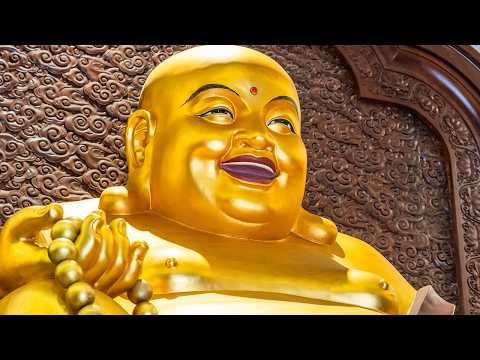
Visual representations of Budai began to emerge around the same time as literary accounts, spreading across China, Japan, and Korea. One of the earliest depictions can be found in the rock-cut temple complex at Failong in Hjo, China, dating back to the Song Dynasty. This sculpture captures Budai's key features: a big sack, a broad smile, and a loosened robe that reveals his belly.
Each aspect of Budai's appearance carries symbolic meaning. His big belly is often interpreted as a representation of abundance and prosperity, while his bag symbolizes a simple life free of attachments. His laughter embodies the joy that comes from true awakening. In traditional art, Budai is frequently depicted in whimsical scenes, often surrounded by children, emphasizing his role as a figure of contentment and domestic well-being.
As Budai's popularity grew, he became associated with Maitreya, the future Buddha in Buddhist eschatology. Traditional depictions of Maitreya show him as a princely figure, in stark contrast to Budai's jovial and informal demeanor. Before his death, Budai reportedly chanted a mysterious poem linking himself to Maitreya, suggesting that he was an incarnation of the future Buddha, unrecognized by those around him.
This connection between Budai and Maitreya resonated strongly among Song Dynasty Buddhists. Chan masters taught that Maitreya's compassionate presence was already manifest in the world, embodied by Budai. This teaching emphasized that awakening could appear in unexpected forms, encouraging laypeople to embrace Budai as a representation of Maitreya.
Over the centuries, Budai has blended into the broader fabric of East Asian popular religion. In Chinese culture, he is revered as a folk deity of prosperity, often featured in household shrines and shop altars. People rub or pat his belly for good luck, and his image has become a symbol of abundance.
In Japan, Budai, known as Hote, is one of the Seven Lucky Gods, representing generosity and good fortune. He is often depicted sailing down from the heavens on New Year's Day, distributing treasures to children, akin to a Buddhist Santa Claus.
In the 20th century, Budai's image transcended Asia, becoming a common curiosity in Western households and restaurants. Despite being widely misidentified as Shakyamuni Buddha, Budai's identity has always been fluid, shaped by the needs and imaginations of the communities that embrace him.
Budai, often mistaken for the historical Buddha, is a complex figure whose life and teachings reflect the rich tapestry of Chan Buddhism and popular religious culture. His eccentricity and joyful demeanor serve as a reminder that awakening can manifest in the most unexpected forms, inviting us to find wisdom in the ordinary. As we continue to explore the diverse expressions of Buddhism, Budai remains a beloved figure, embodying the joy and abundance that comes from true awakening.