
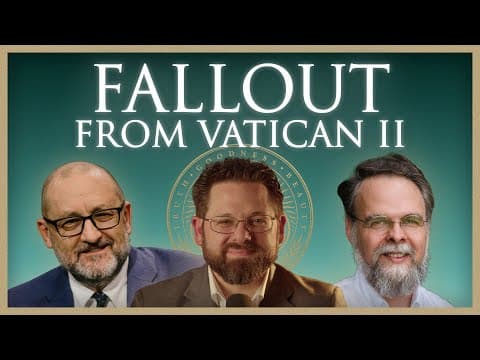
This article presents a comprehensive discussion between Dr. Peter Kwasniewski and Dr. Larry Chapp on the changes in the Catholic Church since Vatican II. They explore the challenges faced by converts, liturgical reforms, doctrinal continuity, and the Church's relationship with modernity, emphasizing the need for deep engagement with the Church's tradition amid ongoing crises.
The Catholic Church has undergone significant changes since the Second Vatican Council (Vatican II), leading to confusion and debate among the faithful, especially converts. In a candid and scholarly conversation hosted by Joshua Charles, Dr. Peter Kwasniewski and Dr. Larry Chapp, both deeply orthodox and educated Catholic scholars, discuss the complexities and challenges the Church has faced since Vatican II. This article summarizes their insightful dialogue, offering clarity and guidance for those navigating the post-conciliar Church.
Joshua Charles introduces the discussion as part of a series aimed at exploring the developments in the Church since Vatican II from an orthodox perspective. Eternal Christendom, the platform hosting the conversation, focuses on engaging with the great tradition of Christendom, emphasizing scholarly work, evangelism, and apologetics rather than ecclesial politics.
Dr. Kwasniewski, a board member of Eternal Christendom, is known for his traditionalist stance, while Dr. Chapp, a retired theology professor and founder of the Dorothy Day Catholic Worker Farm, represents a deeply orthodox viewpoint. Both men share a commitment to the Church and provide a charitable, gentlemanly dialogue on sensitive topics.
Joshua Charles shares his personal journey as a convert, highlighting the confusion and challenges faced during RCIA classes, especially regarding Church teachings on sensitive issues like homosexuality. This sets the stage for discussing how converts should approach the Church today.
Dr. Chapp emphasizes the importance of converting for genuine belief rather than superficial reasons such as marriage or preference for a particular parish. He encourages converts to "come all the way in" and fully immerse themselves in the faith. He notes that many converts he knows are deeply committed, contrasting with some Catholics who are lukewarm or only partially engaged.
Born in 1971, Dr. Kwasniewski describes himself as a revert who rediscovered the faith intellectually through rigorous study of Catholic doctrine and history. He highlights the intellectual richness of the faith and the importance of engaging with the Church's tradition. He acknowledges the shock converts may experience when encountering the diversity of practice and belief within the Church but encourages perseverance, emphasizing the Church as a "field hospital" enduring storms but ultimately the true family of God.
Dr. Chapp recalls the period following Vatican II as marked by indifference rather than outright opposition to liturgical reforms. He notes that the liturgical changes were implemented rapidly during a time of cultural upheaval, leading to confusion and disorientation among the faithful.
Dr. Kwasniewski adds that it took decades for scholarly critique and understanding of the liturgical reforms to develop. He criticizes recent attempts to restrict the traditional Latin Mass, calling such moves absurd given the Church's allowance for its use.
The issuance of Humanae Vitae in 1968, reaffirming the Church's teaching against contraception, caused significant upheaval and dissent, arguably more than the liturgical reforms. This dissent contributed to a broader crisis of authority and faith within the Church.
Both guests agree that the rapid and continuous changes in the Church, combined with the cultural revolution of the 1960s, led to burnout and confusion among Catholics. The Church's leadership underestimated the fragility of the faithful's attachment to tradition and the overwhelming influence of secular culture.
Dr. Chapp views Vatican II as a council primarily concerned with theology, written by theologians for theologians, but acknowledges its pastoral failures in reinvigorating the Church.
The council fathers, many of whom were European and had lived through World War II, sought to engage with liberal democracy and the modern world, sometimes at the expense of prophetic critique. Dr. Kwasniewski notes the Church's current role as a chaplain to modern liberal projects, often failing to confront their moral failures.
Dr. Kwasniewski critiques the phenomenon of "hyperpapalism," where excessive authority is centralized in the pope, overshadowing the broader Church's teaching and tradition. He advocates for a balanced understanding of papal authority, rooted in tradition and the common good.
Dr. Chapp agrees on the pope's universal jurisdiction but emphasizes prudence and respect for tradition in liturgical matters.
Joshua Charles shares personal anecdotes illustrating the stark differences between traditional and Novus Ordo liturgies, highlighting issues such as casual dress, lay ministers, and perceived irreverence.
He argues that the liturgical crisis is deeper than mere change; it reflects a loss of the sense of the sacred in a secularized world. The Novus Ordo, as implemented, emphasized horizontality and accessibility but lacked transcendence, leading to disenchantment and laxity.
Referencing Boniface Loys, a theologian involved in the liturgical reform, Dr. Kwasniewski discusses the secular mentality that influenced the reformers, resulting in desacralization and loss of mystery in worship.
He stresses the importance of liturgy as an encounter with divine mystery, which was undermined by the reforms.
The conversation touches on the deep historical roots of the current crisis, tracing back to the early 20th century and even earlier theological and cultural shifts. The post-Vatican I era is characterized by a rigid hierarchical structure and challenges to traditional authority.
Dr. Kwasniewski introduces Thomas Pink's concept of "official theology," the prevailing theological assumptions and priorities of a given era, which may differ from dogmatic teaching. Recognizing this helps the faithful navigate the complexities of contemporary Church teaching and practice.
The discussion briefly touches on the Church's relationship with other Christian traditions, particularly Eastern Orthodoxy, and the challenges converts face regarding doctrinal continuity and liturgical patrimony.
Both Dr. Kwasniewski and Dr. Chapp emphasize that despite the crises and uncertainties, the Catholic Church remains the true family of God. Converts and faithful alike are called to engage deeply with the Church's tradition, endure suffering, and remain steadfast in faith.
The conversation closes with a prayerful reflection from Psalm 73:25-26, underscoring the enduring strength found in the Lord.
This dialogue offers a rich, nuanced perspective on the post-Vatican II Church, providing valuable insights for converts, scholars, and all Catholics seeking to understand and live their faith authentically in a complex world.



















