
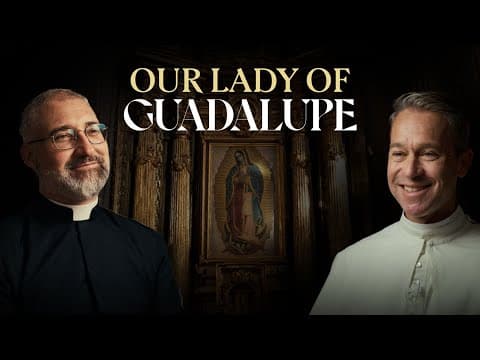
This article explores the deep historical, cultural, and religious connections between Spain and the devotion to Our Lady of Guadalupe. It highlights Spain's unique role in evangelizing the New World, the significance of Marian devotion, especially the Immaculate Conception, and how these elements shaped the spiritual and cultural identity of Hispanic America. The discussion also touches on the ongoing importance of Marian devotion in contemporary faith and evangelization.
The story of Our Lady of Guadalupe is often told beginning with her miraculous apparition in 1531 in Mexico City. However, this narrative is incomplete without understanding the broader historical and cultural context that originates in Spain centuries earlier. This article delves into the vital role Spain played in shaping the devotion to Our Lady of Guadalupe and the evangelization of the New World, as explained by Father Gabriel Calvo Zarraute, a theologian and philosopher from Toledo, Spain.
Father Zarraute emphasizes that the history of Spain cannot be understood without America, and vice versa. The territories of the New World were not mere possessions but were considered part of Spain itself, much like Hispania was an integral part of the Roman Empire. This analogy extends to the Church and Christianity, where the faith was not imposed but fused with indigenous cultures through evangelization.
The evangelization of America was a unique historical event where two peoples—Spanish and indigenous—merged culturally, linguistically, and religiously. This fusion was facilitated by the universal vocation of Catholicism, which transcends mere imposition and embraces cultural integration.
The Reconquista, the centuries-long Christian reconquest of the Iberian Peninsula from Muslim rule, is pivotal to understanding Spain's identity and its evangelizing mission. Unlike the Islamic expansion, which was maintained through conquest and did not retreat, the Christian reconquest was a unique phenomenon lasting approximately 800 years, beginning with the Battle of Covadonga in 722.
This struggle forged a deeply rooted Catholic identity in Spain, characterized by intense Marian devotion. The Reconquista also prepared Spain politically, culturally, and religiously for its later role in evangelizing the Americas.
In Spain, the Virgin Mary is simply known as "La Virgen," reflecting her central role in Spanish Catholicism. The dogma of the Virgin Mary's perpetual virginity and the Immaculate Conception are foundational to understanding the Christian mystery and the Catholic faith.
The Immaculate Conception, which holds that Mary was conceived without original sin, is crucial because it underscores her unique role as the pure mother of Jesus Christ, the Son of God. This belief was deeply ingrained in Spanish spirituality and was carried to the New World by missionaries and settlers.
The devotion to Our Lady of Guadalupe in Mexico is directly connected to Spanish Marian devotion, particularly the Immaculate Conception. The image of Our Lady of Guadalupe, which accompanied the Spanish conquistadors, especially Hernán Cortés, symbolized this deep Marian spirituality.
The apparition of Our Lady of Guadalupe to Saint Juan Diego in 1531 accelerated and deepened the evangelization process in the Americas. The image itself contains iconography that reflects the Immaculate Conception and was recognizable to the Spanish missionaries, while also resonating with indigenous cultural and prophetic traditions.
Spanish missionaries, particularly Franciscans, were the elite of the Spanish Church, well-educated and deeply devoted. They played a crucial role in evangelizing the indigenous peoples, learning their languages, and translating Christian doctrine into native tongues.
One significant aspect of their mission was the restoration of the dignity of women, who in many indigenous cultures were treated as objects and subjected to polygamy and other degrading practices. The Marian devotion, especially to the Virgin Mary as the Immaculate Conception and perpetual virgin, helped elevate the status of women and redefined their role within Christian family life.
Marriage and baptism became essential for forming genuine family bonds, contrasting with indigenous customs. This transformation was part of the broader civilizing mission that accompanied evangelization.
Father Zarraute shares his personal experience of Marian devotion as a priest, highlighting how the Virgin Mary serves as a refuge and source of strength, especially in the solitude and challenges of priestly ministry.
He stresses that Marian devotion is inseparable from true Christian faith. Where devotion to Mary wanes, faith in Christ often weakens. The Virgin Mary has historically been the banner under which Spaniards defended the Catholic faith, from the Reconquista to battles against Protestant forces.
The miraculous event known as the Miracle of Empel in 1585, where Spanish troops found an image of the Immaculate Conception and were saved from defeat, exemplifies the protective and unifying power of Marian devotion.
In the contemporary world, the Church faces a crisis of faith, vocations, and moral challenges. Protestant sects and secular ideologies have gained ground, partly due to a decline in traditional devotions and liturgical reverence.
Father Zarraute argues that a renewed emphasis on Marian devotion, including traditional prayers like the Rosary, the Angelus, and novenas, is essential for reevangelizing the world. The Virgin Mary, as the mother of God and our mother, is the key to restoring faith and family values in a post-Christian society.
Our Lady of Guadalupe stands as a powerful symbol of the union between Spanish and indigenous cultures, the depth of Marian devotion, and the universal mission of the Church. Her apparition marked a turning point in the evangelization of the Americas and continues to inspire the faithful worldwide.
The historical and theological insights provided by Father Gabriel Calvo Zarraute illuminate how Spain's unique history, Marian devotion, and missionary zeal shaped the spiritual landscape of Hispanic America and remain vital for the Church's mission today.
Understanding this rich heritage helps us appreciate the profound significance of Our Lady of Guadalupe not only as a Mexican patroness but as a universal mother guiding the Church in its ongoing journey of faith and evangelization.
This comprehensive exploration reveals the inseparable bond between Spain and the New World in the story of Our Lady of Guadalupe, highlighting the enduring power of Marian devotion in shaping faith, culture, and civilization.



















