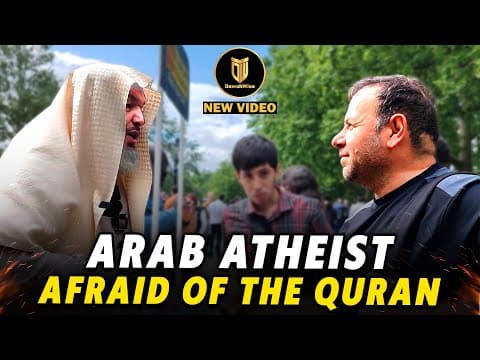
This blog post explores a heated discussion between an ex-Muslim and a Muslim scholar regarding the interpretation of the Quran, emphasizing the importance of context in understanding its verses, the concept of progressive revelation, and the historical implications of religious texts.
In a recent discussion at Speakers Corner, a thought-provoking exchange unfolded between an ex-Muslim and a Muslim scholar, Sh. Ibn Hazm. The conversation centered around the interpretation of the Quran, particularly in relation to violence and the context of its verses. This blog post aims to unpack the key points raised during this dialogue, highlighting the significance of context in understanding religious texts.
The Muslim scholar began by addressing the ex-Muslim's assertion that Muslims kill, urging him to consider the context of the Quranic verses. The scholar emphasized that understanding the Quran requires a comprehensive reading of its verses, as they often address different situations and audiences. He pointed out that the Quran contains various types of verses, some of which may seem contradictory without proper context.
One of the critical concepts discussed was that of progressive revelation. The scholar explained that the Quran was revealed over a period of time, and its verses reflect the circumstances and challenges faced by the early Muslim community. This progressive nature means that some verses may be more applicable in certain contexts than others, and understanding this is crucial for accurate interpretation.
The conversation also touched upon the topic of warfare and treaties between nations. The scholar drew parallels between historical conflicts, such as those between India and Pakistan, to illustrate that when one country breaks a treaty, it often leads to war. He argued that similar principles apply in the context of the Quran, where self-defense and retaliation are justified when a sovereign nation is attacked.
A significant point of contention arose when the ex-Muslim challenged the scholar to read specific verses from the Quran. The scholar insisted on the necessity of reading verses in context, rather than cherry-picking phrases that could misrepresent the overall message. He highlighted that many critics of the Quran often focus on verses that mention violence without considering the surrounding text that provides essential context.
The discussion took a turn when the scholar addressed the historical implications of atheism. He argued that throughout history, some of the most significant atrocities have been committed by atheists, citing figures like Stalin and Mao. This point was made to counter the narrative that violence is inherently linked to religious belief, suggesting instead that it is a broader human issue.
The scholar also emphasized that the Quran is primarily an Arabic text, and translations are interpretations of its meaning rather than the Quran itself. He argued that translations can lead to misunderstandings, as they may not capture the nuances of the original language. This distinction is vital for anyone seeking to engage with the Quran meaningfully.
The dialogue between the ex-Muslim and the Muslim scholar at Speakers Corner serves as a reminder of the complexities involved in interpreting religious texts. It underscores the necessity of context, the concept of progressive revelation, and the importance of understanding the historical background of both the text and the discussions surrounding it. As conversations about religion and belief continue to evolve, engaging with these texts thoughtfully and respectfully remains essential for fostering understanding and dialogue among diverse perspectives.