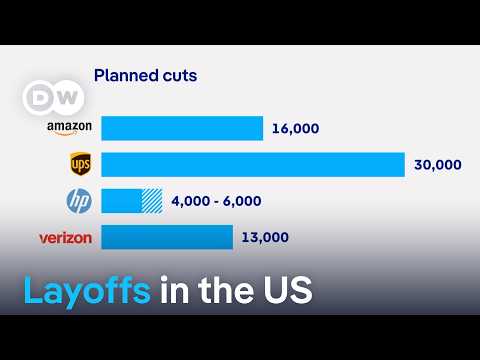
Recent layoffs at major companies like Amazon, UPS, HP, and Verizon have sparked concerns about an AI-driven job cull. However, experts suggest these cuts are more about post-pandemic adjustments and cost-saving measures than wholesale AI replacement. While AI adoption may influence future workforce changes, current data shows layoffs are not at historic highs, and the labor market remains uncertain but stable overall.
In recent months, several large companies including Amazon, UPS, HP, and Verizon have announced significant layoffs. Amazon, for example, is cutting 16,000 jobs on top of 14,000 cuts last year, while UPS plans to reduce 30,000 operational positions this year. These announcements have raised questions about the underlying causes of these job cuts and whether artificial intelligence (AI) is driving a new wave of workforce reductions.
Matthew Bidwell, a professor of management at the Wharton School, provides insight into this phenomenon. According to Bidwell, the current wave of layoffs should not be viewed as a massive AI-driven cull. Instead, these job cuts are influenced by multiple factors, including post-pandemic adjustments and companies preparing to integrate AI more deeply into their operations.
The labor market has experienced a roller coaster over the past five years. Initially, the pandemic caused widespread job losses, but many companies, especially in the tech sector, quickly began rehiring as they anticipated a strong recovery. This led to an unprecedented hiring spree through mid to late 2022, with tech companies expanding their workforce astronomically.
However, many firms now recognize that they may have over-hired during this period. The recent layoffs are, in part, an effort to unwind this pandemic-driven labor force expansion and return to more sustainable staffing levels.
While some companies have cited AI as a reason for streamlining and reducing layers within their organizations, Bidwell emphasizes that there is little evidence so far of wholesale job replacement by AI. Instead, companies appear to be positioning themselves to embed AI technologies more deeply, which may lead to efficiency gains and cost savings in the future.
Interestingly, economy-wide data such as government surveys on layoffs and unemployment claims indicate that the overall rate of layoffs remains near historic lows. This suggests that the recent high-profile layoffs are not indicative of a broader, economy-wide wave.
Moreover, these layoffs are predominantly occurring in large companies rather than mid-size or smaller firms. This concentration may be due to the visibility of large corporations or a genuine trend of more layoffs among bigger companies.
Initially, the post-pandemic layoffs were more concentrated in tech-related jobs. However, the recent wave seems to be affecting more white-collar and corporate roles. Consulting firms, for example, have experienced a slowdown, partly due to reduced spending by tech companies and a general tightening of budgets across corporate America.
Uncertainty driven by technological changes and government policies has also contributed to cautious hiring practices. While hiring rates have dropped significantly, this has not yet translated into widespread layoffs across the economy.
Bidwell notes that the labor market remains in a state of uncertainty. The U.S. economy continues to grow, and upcoming tax cuts may stimulate further economic activity. However, concerns persist on two fronts: the fear that AI will eliminate many jobs and the possibility that an AI investment bubble could burst.
Predicting AI’s impact on employment is challenging. If AI technology remains at its current level, some job cuts may occur, but they are unlikely to be massive. The key question is how quickly and effectively AI technology will advance in the coming years.
Investor and boardroom pressures to increase efficiency and embed AI into business processes also play a significant role in driving workforce changes, sometimes independently of the technology’s current capabilities.
There is still limited understanding of which career fields are most exposed to AI-driven disruption. For example, while AI can assist radiologists by analyzing scans, it has not replaced them, partly due to the critical nature of their work and a shortage of professionals in that field.
It often takes years to fully grasp how new technologies affect labor markets, as organizations and consumers adapt to changes. For now, the labor market is in a “wait and see” mode regarding AI’s broader impact.
The recent wave of job cuts at major companies is a complex phenomenon influenced by post-pandemic labor market adjustments, economic uncertainties, and the gradual integration of AI technologies. While AI is a factor in some corporate decisions, it is not currently driving a massive wave of layoffs.
The labor market remains relatively stable, with layoffs near historic lows and hiring rates slowing down. The future impact of AI on employment is uncertain and will depend on technological advancements and how businesses and workers adapt to these changes.
As the situation evolves, it is essential to monitor both economic indicators and technological developments to understand the true nature of workforce transformations in the coming years.
Interview with Matthew Bidwell, Professor of Management at the Wharton School, provides the basis for this analysis.