
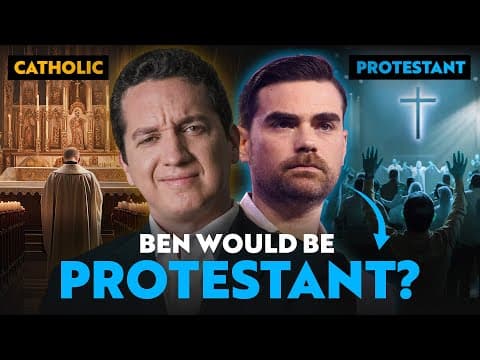
In a recent interview, Ben Shapiro suggested he would prefer Protestantism over Catholicism due to perceived excessive rituals. This blog post clarifies the role of rituals in Catholicism, arguing that both Catholic and Protestant traditions have meaningful practices that serve spiritual purposes. It emphasizes that rituals are not merely about earning salvation but are integral to the faith experience, helping believers grow closer to God.
Recently, Michael Nolles interviewed Ben Shapiro, who was asked whether he would choose to be Protestant or Catholic if he converted to Christianity. Shapiro's response, which suggested he would prefer Protestantism due to its perceived lack of rituals, sparked significant discussion online. Many interpreted his comments as a critique of Catholicism, but this interpretation misses the nuance of his argument. In this blog post, we will explore the role of rituals in Catholicism and clarify some misconceptions surrounding them.
During the interview, Shapiro stated that if he were to convert to Christianity, he would lean towards Protestantism because he associates it with fewer rituals. He humorously noted that as a Jew, he is already accustomed to rituals, and he would prefer a faith that does not add to that burden. However, it is essential to recognize that Shapiro's comments were made in a light-hearted context and were not intended as a comprehensive critique of Catholicism.
Shapiro later acknowledged that if he were convinced of the truth of Christianity, he would likely choose Catholicism. This admission highlights that his preference for Protestantism was not based on a rejection of Catholic beliefs but rather a personal inclination towards less ritualistic practices.
Rituals are defined as solemn ceremonies consisting of a series of actions performed according to a prescribed order. Under this definition, both Catholicism and Protestantism engage in rituals, albeit in different forms. While Shapiro's comments suggest a dichotomy between the two, the reality is more complex.
Catholicism is often characterized by its rich tradition of rituals, which include the Mass, sacraments, and various liturgical celebrations. These rituals serve several purposes:
While some Protestant denominations may emphasize a more personal faith experience, they also engage in rituals. For example, practices such as baptism and the Lord's Supper are central to many Protestant traditions. Shapiro's assertion that Protestantism is devoid of rituals overlooks the fact that many Protestant denominations, such as Anglicanism and Lutheranism, share similar liturgical practices with Catholicism.
A common critique of Catholicism is that its rituals serve as barriers to salvation, implying that one must perform certain acts to earn God's grace. However, this perspective misrepresents the Catholic understanding of grace and salvation.
Catholics believe that salvation is a gift from God, made possible through the sacrifice of Jesus Christ. While rituals such as baptism and the Eucharist are important, they are not viewed as means to earn salvation but as channels through which grace is received. As stated in Galatians 3:24-26, the law served as a custodian until Christ came, and now believers are justified by faith.
Catholics affirm that faith and works are both essential in the Christian life. While it is true that Christ's sacrifice is sufficient for salvation, Catholics believe that faith must be expressed through actions, including participation in the sacraments and living a moral life. This understanding aligns with the teachings of James 2:26, which states that faith without works is dead.
Rituals, whether in Catholicism or Protestantism, are not inherently negative. They can provide structure and meaning to the spiritual journey. The question is not whether rituals exist but rather which rituals lead us closer to God.
It is important to acknowledge that rituals can become empty if performed without genuine faith. This issue is not unique to Catholicism; many individuals across various faiths may find themselves going through the motions without true engagement. The challenge lies in ensuring that rituals are meaningful and foster a deeper connection with God.
Ultimately, the effectiveness of a ritual depends on the intent behind it. A ritual performed with heartfelt devotion can be a powerful means of grace, while one done out of obligation may lack spiritual significance. Both Catholics and Protestants can fall into the trap of empty rituals, but this does not negate the value of the rituals themselves.
In conclusion, while Ben Shapiro's comments about rituals in Catholicism sparked an interesting discussion, it is crucial to understand the broader context of rituals within both Catholic and Protestant traditions. Both faiths engage in rituals that serve to deepen faith, foster community, and provide moral guidance. The key takeaway is that rituals, when approached with the right heart and intent, can be a vital part of the Christian experience, leading believers closer to God and enriching their spiritual lives.
If you would like to explore more about the rituals and practices within Catholicism, consider delving into resources that discuss the significance of these traditions in the life of faith.



















