
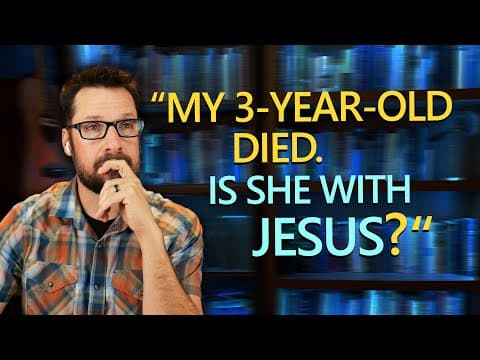
This blog post explores the question of whether young children, particularly those who die before reaching an age of accountability, are saved according to biblical teachings. It discusses scriptural references, the concept of moral awareness, and the implications for grieving parents.
In a recent Q&A session, Mike Winger addressed a deeply emotional question posed by a grieving mother who lost her three-year-old daughter in a tragic accident. The mother sought clarity on the biblical understanding of infant and child salvation, particularly in light of the video Winger had previously made on the topic. This post aims to summarize Winger's insights and provide a comprehensive biblical perspective on the salvation of young children.
Winger began by acknowledging the difficulty of discussing such a painful topic. He expressed his heartfelt sympathy for parents who have lost children at various ages and admitted his own limitations in providing a definitive answer. He emphasized that ultimately, it is God's purview to judge and understand the fate of each individual.
Winger outlined several key reasons why children, particularly those who are very young, are not held accountable for their actions in the same way adults are. Here are the main points he discussed:
Children are not morally aware and therefore are not held accountable for their actions. Winger referenced Deuteronomy 1:39, which states that the little ones who do not know good from evil will enter the promised land. This indicates that there is an age or stage of development where children lack the understanding necessary for moral accountability.
Winger cited examples from scripture where children are depicted as lacking the knowledge of good and evil. For instance, in Jonah 4:11, God expresses pity for the children of Nineveh who do not know their right hand from their left, reinforcing the idea that there is a category of individuals who are not morally accountable.
The way individuals are judged by God seems to depend on their knowledge and awareness of right and wrong. Romans 1 discusses how people are judged based on their understanding of God's existence and moral law. Winger argued that young children do not possess the same level of awareness as adults, which affects their accountability.
Winger referenced King David's response to the death of his infant son, where he expressed hope that he would one day be reunited with his child. This suggests a belief in the salvation of young children, providing comfort to grieving parents.
The question of how old is too old for a child to be considered accountable is complex. Winger discussed various interpretations, suggesting that while some may argue for an age of 20 based on Deuteronomy, it is more reasonable to consider that accountability is based on knowledge rather than a specific age. He noted that many children, even those in their early teens, may not have the same moral reasoning capabilities as adults.
Winger emphasized that accountability is not strictly tied to age but rather to an individual's understanding and mental capacity. He expressed confidence that a three-year-old is not accountable in the same way an adult is, based on his experiences working with young children. He encouraged parents to find comfort in the belief that young children who pass away are likely to be in heaven.
In conclusion, Winger's insights provide a compassionate and biblically grounded perspective on the salvation of young children. While the question of accountability is complex and deeply personal, the overarching message is one of hope for grieving parents. The belief that young children are not held accountable for their actions offers comfort in the face of unimaginable loss, reminding us of God's grace and mercy.
As we navigate these difficult questions, it is essential to lean on scripture and seek understanding through prayer and reflection. Ultimately, we can trust in God's perfect judgment and love for all His creation.



















