
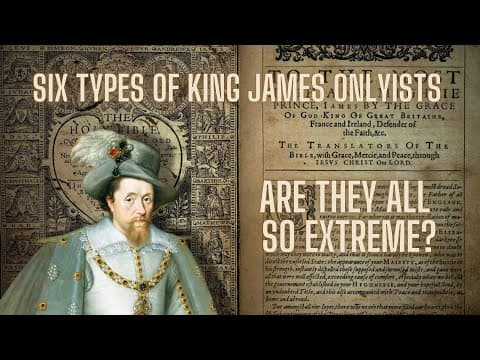
This article explores the six distinct types of King James Onlyism, ranging from those who prefer the King James Version for its beauty and history to extremists who claim it is the only legitimate Bible. Each type is examined for its beliefs and attitudes towards other translations, providing a comprehensive overview of this complex topic.
In the realm of biblical translations, the term "King James Only" often evokes strong opinions and heated debates. However, not all who prefer the King James Version (KJV) share the same beliefs. In this article, we will explore the six different types of King James Onlyism, ranging from moderate preferences to extreme positions.
The first group consists of those who are King James preferential. These individuals appreciate the King James Version for its historical significance, beauty, and the elegance of its language. They believe it to be a superior English translation and often feel it is more reverent and reliable than modern translations. This group tends to be the most reasonable among King James Only advocates and is generally less combative regarding other translations.
The second type believes that the King James Version is superior to other translations. While they do not claim it is the only inspired English translation, they argue that its translation philosophy and textual sources are unmatched. They hold that the KJV is based on the Textus Receptus and the Masoretic Text, which they believe have been faithfully handed down from the early church. This group often shies away from the New King James Version (NKJV) due to its consideration of critical apparatus and other manuscripts, which they feel dilutes the purity of the Textus Receptus.
The third type is known as King James exclusive. Members of this group assert that the KJV is the only translation that should be used for English-speaking audiences. They do not go as far as to claim that the KJV is the only inspired translation, but they do believe that modern translations are corrupt and based on flawed sources. This group tends to favor a formal equivalence approach to translation, which seeks to maintain the original wording as closely as possible.
The fourth type, known as KJV inspiration, takes a more extreme stance. They believe that not only is the King James Version a faithful translation, but that the translation process itself was inspired. This belief in double inspiration elevates the KJV to a level of equality with the original Greek and Hebrew texts. While this perspective is controversial, it reflects a deep reverence for the KJV as a divinely inspired text.
The fifth type is referred to as KJV inerrancy. Adherents of this viewpoint believe that the KJV is the only inerrant and perfect word of God, even claiming that it surpasses the original Greek texts. This belief leads to the idea that the KJV can be used to correct the Greek, which many consider to be a dangerous and cult-like position. Members of this group are often the most combative and argumentative regarding their views.
Finally, the sixth type is the KJV only extremists. This group asserts that the KJV is the only legitimate Bible for all languages, claiming that any deviation from it is corrupt and satanic. They argue that individuals are not truly saved unless they read the KJV, and they advocate for translating all Bibles directly from the KJV. This extreme position is characterized by a high level of intolerance towards other translations and beliefs.
When examining the spectrum of King James Onlyism, it becomes clear that there are varying degrees of belief and attitudes towards biblical translations. While the first two types can be seen as reasonable and respectful of other translations, the latter four types often engage in combative and extreme rhetoric.
It is essential to approach these discussions with an open mind and a willingness to engage in civil discourse. Ultimately, the goal should be to encourage responsible study of the Scriptures, regardless of the translation one prefers. By understanding the nuances of King James Onlyism, we can foster more meaningful conversations about biblical texts and their interpretations.



















