
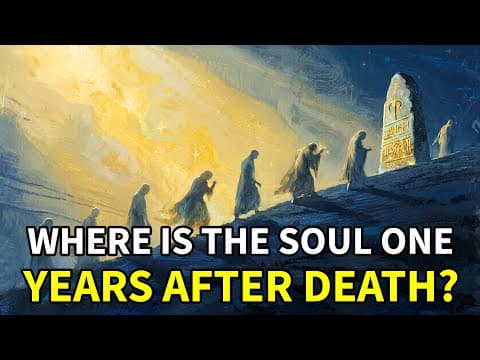
This blog explores what the Bible reveals about the soul's journey after death, particularly one year later. It addresses the immediate fate of the soul, the nature of judgment, and the hope of resurrection, emphasizing the importance of faith in Christ for eternal peace.
Let me ask you something and I want you to answer not with your head but with your heart. Where is your loved one's soul one year after they died? This question is not easy and often avoided until it confronts us directly. One moment, we are engaged in our daily routines, and the next, we find ourselves in a hospital room or a funeral home, grappling with the reality of loss. In these moments, time slows, and a profound question arises: What happens next? Not to the body, which we know returns to the ground, but to the soul—the essence of who they were.
One year later, where have they gone? Are they aware? Are they judged? Are they finally at peace? If you have lost someone close, these questions resonate deeply. For many believers, the initial months after a death are filled with scripture, community, and support. However, as the one-year mark approaches, the pain often resurfaces quietly, leaving us to wonder where our loved ones are now.
I want to be clear: I am not here to offer spiritual clichés. Instead, we will explore what the Bible says about the soul after death. If eternity is real and the Bible is indeed the word of God, then its teachings about the soul's fate are more urgent and personal than any worldly concern.
Most of us have witnessed that sacred moment when a loved one takes their final breath. Death feels like a stillness, a hush that sweeps through the room. Yet, while everything outside becomes quiet, the Bible tells us that the unseen world is anything but still. Ecclesiastes 12:7 states, "The dust returns to the ground it came from, and the spirit returns to God who gave it." This verse illustrates that while the body remains, the spirit—the eternal part of us—immediately goes somewhere.
The Apostle Paul reinforces this in 2 Corinthians 5:8, saying, "To be absent from the body is to be present with the Lord." There is no delay, no limbo. This is echoed in the story of Lazarus and the rich man in the Gospel of Luke, where Lazarus is carried by angels to Abraham's side immediately after his death. For those who belong to Christ, death is not a lonely journey; it is an escorted passage into God's presence.
Conversely, the Bible presents a sobering picture for those who reject God. The rich man in Luke also dies and finds himself in torment, fully aware and in anguish. This immediate experience of the soul reveals its true spiritual state. Upon death, the soul does not vanish or linger; it steps into eternity, either welcomed into God's presence or separated from Him. There is no in-between.
When reflecting on someone you’ve lost, what matters most is not how they died but where they are now. Are they at peace? Did they see the Lord they believed in? The Bible does not teach that everyone who dies goes to a better place. What matters is whether their soul was anchored to Christ. Many believe that being kind or spiritual is sufficient for heaven, but scripture draws the line between the forgiven and the unforgiven.
The moment the soul leaves the body, it enters a divine courtroom. Hebrews 9:27 states, "It is appointed for man to die once, and after that comes judgment." This judgment is personal and immediate, with no chance for preparation afterward. Every thought and motive will be brought into full light before Christ. For those in Christ, there is assurance: "There is now no condemnation for those who are in Christ Jesus" (Romans 8:1). However, this does not mean there is no accountability.
Many Christians believe this judgment determines eternal destiny based on faith in Jesus. Yet, there are deeper questions to consider. What about those who lived a double life or those who never heard of Jesus? Some theologians argue that judgment is based on how one responds to the light they are given. Others believe that judgment is symbolic, merely acknowledging one's life choices rather than examining them. However, scripture indicates that judgment involves both reward and accountability.
For believers, the moment judgment concludes, something extraordinary happens. The soul does not drift aimlessly; it steps into the presence of God. Paul expresses this desire in Philippians 1:23, stating, "I desire to depart and be with Christ, which is better by far." Revelation 21:4 promises that God will wipe away every tear from their eyes. Heaven is not a vague concept; it is a tangible reality filled with joy, purpose, and communion with God.
However, not everyone experiences the same level of joy in heaven. Jesus spoke of treasures in heaven and rewards based on faithfulness. Our choices on earth ripple into eternal purpose, reflecting our commitment to Christ. Some wonder if our earthly roles will continue in heaven, reshaped by glory. While some view heaven as symbolic, the Bible presents it as a real place, not merely a state of inner peace.
The Bible does not shy away from discussing hell. In 2 Thessalonians 1:9, Paul states, "They will be punished with everlasting destruction and shut out from the presence of the Lord." Hell is not just about torment; it is the total removal from God's presence. Most people do not choose hell outright; they are often indifferent, assuming their goodness is enough. However, the standard is holiness, fulfilled only in Christ.
If you have lost someone who did not profess faith, the ache of uncertainty is real. We can trust God to be both just and merciful, seeing hearts in ways we cannot. We do not know what happens in someone's final moments, but we can hope for grace. Some believe in annihilation, where the unrepentant are simply destroyed, but scripture suggests otherwise, indicating a conscious existence in separation from God.
The first year after someone dies is often the most defining season for believers. It shapes how we grieve, heal, and grow in faith. This year can bring unexpected turns, prompting some to retreat from community while others feel compelled to serve more deeply. Facing mortality forces us to reevaluate what truly matters. Many believers who have lost loved ones begin to pray with urgency, understanding the stakes for the living.
While the dead may exist outside of time, we are still bound by it. The Bible does not provide full clarity on whether the dead can see us, but it suggests that they retain memory and identity. We trust that God allows what is good and withholds what would harm us.
Prayer remains a vital connection for those grieving. Revelation 8:4 illustrates that the prayers of the saints ascend before God. While prayer does not change the destiny of the deceased, it changes us, anchoring us in God's comfort and allowing us to grieve with hope. Many find that their grief ignites a boldness for evangelism and discipleship, drawing them closer to their mission on earth.
As we reflect on the future, we hold onto the promise of resurrection. 1 Thessalonians 4:16 assures us that "the dead in Christ will rise first." This resurrection is not merely a metaphor; it is the anchor of our faith. It signifies the reunion of soul and body in a new, imperishable form. The resurrection is about transformation, not just restoration, allowing us to dwell with God in fullness.
This life is not the end; it is just the beginning. Every decision we make shapes something much larger than our temporary existence. If you belong to Christ, your soul and the souls of your loved ones are safe, known, and loved. You do not have to wait for a crisis to consider eternity. Jesus invites you to choose life, hope, and a relationship with Him that transcends death.
As we close this exploration, I urge you to reflect on your own life. Are you living as if eternity is real? This is your moment to choose Christ, to choose hope that death cannot destroy. Because one year after death, ten years, or even a hundred years, what you believe today continues to echo. Make it count.



















