
This blog post explores the Taoist worldview as defined by Boken Camp, highlighting its distinct features such as the concept of Dao, the significance of Chi, the nature of scriptures, and the role of transcendent beings in achieving longevity and transcendence.
In this exploration of Taoist traditions, we delve into the insights provided by Dr. Gregory and Boken Camp regarding the worldview of Taoism. This post will outline the defining characteristics of Taoism as an organized religion, its cosmological beliefs, the nature of its scriptures, and the role of transcendent beings.
Taoism, as an organized religion, has always sought to distinguish itself from what is referred to as "popular religion." Boken Camp emphasizes that while it is challenging to pin down the essence of Taoism, there are commonalities that can be identified. The term "popular religion" refers to the blending of various religious practices and beliefs that occur as one moves away from the core teachings of major traditions like Buddhism, Taoism, and Confucianism.
At the heart of Taoism is the concept of the Dao, which Boken Camp describes as a revolutionary understanding of a divine principle that predates all existence and time. This deified Dao is seen as a god-like entity that manifests in the world through various avatars and transcendent deities. These manifestations are crucial to the Taoist experience, as they provide a connection to the divine and the teachings of figures like Laozi.
Another fundamental aspect of the Taoist worldview is the concept of Chi (or Qi), which is understood as the vital energy that circulates within the universe and within individuals. According to the Taoist cosmology, everything began from nothingness, from which Chi emerged and began to circulate in cycles. This idea is not only central to Taoist philosophy but also resonates with narratives found in classic texts such as the I Ching and Journey to the West.
Boken Camp articulates that Chi serves as a bridge between the sensible and transcendent worlds, linking abstract cosmological concepts with the practical aspects of daily life. This circulation of Chi within the body is essential for health and longevity, emphasizing the interconnectedness of the universe and the individual.
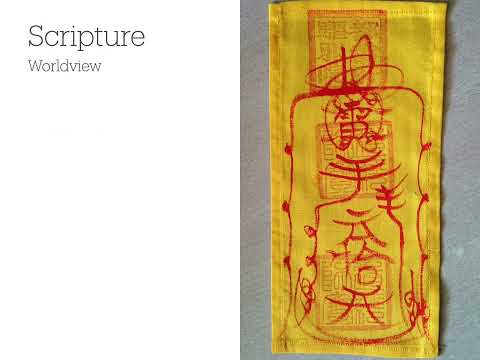
In Taoism, the term for scripture is "Jing," which is also used in Buddhism and Confucianism. However, Boken Camp notes that the Jing of Taoism represents historical manifestations of the eternal Dao. These texts are seen as accessible forms of the Dao, albeit somewhat corrupted or simplified compared to the celestial scripts that are beyond human comprehension.
Taoist scriptures, therefore, serve as a means for practitioners to connect with the eternal principles of the Dao, providing guidance and insight into the nature of existence and the universe.
A significant aspect of the Taoist worldview is the belief in transcendent beings and the practices aimed at merging with the Dao. Boken Camp clarifies that the goal is often misinterpreted as achieving immortality. Instead, Taoism emphasizes a form of longevity that aligns with the natural transformations of the Dao. This process involves cycling through the natural order rather than simply avoiding death.
The term "Shen" is often translated as immortal, but Boken Camp prefers the term "transcendence," highlighting a spectrum that ranges from human existence to various levels of transcendence, including earthbound and celestial forms.
In certain Taoist traditions, such as Shanqing and Lingbao, there exists a concept of the "perfected ones." These individuals have transcended ordinary existence and constructed bodies made of what Boken Camp describes as stellar substance, allowing them to navigate the highest heavens. This notion of perfection represents the ultimate goal of Taoist practice, where practitioners aspire to achieve a state of being that transcends the limitations of the physical world.
The Taoist worldview, as articulated by Boken Camp, presents a rich tapestry of beliefs and practices that emphasize the interconnectedness of existence, the significance of Chi, and the pursuit of transcendence. By understanding these core concepts, one can gain deeper insights into the profound nature of Taoism and its enduring relevance in the exploration of spirituality and existence.



















