
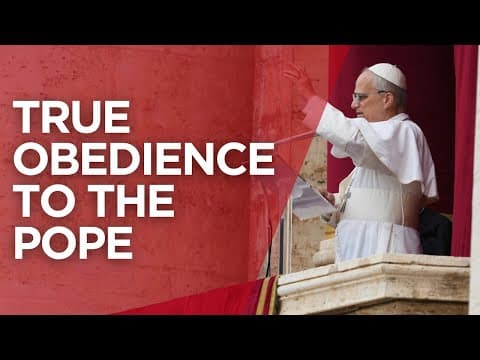
This blog post explores the complexities of obedience within the Catholic Church, particularly in relation to Pope Leo XIV. It discusses the balance between respecting authority and maintaining a well-formed conscience, emphasizing the importance of virtue in obedience while navigating the challenges posed by modern leadership.
The election of Pope Leo XIV has ignited a significant discussion within the Catholic community, revealing two extremes in the perception of obedience to authority. Some view him as a beacon of hope, akin to the revered Pope Pius X, while others dismiss him as a modernist or even an antipope. This blog post aims to clarify the nature of authority and the virtue of obedience, particularly in the context of Catholic teachings.
As Catholics, we are called to obey all lawfully constituted authority, whether civil or religious. However, obedience is not a blind adherence; it is a virtue that must be exercised with discernment. There are limits to obedience, especially when commands conflict with moral principles or a well-formed conscience.
Moral Conflicts: If an authority figure asks us to act immorally, we cannot comply. For instance, during the COVID-19 lockdowns, some bishops prohibited priests from performing essential sacraments like confessions or baptisms. In such cases, a priest is obligated to prioritize the spiritual needs of the faithful over unjust commands.
Conscience and Unease: There are situations where a command may not be explicitly immoral, but it causes significant discomfort or conflict with one's conscience. In these instances, it is acceptable to respectfully decline to follow the directive.
Unjust Laws: In the civil realm, there are unjust laws that may harm one's livelihood or well-being. Obedience to such laws is not obligatory if they lead to destructive outcomes.
Even when an authority figure, such as the pope, demonstrates questionable behavior, Catholics are still obliged to obey commands that are not inherently evil. This principle is rooted in the belief that all authority ultimately comes from God. For example, St. Paul acknowledges the emperor's role in justice, despite the emperor's moral failings.
Historically, the Church has faced various challenges with its leaders. The example of Archbishop Marcel Lefebvre illustrates a commitment to obedience while navigating complex relationships with the Vatican. Lefebvre's life was marked by efforts to engage with Church authority through dialogue and negotiation, demonstrating a model of obedience that respects the hierarchy while advocating for traditional values.
As traditional Catholics, it is crucial to remain patient and engaged with the Church's leadership. The current pope, being relatively young, may evolve in his role over time. It is essential to recognize that even leaders who start with questionable views can change for the better, as seen in past papacies.
The Society of St. Pius X (SSPX) has shown a willingness to engage with the Church, even during challenging times. Their pilgrimage to Rome in 2000 was a demonstration of good faith, aimed at participating in the life of the Church rather than rejecting it outright. This approach highlights the importance of maintaining a connection with the Church while advocating for traditional practices.
In the contemporary context, it is vital for Catholics to express their concerns respectfully while also acknowledging the positive actions of Church leaders. The initial years of Pope Francis's papacy saw many Catholics hopeful for reform, and it was only later that concerns about his decisions began to surface. This illustrates the need for a balanced approach to authority—one that neither dismisses it outright nor accepts it blindly.
Catholics are encouraged to support their leaders when they make positive changes and to voice their concerns when necessary. This balanced approach fosters a healthy dialogue within the Church and encourages leaders to act in the best interest of the faithful.
In conclusion, true traditional Catholic obedience requires a nuanced understanding of authority. It is essential to avoid the extremes of blind obedience and outright rejection of authority. Instead, Catholics should strive for a virtuous obedience that respects the hierarchy while remaining true to their conscience and moral principles. As we navigate the complexities of modern Church leadership, let us pray for our leaders and engage with them constructively, embodying the spirit of true Catholic obedience.



















