
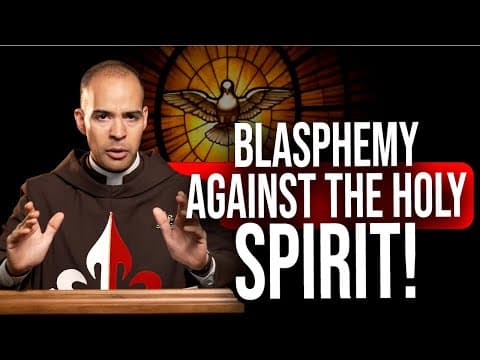
This article explores the meaning of blasphemy against the Holy Spirit as explained in the Gospel of St. Mark and further illuminated by St. John Paul II. It discusses how this sin is not merely about offensive words but a refusal to accept God's salvation, illustrated through a real-life example and reflections on spiritual self-imprisonment through rationalization and relativism.
In the third week of Ordinary Time, the liturgy presents a profound passage from the Gospel of St. Mark (3:22-30) where the scribes accuse Jesus Christ of being possessed by Beelzebub, the prince of demons. Jesus responds by explaining the impossibility of a kingdom divided against itself standing firm. He then delivers a solemn warning about blasphemy against the Holy Spirit, stating that while all sins and blasphemies can be forgiven, blasphemy against the Holy Spirit is an eternal sin without forgiveness.
This article delves into the meaning of this grave warning, drawing from the Gospel, the teachings of St. John Paul II, and a poignant real-life example to understand what it truly means to blaspheme against the Holy Spirit.
The scribes accuse Jesus of casting out demons by the power of Beelzebub. Jesus counters this by pointing out the illogical nature of their claim: a kingdom divided against itself cannot stand. He emphasizes that his power to drive out demons comes from God, not from an unclean spirit.
He concludes with a powerful statement:
"Amen, I say to you, all sins and all blasphemies that people utter will be forgiven them. But whoever blasphemes against the Holy Spirit will never have forgiveness, but is guilty of an everlasting sin."
This statement raises a critical question: What exactly does it mean to blaspheme against the Holy Spirit?
Is blasphemy against the Holy Spirit merely about uttering offensive words, such as calling the Holy Spirit an unclean spirit, as the scribes did? Or is there a deeper spiritual reality?
In his 1986 encyclical Dominum et Vivificantem, St. John Paul II offers a profound insight:
Thus, blasphemy against the Holy Spirit is a hardened state of heart that refuses to open to God's grace and salvation.
A priest friend once visited a man on his deathbed to administer the last sacraments. Upon entering, the priest noticed objects in the house that were contrary to Catholic faith. When he asked about them, the son deferred the matter to his father.
The priest prepared for a difficult conversation. The man welcomed him warmly but was reluctant to remove the objects, which represented idolatry—a mortal sin. The priest explained that confession could not proceed while the man held on to such sin.
The man then expressed a desire to avoid conflict with anyone, saying he preferred to be friends with everyone rather than have enmity with anyone. This attitude reflected a refusal to renounce sin and accept the grace offered by the Holy Spirit.
This example illustrates how a person can close themselves off from the Holy Spirit’s action, effectively blaspheming by rejecting the grace of salvation.
Many people fall into the trap of rationalizing or relativizing sin, making it appear less serious or acceptable. Satan exploits this by disguising sin so that it is more easily accepted.
This leads to serving two masters and creating enmity with the Holy Spirit. The person becomes imprisoned by their own rationalizations and cannot escape without divine intervention.
The article encourages readers to seek the intercession of Mary, the spouse of the Holy Spirit, to enlighten minds and strengthen hearts. Through her help, believers can recognize where they might be rationalizing sin or resisting grace and find the strength to cut away what leads them away from the Holy Spirit.
Blasphemy against the Holy Spirit is not simply about speaking ill of the Spirit but about a deeper spiritual rejection of God’s grace and salvation. It is a state of self-imposed spiritual imprisonment that prevents forgiveness and purification.
By understanding this, believers are called to examine their hearts, avoid rationalizing sin, and open themselves fully to the Holy Spirit’s transformative power. Through prayer and Mary’s intercession, one can seek the grace to remain faithful and receptive to God’s mercy.
May the blessing of the Almighty God, the Father, the Son, and the Holy Spirit be upon all who seek to understand and live by this profound truth.
Salve Maria.



















