
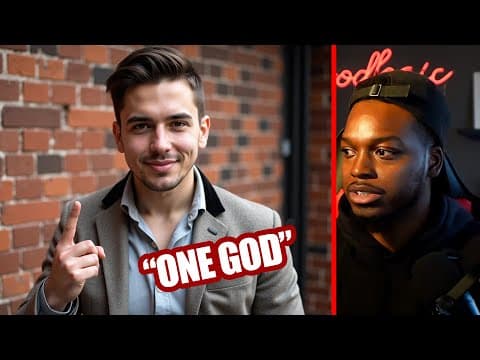
This blog post explores a debate between a Unitarian and a Trinitarian, focusing on their differing beliefs about the nature of God, the interpretation of the Bible, and the epistemological principles that guide their understanding of truth.
In a recent discussion, a Unitarian engaged in a debate about the nature of God, specifically addressing the concept of the Trinity. This post aims to unpack the key points of the conversation, exploring the Unitarian perspective, the epistemological principles involved, and the implications for biblical interpretation.
The Unitarian participant in the debate identified as someone who believes in one God, referred to as Yahweh, and does not accept the doctrine of the Trinity. This belief system posits that Jesus is not Yahweh, which is a fundamental divergence from traditional Christian doctrine that embraces the Trinity.
When asked about their belief in the Bible, the Unitarian stated they accept only the parts that correspond to reality. This raises an important question about the criteria for determining what is true within the biblical text. The Unitarian explained that their epistemic principle is based on logic and reality, asserting that truth is what corresponds to reality.
The conversation quickly turned to epistemology, the study of knowledge and justified belief. The Trinitarian interlocutor challenged the Unitarian's assertions, questioning the basis for their epistemic principles. The Unitarian maintained that logic is foundational, but the Trinitarian pressed for justification of this assumption.
A significant point of contention arose around the concept of knowledge claims. The Unitarian argued that while beliefs can be formed, certainty about their truth is elusive. This led to a discussion about contradictions in asserting knowledge while simultaneously claiming uncertainty. The Trinitarian pointed out that every assertion made by the Unitarian is a knowledge claim, which complicates their position.
The debate also touched on the nature of reality itself. The Unitarian insisted that reality is the most fundamental starting point for their worldview. However, the Trinitarian countered that this assertion lacks justification and leads to an infinite regress of self-referencing claims. The discussion highlighted the complexities of defining what constitutes reality and how it informs one's beliefs.
As the debate progressed, the Unitarian was asked about specific biblical passages that relate to the Trinity. They acknowledged that certain verses could be interpreted to support a skeletal framework for the Trinity but argued that the full doctrine developed through church councils is not explicitly present in the Bible.
The Trinitarian pointed out that many early Christians, including Jewish believers, accepted the deity of Christ, citing instances from the New Testament where Jesus is identified with Yahweh. The Unitarian, however, maintained that these interpretations could be figurative or representative rather than literal affirmations of the Trinity.
The discussion between the Unitarian and the Trinitarian illustrates the complexities of theological debate, particularly regarding the nature of God and the interpretation of scripture. The Unitarian's reliance on logic and empirical observation as a basis for belief contrasts sharply with the Trinitarian's faith in the doctrinal assertions of Christianity. This dialogue not only highlights the differences in belief systems but also raises important questions about the foundations of knowledge and truth in religious discourse.
As the conversation concluded, both participants acknowledged the need for further exploration of these profound topics, leaving the door open for continued dialogue on the nature of God and the interpretation of sacred texts.



















