
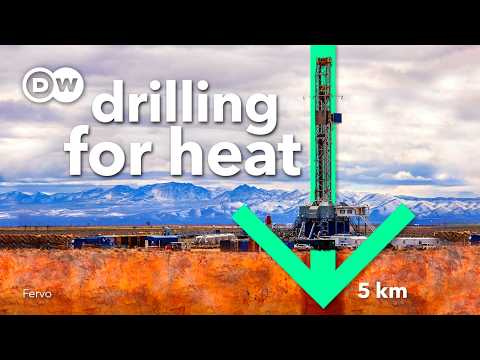
Geothermal energy, particularly through new technologies, has the potential to provide renewable energy globally, even in areas without traditional hot water reservoirs. Companies like Eavor and Fervo Energy are pioneering methods to harness this energy, but challenges such as costs, safety concerns, and the need for investment remain.
Can we harness the energy of the Earth's core? Iceland is already doing it, deriving two-thirds of its primary energy from geothermal sources. By tapping into vast underground hot water reservoirs, Iceland generates heat and electricity around the clock. Other countries are eager to replicate this success, but there is a significant limitation: geothermal energy can only be harvested in regions with accessible hot water reserves. Fortunately, a new generation of geothermal technologies is emerging, promising to make energy from the Earth's core available almost everywhere.
Conventional geothermal operations typically drill a few hundred to three thousand meters deep to access hot water reservoirs. For context, oil and gas wells can reach depths of up to four thousand meters. However, the next generation of geothermal technology, often referred to as Geothermal 2.0, aims to go much deeper—beyond four thousand meters—where the heat resource becomes more universally available. Heymi Bahar from the International Energy Agency explains that at depths between four thousand and seven thousand meters, geothermal energy can be accessed similarly to wind or solar resources.
As we drill deeper into the Earth, temperatures increase, averaging 25 to 30 degrees Celsius per kilometer. This means that deeper drilling can yield more energy. Maps indicate promising geothermal locations at two thousand meters, where temperatures exceed 150 degrees Celsius, sufficient for heat and electricity generation. Collectively, these sites could potentially provide energy equivalent to one hundred and fifty times the annual global electricity demand.
Drilling deeper alone won't unlock this energy. Innovative methods are being explored, such as the Eavor-Loop system being developed by the Canadian company Eavor in Bavaria, Germany. This technology allows for multiple wells to be drilled from a single mother well, extending beyond eight thousand meters. The Eavor-Loop operates without a hot water reservoir, extracting heat from dry rocks instead.
The process involves drilling two vertical wells into the Earth, then fanning out several lateral wellbores. Cold water is pumped through these tubes, absorbing heat from the hot rock and returning to the surface for heating or electricity generation. Eavor is investing 350 million Euros into this technology and plans to cover a significant portion of Hannover's heating requirements with a second project.
In the United States, Google is also investing in geothermal energy. In 2021, they partnered with Fervo Energy to develop a new geothermal plant in Nevada. Fervo's approach involves creating an artificial hot water reservoir through horizontal drilling, which enhances heat transfer efficiency. This method, reminiscent of hydraulic fracturing used in oil and gas extraction, has shown promising results, significantly reducing costs and drilling time.
However, the excitement surrounding geothermal energy is tempered by concerns about induced seismicity. The 2017 earthquake in Pohang, South Korea, linked to enhanced geothermal exploration, serves as a cautionary tale. Experts like William Ellsworth from Stanford University highlight the risks of triggering earthquakes when creating geothermal reservoirs. While companies like Fervo emphasize careful monitoring and geological assessments to mitigate these risks, public opposition remains a challenge.
Another hurdle for next-generation geothermal technology is the high cost of drilling deep wells. The International Energy Agency (IEA) warns that without subsidies, geothermal electricity could be significantly more expensive than solar or wind energy. The IEA estimates that the geothermal sector will require one trillion dollars in investment over the next decade to realize its full potential.
To overcome these challenges, collaboration with the oil and gas industry may be essential. The expertise and resources of these companies could accelerate the development of geothermal energy. Many of the drilling techniques used by Fervo and Eavor are derived from methods developed for fracking, and a significant portion of their workforce comes from the fossil fuel sector.
Next-generation geothermal technology holds the promise of providing renewable energy to regions previously unable to access it. Countries like China, the United States, and India are poised to lead in this sector, potentially supplying 15% of global electricity demand by 2050. As technology advances and costs decrease, geothermal energy could become a vital component of the global energy landscape, offering a clean, reliable power source while creating quality jobs.
In conclusion, the future of geothermal energy is bright, but it hinges on overcoming economic, regulatory, and safety challenges. With the right investments and innovations, geothermal energy could play a crucial role in the transition to a sustainable energy future, allowing us to drill deeper while leaving fossil fuels in the ground.



















