
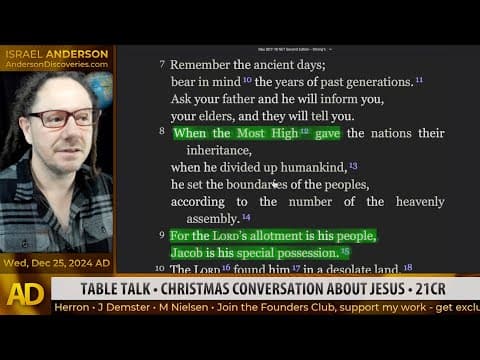
This blog post explores a Christmas Day Gospel message that challenges traditional Christian narratives about Jesus and Yahweh. It discusses the author's journey from conventional Christianity to a deeper understanding of biblical texts, emphasizing the differences between the teachings of Jesus and the character of Yahweh as depicted in the Old Testament. The post highlights key biblical passages and interpretations that suggest a different story than what mainstream Christianity presents, focusing on the concept of the Divine Council and the implications for understanding the nature of God and humanity's relationship with the divine.
In this Christmas Day Gospel message, the speaker shares his personal journey from traditional Christianity to a deeper understanding of biblical texts. He emphasizes the importance of examining the scriptures beyond the conventional narratives and highlights the differences between the teachings of Jesus and the character of Yahweh as depicted in the Old Testament.
The speaker hails from New Zealand and has spent his life in ministry as a pastor. He began his journey in faith at a young age, eventually planting an inner-city fellowship in Oakland. Eight years ago, he embarked on a transformative study of the Bible, leading to the creation of a Bible ministry called God's iPod, which offers free audio versions of the Bible.
The speaker recounts how, during his studies, he began to notice significant discrepancies between what the Bible teaches and what mainstream Christianity conveys. He emphasizes that Christianity, as it stands, often presents a narrative that diverges from the original biblical texts. This realization prompted him to reevaluate his beliefs and approach to scripture.
The speaker discusses how archaeological discoveries have revealed connections between ancient cultures and biblical narratives. He mentions the importance of understanding these connections to grasp the broader context of biblical teachings. He highlights the significance of the Dead Sea Scrolls, which provide older and more accurate copies of the Old Testament, shedding light on previously concealed information.
The speaker delves into Deuteronomy 32, where Moses shares a deathbed confession, revealing the complexities of Yahweh's character. He argues that the translation of key terms in this passage has been manipulated to obscure the true meaning. The speaker asserts that the text indicates a distinction between the Most High and Yahweh, suggesting that Yahweh was given authority over the Hebrews by a higher power.
The discussion continues with Psalm 82, where the speaker highlights the concept of the Divine Council. He explains that the term "Elohim" refers to both the leader of the council and its members, challenging the conventional understanding of God in Christianity. The speaker argues that this passage illustrates a hierarchy within the divine realm, with Yahweh being one of many divine beings.
In Genesis 1:26, the speaker points out that humanity is created in the image of the Elohim, suggesting that humans share a likeness with these divine beings. This perspective challenges the traditional view of humanity's relationship with God and emphasizes the potential for a deeper connection with the divine.
The speaker critiques the character of Yahweh as depicted in the Old Testament, arguing that Yahweh's actions often contradict the teachings of Jesus. He contrasts Yahweh's harsh treatment of the Hebrews during their exodus from Egypt with Jesus' compassionate ministry, highlighting the differences in their approaches to humanity.
The speaker analyzes the temptation of Jesus in the wilderness, suggesting that Yahweh is the one testing Jesus, rather than a separate entity. He argues that this narrative reflects Yahweh's attempts to undermine Jesus' mission, further illustrating the conflict between the two figures.
The speaker examines the Lord's Prayer, emphasizing that it serves as a prayer for protection against Yahweh. He argues that Jesus' teachings consistently contrast with Yahweh's character, presenting a different vision of God that emphasizes love, compassion, and forgiveness.
The speaker concludes by inviting listeners to reconsider their understanding of the gospel and the nature of God. He encourages a shift away from religious systems towards a personal relationship with Jesus, emphasizing the importance of faith and trust in the teachings of Christ. The message serves as a call to explore the depths of biblical texts and to seek a more profound understanding of the divine.
This Christmas Day Gospel message challenges traditional Christian narratives and invites a reevaluation of the relationship between Jesus and Yahweh. By examining key biblical passages and their implications, the speaker encourages a deeper exploration of faith and a more authentic connection with the divine.



















