
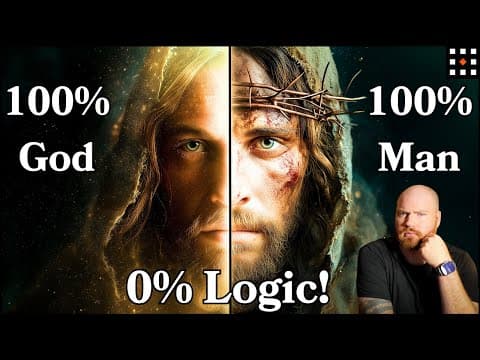
The hypostatic union, the doctrine that Jesus is both fully God and fully man, presents significant philosophical, biblical, and theological contradictions. This blog explores its historical roots, the various heresies that arose to explain it, and the implications for Christian doctrine, ultimately questioning the coherence of this central tenet of Christianity.
The hypostatic union is a crucial doctrine in Christianity, asserting that Jesus Christ is both 100% God and 100% man. This concept, while accepted as a mystery by many believers, raises significant questions about its coherence and biblical foundation. In this blog post, we will explore the historical context of the hypostatic union, examine its philosophical, biblical, and theological issues, and compare it with other religious views of divinity.
The term "hypostatic union" refers to the belief that Jesus possesses two natures: one divine and one human. This doctrine is often accepted without question by those within the faith, similar to the concept of the Trinity. However, the origins of this doctrine are complex and rooted in historical debates within the early church.
The hypostatic union was formalized in the early ecumenical councils, particularly the Council of Nicaea and the Council of Chalcedon. These councils were convened to address various theological disputes and to establish a unified doctrine regarding the nature of Christ. However, the fact that such councils were necessary indicates that there was significant disagreement among early Christians about Jesus's nature.
Proponents of the hypostatic union often cite several biblical verses to support their claims:
While these verses are used to argue for the hypostatic union, critics contend that they do not provide a clear or coherent basis for the doctrine. Instead, they suggest that the biblical texts reflect a post hoc systematization of beliefs that were not explicitly taught by Jesus or his early followers.
One of the primary philosophical challenges to the hypostatic union is the law of non-contradiction. This law states that contradictory statements cannot both be true at the same time. The claim that Jesus is both 100% God and 100% man presents a logical inconsistency. For example, if Jesus is fully divine, he cannot simultaneously possess human limitations such as ignorance or fatigue.
Another philosophical issue arises from the concept of immutability, which asserts that God does not change. However, the New Testament describes Jesus as experiencing growth, learning, and emotional variability. This raises questions about how a being that is supposed to be immutable can also undergo change.
The doctrine also faces challenges regarding omniscience. In Mark 13:32, Jesus states that he does not know the day of his return, which contradicts the claim that he is fully divine and all-knowing. This discrepancy highlights the tension between the divine and human natures attributed to Jesus.
The relationship between free will and omniscience presents another philosophical dilemma. If Jesus is fully aware of his destiny, can his choices truly be considered free? This question complicates the understanding of Jesus's actions and motivations, particularly in moments of prayer and supplication.
The concept of temptation further complicates the hypostatic union. If Jesus was tempted in every way as humans are, yet did not sin, it raises questions about the nature of his humanity. If he was not born with original sin, how can he be considered fully human?
Several biblical instances illustrate the contradictions inherent in the hypostatic union:
The hypostatic union also has significant implications for various Christian doctrines:
The relationship between the hypostatic union and the Trinity is fraught with contradictions. If Jesus is fully God, how can he be distinct from the Father? This distinction is essential for understanding the Trinity, yet it becomes muddled when considering the hypostatic union.
The doctrine of substitutionary atonement, which posits that Jesus's death was necessary for humanity's salvation, is also complicated by the hypostatic union. If Jesus's divine nature did not die, then the sacrifice may not hold the infinite value required for atonement.
Other religious traditions handle the concept of divinity differently, often avoiding the contradictions present in the hypostatic union. For example:
The hypostatic union, while a central tenet of Christianity, presents numerous philosophical, biblical, and theological challenges. Its historical development reveals a patchwork of ideas that were created to address contradictions within the faith. As we explore these complexities, it becomes clear that the doctrine may not be as coherent or self-evident as many believers claim. Instead, it reflects the struggles of early Christians to reconcile conflicting beliefs about the nature of Jesus and God. Ultimately, the hypostatic union serves as a reminder of the intricate and often contradictory nature of religious doctrine, inviting believers and skeptics alike to question and seek deeper understanding.



















