
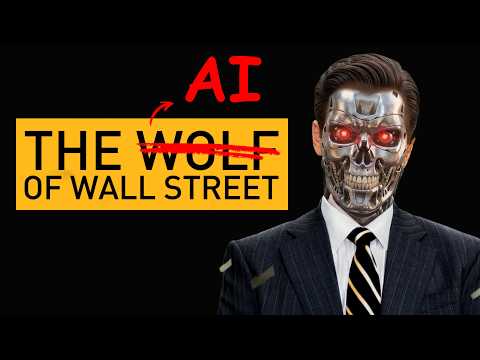
Wall Street is rapidly evolving due to AI integration, leading to significant job reductions in traditional finance roles like trading, investment banking, hedge funds, and private equity. While AI automates repetitive tasks, human skills in relationships, negotiation, and judgment remain crucial. The future favors those who combine AI proficiency with essential human skills.
Wall Street is experiencing a profound transformation driven by artificial intelligence (AI). According to Bloomberg, more than 200,000 jobs on Wall Street are expected to be lost over the next few years due to AI advancements. This shift is not about fear-mongering but understanding the evolving landscape and how finance professionals can adapt.
Wall Street traditionally consists of four key areas:
Trading: The buying and selling of stocks, bonds, currencies, and derivatives. This involved finance professionals intensely monitoring market movements to make profitable trades.
Investment Banking: The dealmakers handling mergers, acquisitions, IPOs, and capital raises.
Hedge Funds: Managing billions of dollars with some of the smartest and highest-paid finance experts.
Private Equity: Firms that buy entire companies, restructure them, and sell them for profit.
Historically, these roles required long hours, intense pressure, and significant human brainpower. Analysts worked late nights crunching numbers, traders made split-second decisions, and hedge fund managers leveraged insider information. This high-pressure, money-focused environment became an ideal ground for AI to start dominating.
Wall Street was among the first industries to adopt AI, starting with trading. Trading floors, once chaotic with hundreds of people shouting and waving papers, have transformed dramatically. Today, over 70% of all trades on the US stock market are executed by algorithms.
For example, Goldman Sachs reduced its equities trading desk from around 600 human traders to just two traders supported by 200 engineers maintaining complex trading algorithms. Unlike humans, AI systems do not require sleep or emotional regulation and can analyze thousands of data points and execute trades in microseconds.
While trading was the first area to be transformed by AI, other sectors of finance initially believed their roles were too relationship-driven or complex to automate. However, this is rapidly changing.
Junior bankers traditionally spend 80 to 100 hours a week building financial models, preparing pitchbooks, running valuations, and reviewing legal documents. This repetitive, detail-heavy work is exactly what AI excels at.
OpenAI has been running Project Mercury, hiring over 100 investment bankers at $150 an hour to train AI to replicate these tasks. Banks like Goldman Sachs, JPMorgan, and Morgan Stanley are deploying AI assistants to streamline workflows, reduce junior hiring, and increase efficiency.
Interestingly, banks are adopting different AI strategies:
Hedge funds have embraced AI for years, with roughly 70% using machine learning. New AI-driven funds outperform traditional ones by 4 to 7%. Renaissance Technologies, for example, has averaged 66% annual returns over 30 years using mathematical and machine learning algorithms.
AI applications in hedge funds include:
These capabilities allow hedge funds to analyze data at a scale and speed impossible for human teams.
Private equity seems harder to automate due to its relationship-driven nature involving deal sourcing, negotiation, and portfolio management. However, AI is accelerating non-relationship tasks such as due diligence and deal sourcing.
Tools like Alphasense and Grata scan thousands of potential acquisition targets, reducing the time to create shortlists from months to days. AI is transforming the analytical and data-heavy aspects of private equity.
Despite AI's rapid advancement, certain aspects of finance remain human-centric:
AI can assist in informing decisions but cannot replace the human judgment essential in high-stakes finance.
For those considering a career in finance, the AI revolution is not a death sentence but an opportunity. AI is automating the tedious, repetitive tasks that have traditionally burdened junior professionals, such as:
This automation frees up time for more meaningful work involving critical thinking, communication, strategy, and risk management. Skills that once took years to develop will now be accessible earlier in one's career.
Moreover, AI is creating new roles such as AI compliance officers, prompt engineers, model risk auditors, and data scientists. By 2026, nearly a third of finance job listings will require AI or machine learning skills.
The key to success will be combining technical proficiency with uniquely human skills. Professionals who can work alongside AI tools and excel in areas AI cannot replicate will thrive.
Wall Street is undergoing a fundamental shift driven by AI. While many traditional roles are being automated, new opportunities are emerging for those who adapt. The future belongs to finance professionals who embrace AI as a tool and cultivate the human skills that remain irreplaceable.
Understanding this evolving landscape and preparing accordingly will be crucial for anyone working in or entering the finance industry.



















