
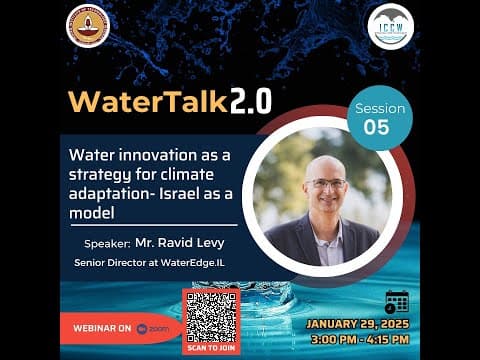
Mr. Ravid Levy discusses the critical role of water innovation in climate adaptation, highlighting Israel's strategies and technologies for managing water resources effectively amidst global challenges.
In a recent talk, Mr. Ravid Levy, a distinguished expert in water innovation and technology transfer, shared his insights on the importance of water management in the context of climate adaptation. As a senior director at Water Edge, Mr. Levy has nearly 20 years of experience in advancing water and waste treatment solutions. His work focuses on bridging the gap between research and practical applications, fostering collaboration among academia, startups, established firms, and government bodies.
Mr. Levy emphasized that water is central to both climate adaptation and mitigation. Despite its significance, many climate professionals and investors overlook water's role in climate strategies. He pointed out that the increasing demand for usable water, coupled with climate change effects such as droughts and floods, creates a growing gap between water supply and demand globally.
The world faces several water challenges, which can be categorized into four main areas:
These challenges necessitate innovative solutions to ensure sustainable water management.
According to a Global Water Intelligence report, the water sector contributes approximately 2-5% of global greenhouse gas emissions, primarily in methane emissions from wastewater and sludge. While this may seem minor compared to other sectors, the economic losses related to water and climate change are significant, with estimates suggesting nearly $2 trillion in damages, 70% of which is related to water.
Despite the pressing need for water solutions, investment in this sector remains low. In 2024, only about $1 billion was raised for early-stage water solutions, highlighting a critical gap in funding. Most investments are directed towards digital and AI solutions, with less focus on physical interventions like water treatment and desalination.
Mr. Levy provided insights into Israel's approach to water management, which serves as a model for other countries facing similar challenges. Israel has developed a comprehensive water strategy based on three main pillars:
Israel is a leader in water recycling, treating and reusing nearly 90% of its domestic wastewater for agricultural purposes. This strategy not only conserves natural water resources but also supports food security in a country with limited freshwater availability.
Mr. Levy highlighted several innovative technologies and strategies being implemented in Israel:
In conclusion, Mr. Levy stressed the importance of enhancing water resilience through innovation. As climate change continues to pose significant challenges, integrating water management into broader climate strategies is essential. Israel's experience offers valuable lessons for other nations, particularly in leveraging technology and fostering collaboration to address water-related issues effectively.
Mr. Levy's insights underscore the need for a paradigm shift in how we view water in the context of climate adaptation, advocating for increased investment and focus on innovative water solutions to secure a sustainable future.



















