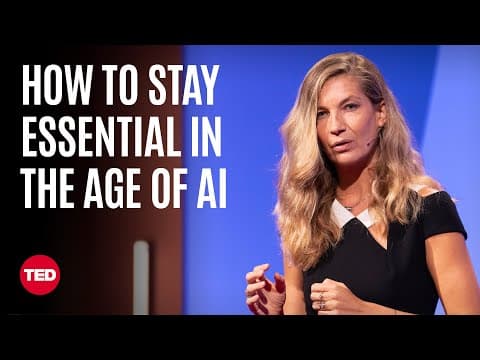
The future of work in the age of AI is not about job loss but about redefining human roles and skills. As AI capabilities grow, organizations must strategically determine where humans add unique value, invest in talent development, and reinvent workforce models to thrive alongside AI agents. This shift requires radical reinvention, focusing on human differentiation through trust, authenticity, and accountability.
Back in the 1950s, Alan Turing proposed a test to determine machine intelligence: if you couldn't tell whether you were talking to a machine or a human, the machine must be intelligent. Today, most chatbots easily pass this "Turing Test." However, this test focuses on talking, which, according to Vinciane Beauchene, misses the point. The real transformation will come from what machines can do, not just what they can say.
Instead of asking whether AI will take your job in the next decade, Beauchene suggests a more strategic question: if AI could take over all your team's tasks, who would you keep and why? This question forces organizations to think deeply about the unique value humans bring to the workplace.
Beauchene's concern is personal as well as professional; she has two young daughters and wonders about the world of work they will enter. She emphasizes the need to build a future where humans matter more, not less.
A client in the consumer goods sector explored the use of AI agents—autonomous systems capable of connecting across platforms, planning, acting, learning, and adapting. These agents could potentially handle the entire sales process independently, from targeting customers to closing deals.
While technically feasible, the company realized that their most loyal customers stayed loyal not because of prices or products but because of how sales representatives made them feel. This insight led to a fundamental shift: humans would focus on building relationships, fostering belonging, and creating loyalty rather than pushing products.
This shift required new skills, incentives, and mindsets but proved successful. It demonstrated that in the age of AI, human value is not lost but transformed.
The common narrative has been that AI will augment humans, not replace them. However, current technology trends suggest AI is moving toward greater autonomy, capable of handling complex, ambiguous tasks with minimal oversight—what Beauchene calls Artificial Capable Intelligence (ACI).
Unlike Artificial General Intelligence (AGI), which remains speculative, ACI is already emerging and will significantly change how work is done and by whom. Organizations must proactively shape this future rather than passively wait.
Beauchene identifies three myths she calls the "head in the sand ideology":
While humanity has adapted to past technological revolutions, those adaptations often occurred over generations without the necessary training or time. AI technology advances exponentially, but human growth is linear. Without preparation, many will struggle to keep pace.
Contrary to popular belief, AI is increasingly capable of demonstrating empathy and creativity. Many people prefer interacting with AI because it does not tire, judge, or become cranky. The focus should shift from what AI cannot do to where humans truly make a difference.
Protecting jobs is likened to anchoring a boat in a storm. Jobs are fixed, but human potential is not. Organizations must invest in human growth and adaptability. Current organizational structures with static career paths and occasional training are inadequate for the rapid changes AI will bring.
Beauchene describes an ideal company that starts with strategy, not technology. Such companies focus on outcomes that differentiate them in the market and understand how AI agents can help achieve these outcomes differently. They identify where humans add unique value and reinvent their operating models accordingly.
For example, an industrial goods client conducted extensive workshops to understand AI's impact across their business. This process helped align leadership on a vision where AI agents and humans complement each other.
Next, companies translate this vision into a workforce model, determining the number of people needed and the skills required. This approach replaces guesswork with intentional, multi-year skills forecasting.
A consumer goods client faced the challenge of reformulating their product portfolio while maintaining innovation leadership. AI unlocked productivity, but the deeper work involved reinventing the researcher's role—from chemist to data-driven biologist and from solo expert to multifunctional teammate. They succeeded by precisely mapping future skills and building effective upskilling and mobility programs.
Organizations must publicly commit to developing their talent to its fullest potential. While AI can perform tasks faster and cheaper, human interaction will gain new importance as AI becomes the norm. Trust, authenticity, and accountability will be the values that differentiate human contributions.
The smartest companies will invest systematically in all talent, not just technical skills, and protect time for learning. Currently, freelancers spend about four hours per week learning, but employees spend almost none.
The future is not about being more human but about building systems that enable humans to focus on what matters most. This is a story of human differentiation, not job loss.
AI will continue to advance, but how quickly we climb with it depends on us. We must stop asking if there will be jobs for humans and start asking what humans should be best at.
Being human in the age of AI is not a fallback; it is a practice that we must make exceptional.
Thank you.
This perspective challenges us to rethink the future of work and embrace a proactive, strategic approach to integrating AI and human talent for a better tomorrow.