
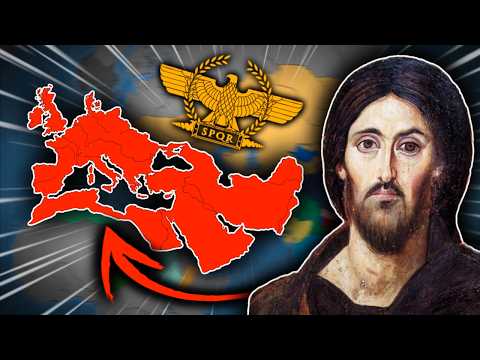
This blog explores a hypothetical scenario where Jesus Christ, after his resurrection, becomes the Roman Emperor. It details how his teachings and miracles could have transformed the Roman Empire and beyond, leading to a global Christian dominion characterized by love, justice, and charity.
As the world celebrated Easter, the holiest of Christian feasts, we commemorate the death and resurrection of Jesus Christ, the Son of God. His triumph over death is the cornerstone of Christianity, uniting believers across Catholic, Orthodox, and Protestant traditions. After spending 40 days on Earth instructing his disciples, Jesus ascended into Heaven, where he is seated at the right hand of God the Father Almighty. This exploration is not to challenge historical or theological truths upheld by any Christian denomination but to honor the message of Easter: Christ’s victory over sin and death.
History was forever changed in the days following Jesus' resurrection. Emerging from the tomb, his glorified body was radiant yet scarred with the marks of crucifixion, as chronicled in the Gospel accounts. Mary Magdalene and the other women who first encountered him spread the word of his return, trembling with awe and joy. Initially gripped by doubt, the disciples soon met him in the upper room, where he revealed his wounds and broke bread, reaffirming his identity as the Christ.
For reasons beyond human understanding, Christ was compelled to remain on earth by God the Father, forgoing immediate ascension. He decided to wield his divine authority to reshape the Roman Empire. His Gospel teachings heralded the Kingdom of God, a realm of justice, mercy, and love starkly contrasting the empires of this world. Risen and unbound by death, he resolved to forge this kingdom not through bloodshed but by divinely reordering Rome’s vast dominion.
In the weeks after his resurrection, Jesus traversed Galilee and Judea, appearing to thousands alongside his disciples. The First Letter to the Corinthians noted his appearance to a great multitude. Crowds flocked to hillsides, synagogues, and dusty roads, drawn by proclamations of a man who defied death. His teachings now carried undeniable weight, as his resurrection validated every syllable. He preached of a kingdom where the poor were exalted, swords became plowshares, and God’s law etched itself on every heart.
Miracles abounded: the blind saw, the lame walked, and the dead rose, each act a testament to his divinity, summoning all to repent and swear fealty to the one true God. His validated resurrection terrified the Pharisees, Sadducees, and High Priests, who recalled the many Old Testament prophecies Jesus fulfilled. Most Jews were convinced and began to follow Jesus, agitating tensions with the Romans.
Pontius Pilate, the Roman governor who had ordered Jesus’ crucifixion, grappled with reports of his return. Fearing revolt, he sent soldiers to seize him, but these efforts crumbled. In one vivid account, a cohort of legionaries cornered Jesus, only to freeze, overwhelmed by a divine calm that brought them to their knees. As months unfolded, Jesus’ following swelled, bridging ethnic and social divides. Gentiles, captivated by his universal call, joined Jews in hailing him as Messiah.
By 35 AD, when he reached Rome, his fame preceded him. Tiberius, the aged emperor, weary and cynical, was struck by Jesus’ serenity and piercing words. Jesus urged Tiberius to repent, to rule justly, and to honor the one true God. Moved by Jesus’ presence and tales of his miracles, Tiberius granted him freedom to teach throughout the imperium, allowing Jesus to establish a foothold in the city.
Over the next few years, Jesus’ influence in Rome deepened. His teachings challenged Rome’s reliance on violence and a rigid class system. Miracles further bolstered his divinity, healing a blind senator and raising a child in the slums. Resistance was fierce, as many pagan priests decried Jesus as a blasphemer, while senators feared his teachings would erode Roman traditions.
Tiberius’ death in 37 AD plunged the empire into uncertainty. Amid this chaos, Jesus’ presence loomed large. His followers, now millions strong, hailed him as their leader. A famine struck Italy, and Jesus multiplied loaves and fish in the Circus Maximus, feeding thousands. This miracle swayed key figures, leading a senatorial faction to propose Jesus as emperor.
In late 37 AD, the Senate proclaimed Jesus emperor in a historic session. He accepted, redefining the title as a servant’s role, echoing his words in the Gospel of Matthew. His coronation unfolded with a beautiful liturgy in the Forum Romanum, where he broke bread with disciples and citizens. The vast Roman Empire now rested under Jesus Christ, the Messiah.
Despite his ascent as the ruler of Rome, the world teetered on the brink of transformation. Christ’s reign began reshaping Rome’s core, trading the arena’s savagery for charity and pagan worship for devotion to the one true God. Beyond Rome’s borders, the world was dominated by demon-worshipping powers like Parthia. In 40 AD, Jesus set his campaign in motion, preparing to lead his followers eastward.
As Jesus neared the Euphrates, he dispatched emissaries to King Vardanes I, urging him to forsake idolatry. Vardanes dismissed Jesus as a Roman madman, yet whispers of Jesus’ miracles had flooded into Parthia. The first clash with Parthian forces saw Jesus raise his hand, engulfing the field in radiant divine light, blinding the attackers. Many knelt before him, while others fled to warn their king. Tens of thousands converted on the spot.
This pattern defined Jesus’ advance through Parthia, a procession of redemption, not ruin. Every army sent to attack met a similar fate. In Ctesiphon, the great fire temple of the Zoroastrians was struck down by lightning before he entered. Vardanes, witnessing the loss of cities, fell to his knees in surrender, acknowledging Jesus as no mortal king. Parthia, once Rome’s greatest rival, was now united through worship of the Trinity.
With Parthia subdued, Jesus cast his gaze across the world. He sent apostles eastward to India and the Silk Road’s reaches, while others journeyed through Britain and Spain. His approach remained steadfast: miracles to showcase his divinity, preaching to transform hearts, and charity to forge communities. In Ethiopia, he met the queen, who, through his teachings, embraced baptism, transforming Aksum into a Christian bastion.
In India, Jesus preached to Brahmins, merchants, and peasants alike. His miracles drew tens of thousands, while his teachings weakened the caste system. Indian emperors, awed by Jesus’ resurrection, converted, proclaiming Christianity the state religion. From India, Jesus pressed eastward, subduing the rest of Asia, winning over nomadic tribes along the Silk Road.
Jesus eventually crossed the Atlantic to bring the Gospel to the Americas. Landing in Mesoamerica in 55 AD, he performed miraculous healings and calmed the weather. The rulers recognized his divine authority and converted to Christianity. This global conquest, achieved without violence, formed a universal order where charity, justice, and faith reigned.
With his earthly mission nearing its close, Jesus prepared for the final act foretold in the Gospels: his ascension into heaven. On Mount Zion, he gathered his apostles and a vast multitude of believers. He reaffirmed his promise, stating he would not leave them desolate. As the crowd gazed upward, a radiant cloud enveloped Jesus, and he rose, his form luminous against the Jerusalem sky.
The apostles fell to their knees, gripped by awe, as angels proclaimed his return. His ascension sealed his mission to redeem the world. The apostles, led by Peter, assumed the mantle of governance, ensuring the Church’s unity across continents. The steadfast presence of Mary inspired devotion, her life a model of fidelity to God’s will.
In this hypothetical scenario, the world transformed under Jesus’ reign, illustrating a vision of love, justice, and mercy that reshaped not only Rome but the entire globe, fulfilling his mission as the risen Son of God.



















