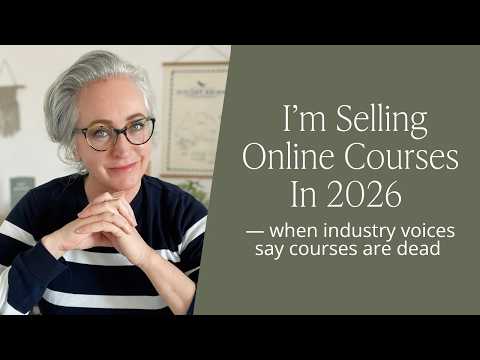
Despite widespread claims that online courses are no longer in demand and that people prefer implementation over information, my experience shows otherwise. After initial success with self-study courses, I experimented with live, gamified programs but found them exhausting and not more effective. Feedback from my audience led me to re-release my courses, which are now selling well again with minimal effort, proving that courses still hold value.
In recent times, many business coaches have been proclaiming that nobody is buying online courses or information anymore. Instead, they argue, people are seeking implementation support rather than just information. But is this really true? In this article, I will share my personal journey and insights into the online course market, exploring whether courses are truly dead or if they still hold value.
I first entered the online course market in 2020, which, unbeknownst to me at the time, was the peak period for course sales. I focused my energy on creating a suite of what I call "tiny courses." These were small, manageable courses designed to provide focused learning experiences.
By the end of 2021, these courses were generating a steady income of around $10,000 per month. What was remarkable is that this income was largely passive; I wasn’t heavily promoting the courses on social media or other platforms. Instead, I relied on content like blog posts to attract learners.
This income level continued into 2022, and everything seemed to be going well.
However, in 2023, as life began returning to normal post-pandemic, I noticed a decline in course sales. Around this time, I started hearing more voices in the business coaching community saying that people were no longer interested in buying information alone. Instead, they wanted implementation support — guidance on how to apply what they learned.
I watched a video from a fellow creator that resonated with me. It became clear that this trend was not unique to me but was affecting many course creators.
In response, I decided to pull many of my courses off the market and combine some of the key ones into a live, gamified program. This new offering included:
The engagement during this live program was impressive. Unlike typical live courses where attendance drops off after the first few sessions, participants stayed engaged throughout the two to three months the program ran.
Despite the high engagement, I found the live program exhausting to run. The workload and energy required were significant, and I realized I was not eager to repeat the experience.
Moreover, the results from this live, implementation-focused program were not better than those from my previous self-study courses. This was a surprising discovery.
While running the live program, I received feedback from a few participants who expressed that they did not want the additional extras or hand-holding included in the program. They felt that these extras were unnecessary and that they did not want to pay extra for them.
Simultaneously, people from my email list and previous course customers began asking when I would bring back my tiny courses. This feedback was eye-opening.
Reflecting on the feedback and results, I realized that for my audience, the traditional self-study courses were still valuable. Many students who took my self-paced courses completed them successfully and achieved their goals without any hand-holding or additional implementation support.
This led me to reconsider the narrative that courses are dead and that implementation is king.
Based on these insights, I have shifted my focus back to selling online courses. Over the past year, I have started re-releasing my tiny courses, and they are selling again with minimal effort on my part.
This experience suggests that while some learners may prefer implementation support, there remains a significant audience that values well-structured, self-paced courses.
The conversation around the relevance of online courses is ongoing, but my journey shows that courses are far from dead. They continue to provide value and generate income when designed and marketed appropriately.
If you are a course creator or considering creating courses, it’s important to listen to your audience and experiment with different formats. What works for one group may not work for another.
For more detailed insights, I have shared a blog post linked below where I delve deeper into this topic.
I invite you to share your thoughts and experiences on this subject. Are courses dead, or do they still have a place in the digital learning landscape?
Thank you for reading, and I look forward to the conversation.