
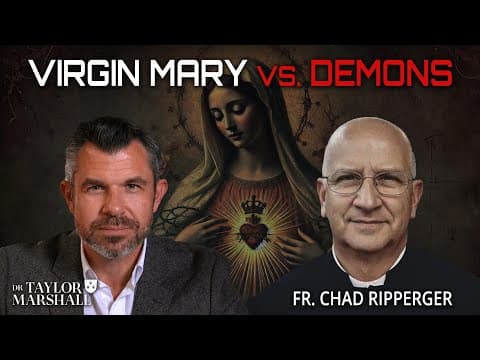
This article explores the deep enmity between Satan, demons, and the Virgin Mary from a theological and exorcist perspective. Drawing from Genesis, Revelation, and Catholic teachings, Father Chad Ripper explains why Mary’s sinlessness, her role in salvation history, and her authority as Queen of Heaven make her a powerful adversary to evil spirits. The discussion also addresses common Protestant objections and the spiritual implications of Mary’s unique position.
The relationship between Satan, demons, and the Virgin Mary is a profound and often misunderstood topic within Christian theology. Father Chad Ripper, a Thomistic theologian, philosopher, and exorcist, offers a compelling perspective on why Satan and the demons harbor such intense hatred for Mary, the Mother of God. This article delves into the biblical foundations, theological insights, and practical implications of this spiritual enmity.
The origin of the conflict between Satan and Mary can be traced back to the Book of Genesis. In Genesis 3:15, God declares, "I will put enmity between you and the woman, and between your offspring and hers; he will crush your head, and you will strike his heel." The Latin Vulgate text uses "ipsa" (she) to indicate that a woman will crush the serpent's head, symbolizing a decisive defeat of Satan by a female figure.
This prophecy establishes a primordial enmity between Satan and the woman, which Catholic tradition identifies with the Virgin Mary. This enmity is not merely symbolic but reflects a real spiritual battle, as Satan's hatred for women, especially Mary, is profound. Exorcists have observed that women seem to be more frequently possessed than men, possibly linked to this spiritual conflict.
The Book of Revelation (Apocalypse 12) further illuminates this battle. It describes a "great sign" in heaven: a woman clothed with the sun, standing on the moon, crowned with twelve stars, who gives birth to a male child destined to rule all nations. The dragon (Satan) attempts to devour the child but is ultimately defeated and makes war against the woman and her offspring. This passage is understood as a depiction of Mary and her spiritual struggle against Satan and his demons.
A critical aspect of Mary’s power over Satan is her sinlessness, known as the Immaculate Conception. Unlike all other humans, Mary was conceived without original sin, making her uniquely pure and free from Satan’s influence. This sinlessness is a direct challenge to Satan, who thrives on sin and separation from God.
Father Ripper emphasizes that Mary’s sinlessness is a theological truth upheld by the Catholic Church, though often rejected by Protestant traditions. Her purity means she is not subject to Satan’s dominion, which intensifies his hatred toward her.
Mary’s role extends beyond her sinlessness. She stood at the foot of the cross, participating in Christ’s victory over Satan. As Queen of Heaven and Earth, she holds a position of authority over the demons. St. Thomas Aquinas discusses the concept of "prolation," meaning power or authority, which Mary possesses to a greater degree than any other angel or saint.
This authority is not independent of Christ but flows from His merits and passion. Mary’s power to command demons and protect the faithful is a participation in Christ’s redemptive work. This explains why Satan fears her so much: she embodies the triumph of God’s plan and wields spiritual power that directly opposes his influence.
Many Protestants question the emphasis Catholics place on Mary’s role, arguing that Jesus alone conquered Satan. Father Ripper clarifies that Mary’s prerogatives are entirely dependent on Christ’s victory. Her power is an instrumental causality, meaning God works through her as a secondary cause to apply the merits of Christ’s passion.
This concept of instrumental causality is consistent with biblical examples where God uses physical means or people to accomplish His will, such as Jesus healing the blind man with mud and saliva. Thus, Mary’s role does not detract from Christ’s glory but rather manifests it through her unique cooperation.
Satan’s sin is pride, and being defeated by a woman is a profound humiliation. Mary, though a created being and the lowest in the hierarchy of intelligent creatures, surpasses all angels in holiness and authority due to her unique relationship with God.
St. Louis Marie de Montfort explains that Satan’s principal sin was against Mary, rejecting Christ under the aspect of His humanity as borne by her. The demons conspired in this rejection, which was the root of their fall. Their envy and hatred of Mary’s interior beauty and intimate relationship with God fuel their ongoing opposition.
Satan’s temptation of Eve is also connected to his hatred of Mary. Some Church Fathers suggest that Satan targeted Eve because he knew Mary would be the woman to crush his head. Eve was seen as more vulnerable, and by tempting her, Satan aimed to undermine God’s plan of salvation.
Father Ripper shares that in his experience as an exorcist, demons rarely blaspheme Mary directly. They avoid using her name because it is sacred and holy, and they fear the swift retribution from God. This respect, or fear, underscores Mary’s powerful spiritual status.
The deep enmity between Satan and the Virgin Mary is rooted in Scripture, theology, and spiritual reality. Mary’s sinlessness, her role in salvation history, and her authority as Queen of Heaven make her a formidable adversary to evil. Understanding this relationship enriches the Catholic faith and offers spiritual protection to believers.
For those interested in exploring this topic further, courses on angels, demons, and the Blessed Virgin Mary provide deeper insights into the spiritual battles that shape our faith journey.



















