
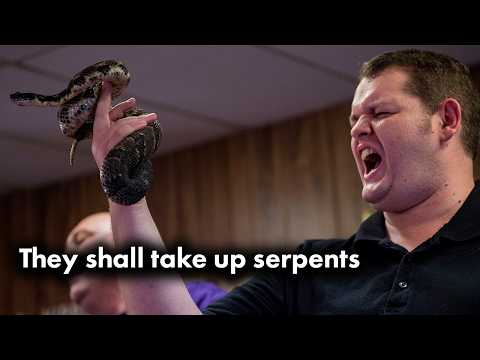
A small number of Pentecostal churches in the Appalachian region of the US practice snake handling during worship as a demonstration of faith, based on a literal interpretation of a biblical passage in Mark. This practice, though illegal in most states and controversial, is seen by believers as proof of the Holy Spirit's presence and protection. Scholars study the physiological and cultural aspects of this ritual, which remains a powerful example of embodied religious experience.
In the Gospel of Mark, Jesus promises his followers that those who believe in him will perform miracles, including casting out demons, speaking in new tongues, picking up snakes, drinking deadly substances without harm, and healing the sick. While many Pentecostal and charismatic Christians worldwide practice speaking in tongues, healing, and exorcisms, the practice of picking up snakes during worship is rare and mostly confined to a handful of churches in the Appalachian mountains of the United States.
Snake handling as a religious practice is based on a literal interpretation of Mark 16:17-18, where Jesus says believers will pick up snakes and not be harmed. For these Pentecostal churches, handling venomous snakes during worship is a demonstration of faith and a physical testimony that the Holy Spirit dwells within them.
Today, there are about a hundred small independent Christian churches in the US where venomous snake handling is common. These churches typically identify with the Church of God and the Church of God Prophecy denominations, which fall under the broader Pentecostal and charismatic Christian umbrella. However, major Pentecostal denominations like the Assemblies of God and the Church of God in Christ do not recognize or condone snake handling, and Pentecostal leaders have disavowed the practice for decades.
Snake handling churches are primarily located in the Appalachian mountains, especially in West Virginia, Kentucky, and Tennessee, with a few in the Southeast states such as Florida, Georgia, and Alabama. Despite its religious significance to practitioners, snake handling is illegal in every US state except West Virginia.
Services in these churches resemble other fundamentalist Pentecostal worship services, including worship music, sermons, and charismatic practices like speaking in tongues and healing. According to scholars Ralph Hood and W. Paul Williamson, who conducted extensive ethnographic research, sermons may be brief before worshipers begin demonstrating charismatic gifts, such as speaking in tongues or shaking under the influence of the Holy Spirit.
During the service, men may bring out a wooden box containing venomous snakes. Worshipers then handle the snakes, testifying to the experience and the protection they feel from God. Snake handling is viewed as evidence of complete faith and the Holy Spirit's presence, which believers physically feel as a protective anointing.
Scholars have debated whether charismatic practices like speaking in tongues or snake handling involve trance states. Some argue these are learned social behaviors without trance, while others suggest a focused dissociative state influenced by ritual and belief.
Research involving EEG studies and blood analysis of snake handlers during worship found significant physiological changes, including increased brain activity similar to hypnosis and spikes in adrenaline, endorphins, and cortisol. These chemical changes likely reduce fear and pain, enabling handlers to engage with the snakes while remaining aware and responsive.
Handlers often preach that snake handling is a test of faith and a sign of salvation. One worshiper stated, "The Bible says, they shall take up serpents. Honey, it means what it says, and says what it means. It won't change for me, it won't change for you. Amen. Thank God. The word of God is right."
Another emphasized that handling snakes is non-negotiable obedience to scripture and proof of true belief, referencing Mark 16. Church of God overseer AJ Tomlinson affirmed that the church stands for the whole Bible, including tongues and serpents.
Snake handling has been outlawed in most states since Kentucky first banned it in 1940. Courts have ruled that states can regulate religious behaviors if they have an overriding interest, such as protecting citizens from harm. Despite legal prohibitions, enforcement has been inconsistent.
Handling venomous snakes is extremely dangerous. Over 15 years of study, researchers observed about 25 snake bites, with handlers usually surviving. However, at least 89 deaths have been documented from snake handling, likely an underestimate. The snakes used are typically pit vipers native to the region, such as timber rattlesnakes, copperheads, and cottonmouths. These snakes inject venom amounts often insufficient to kill most adults in a single bite.
Additionally, snakes kept in poor conditions are less likely to bite or inject venom. While some handlers historically refused medical aid, younger pastors increasingly accept emergency care, viewing the Bible as commanding serpent handling but not forbidding medical attention.
Snake handling churches operate quietly and often against the law. The practice gains public attention mainly after tragedies, such as the death of a pastor or worshiper from a snake bite. Media portrayals often frame snake handling as a spectacle rather than a deeply embodied religious practice.
In 2013, National Geographic aired "Snake Salvation," a series following Kentucky pastor Jamie Coats and his congregation. Coats died a year later from a snake bite after refusing medical treatment. Such portrayals can oversimplify and sensationalize the practice.
Scholars like Nancy Ammerman and Meredith McGuire describe snake handling as an example of embodied religion, where faith is lived through bodily habits, sensations, and movements. The anointing—the physical sensation of the Holy Spirit moving through the body—is central to this embodiment. Handlers describe warmth, trembling, and an electric rush, with fear replaced by protection and purpose.
Snake handling in Pentecostal churches of Appalachia is a complex, controversial, and deeply meaningful religious practice. Rooted in a literal interpretation of scripture, it serves as a powerful testament of faith and embodiment of belief. Despite legal challenges and dangers, it persists as a vivid example of how religion can be experienced through the body and community.
This exploration reveals the nuanced reality behind a practice often misunderstood or sensationalized, highlighting the importance of understanding religious traditions in their cultural and embodied contexts.



















