
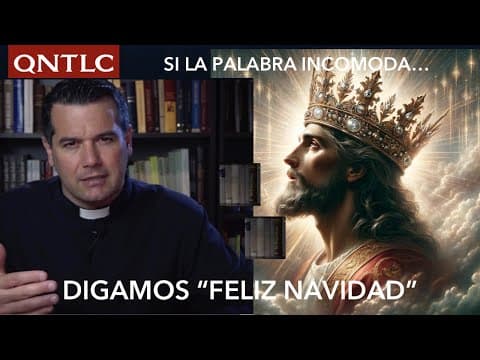
This article reflects on the cultural and historical attempts to change or suppress traditional religious expressions, focusing on the importance of preserving the true meaning of Christmas. It discusses how words shape reality, the impact of revolutions on language and faith, and encourages Catholics to boldly celebrate and share the message of Christ during the Christmas season.
On December 24, 2025, from San Francisco, California, a heartfelt reflection was shared about the true essence of Christmas and the importance of preserving its meaning in the face of cultural and ideological changes. This reflection comes after a period of rest and pilgrimage to the Holy Land, marking a return to normal life and the preparations for Christmas Eve and Christmas Day.
Historically, words have held immense power. During the Spanish Civil War (1936-1939), the Republican government, which was communist and atheist, banned the use of the Spanish farewell "adiós" because it means "until we see each other in God." This was unacceptable to a regime that rejected God and religion.
Vladimir Lenin famously said that words are like bullets, serving the revolution, especially the cultural revolution. This highlights the importance of guarding our language carefully.
During the French Revolution, a cultural revolution preceded the violent upheaval. The new Republic sought to erase religious influence by changing the calendar from seven-day weeks to ten-day weeks to eliminate Sunday, the Lord's Day. They renamed months and even altered the words of the "Our Father" prayer, replacing "kingdom" with "republic" to remove any reference to the old regime.
These examples show how revolutions attempt to change reality by changing language.
In recent decades, similar efforts have been made to alter the meaning and language surrounding Christmas. Many people today do not understand what Christmas truly celebrates—the birth of Jesus Christ.
Instead, Christmas has become associated with secular symbols like Santa Claus, whose modern image was popularized by Coca-Cola in the 1930s, and even characters like the Grinch, who steals Christmas presents.
In some places, people avoid saying "Merry Christmas" or "Feliz Navidad" to not offend those who are not Christian, opting instead for neutral greetings like "Happy Holidays" or "Felices Fiestas."
As Catholics, it is important to resist this cultural dilution and boldly proclaim the true meaning of Christmas. The phrase "Merry Christmas" in English comes from "Christ's Mass," directly referencing the celebration of Christ's birth.
Similarly, "Feliz Navidad" in Spanish celebrates the Nativity of Jesus, the one who divided history into before and after His coming. There is no year "after Muhammad" or "after Buddha," but the calendar is marked by the birth of Jesus Christ.
During the Christmas season, Catholics are encouraged to greet others with "Feliz Navidad," even if it may seem politically incorrect or uncomfortable. This greeting is a simple yet powerful way to witness to the faith and share the joy of Christ's birth.
Jesus Christ is the Prince of Peace, Emmanuel—God with us. However, He also said He did not come to bring peace as the world gives but a sword, indicating that following Him may bring division and challenge.
This Christmas season is an opportunity for Catholics to renew their commitment to a vibrant, militant faith—not a passive or complacent one. Through words and example, believers can evangelize and help others come to know the salvation brought by Jesus.
As Christmas approaches, it is a time for sanctification, good resolutions, and missionary zeal. The reflection concludes with blessings for all, especially those who are alone, imprisoned, or ill, invoking God's presence and grace.
The call is to celebrate Christmas with joy and courage, to say "Feliz Navidad" proudly, and to be part of a cultural and spiritual counter-revolution that upholds the truth of Christ in a changing world.
In a world where language and traditions are often altered to fit modern sensibilities, it is crucial to remember the power of words and the importance of preserving the true meaning of Christmas. Saying "Feliz Navidad" is more than a greeting; it is a declaration of faith and a celebration of the birth of the Savior who changed history forever.
Let us embrace this Christmas season with joy, courage, and a renewed commitment to share the message of Christ with all those around us.
Feliz Navidad!



















