Many couples face a sudden 30-50% drop in income when one spouse dies, known as the widow's penalty. This happens due to reduced Social Security, pension income, and investment management challenges. By testing your survivor income against fixed expenses and adopting strategies like delaying Social Security, choosing survivor pension options, using life insurance, and preparing a widow-ready account, you can protect your spouse's financial future.
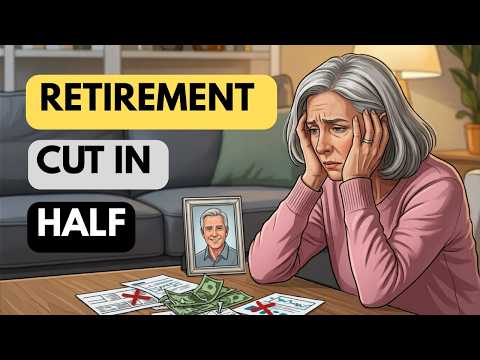
You and your spouse may have spent decades building your retirement savings, planning carefully, and making sacrifices to secure your financial future. But what if everything you built could be cut in half almost overnight—not because of a bad investment or overspending, but simply because one of you passes away first?
This harsh reality affects thousands of couples every year, often catching them by surprise because their retirement plan looked solid on paper. This phenomenon is known as the widow's penalty.
The widow's penalty refers to the immediate loss of between 30% and 50% of monthly income when one spouse dies. This loss happens overnight, while the household expenses remain the same or even increase.
Social Security: Both spouses receive monthly Social Security checks. When one passes away, the smaller check disappears, and the surviving spouse keeps only the larger one. If the deceased spouse was the higher earner, the surviving spouse's income drops significantly.
Pension Income: Many pensions offer a single life option that pays more while both spouses are alive but stops payments upon the death of one spouse. If the plan was based on this higher amount, the surviving spouse may be left with no pension income.
Investment Accounts: Often, one spouse manages the investments. When that spouse passes, the surviving spouse may have to manage unfamiliar accounts while grieving, increasing the risk of costly mistakes.
Despite the income drop, fixed expenses such as mortgage, property taxes, groceries, utilities, and health insurance remain unchanged. In fact, health insurance may become more expensive without the benefit of a couple's plan.
Bob and Linda retired with a combined Social Security income of $4,000 per month ($2,400 from Bob and $1,600 from Linda). Their budget was built around this amount.
When Bob passed away, Linda kept Bob's $2,400 check but lost her own $1,600. Her monthly income dropped to $2,400, a loss of $1,600 every month or $19,200 annually, while her expenses remained the same.
Bob and Linda were diligent savers and planners, but their plan was designed for two people, not one. This example highlights the importance of testing your retirement plan for the surviving spouse scenario.
If the higher earner claims Social Security at age 62, the benefit is permanently reduced. The surviving spouse will live on this reduced amount for life. Waiting until age 70 can increase monthly benefits by hundreds of dollars, providing a more secure income for the surviving spouse.
Pension plans often offer a choice between a higher monthly payment that stops at death or a lower payment that continues for the surviving spouse. Choosing the higher payment can leave the surviving spouse without income for many years.
If only one spouse manages investments, the other may be unprepared to take over. This can lead to emotional stress and financial mistakes during a difficult time.
Grab a pen and paper and answer these questions with your spouse:
What does your monthly income look like if only one of you survives?
What are your fixed monthly expenses?
Is your survivor income larger than your fixed expenses?
Many couples are surprised by the results because they never tested this scenario.
If you find a gap, it is fixable with timely action. Consider these strategies:
Delay the Higher Earner's Social Security to Age 70
Choose the Joint and Survivor Pension Option
Use Life Insurance as Income Replacement
Build a Widow-Ready Account
The widow's penalty is a predictable financial gap that arises when retirement plans are made for two people but not tested for one. Protecting your spouse's financial security after your passing is one of the most important decisions you can make.
Take the time today to sit down with your spouse, run the three-question test, and understand where you stand. This conversation could be the most crucial financial step you take this year.
Remember, you have worked hard to build your retirement. Don't leave your spouse vulnerable to the widow's penalty. Plan ahead, protect each other, and ensure financial peace of mind for both of you.
If you found this information helpful, share it with couples you care about. They may not realize this is something they need to consider.
Take care of each other.