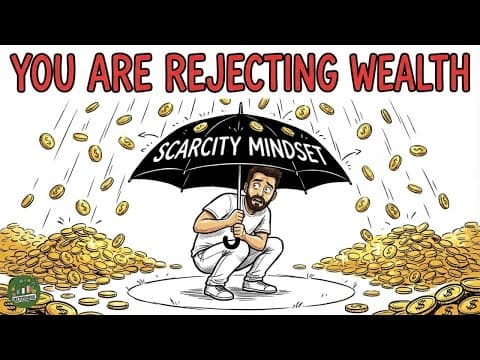
Many people unknowingly manage their finances through a scarcity mindset rooted in fear rather than reality. This mindset, shaped by early experiences and loss aversion, causes emotional financial decisions that hinder growth and create self-fulfilling cycles of stress and stagnation. By recognizing and shifting this mindset, building real safety nets, and making decisions based on facts instead of fear, individuals can improve their financial health and overall quality of life.
A few months ago, after receiving a bonus at work, instead of feeling excited, my first thought was, "What if I lose my job next month?" I didn't celebrate; I immediately moved the money into savings and started catastrophizing. Despite having a stable job and solid finances, I couldn't enjoy having more money because my brain was preparing for disaster.
This realization struck me hard: I wasn't managing money. I was managing fear. Many of us do this without realizing it. We treat money like it's always about to disappear, even when it’s not. We make decisions from panic rather than reality.
This mindset affects more than just our bank accounts; it influences how we feel daily, how we see ourselves, and what we believe we deserve.
When was the last time you made a money decision that wasn’t rooted in fear? Not greed or impulse, but quiet fear that you won’t have enough? Most of us have convinced ourselves that being anxious about money is responsible, and if we’re not worried, we’re reckless.
But what if that’s not true? What if the scarcity mindset we’ve adopted is making us poorer, not safer?
Scarcity thinking isn’t always based on your actual financial situation. You can have a decent income, savings, and investments and still operate from scarcity because it’s not just about numbers. It’s about how your brain has been wired to see money.
Many of us learned this early. Maybe your parents stressed about bills, or you grew up hearing, "We can’t afford that." Or perhaps you had one bad financial moment that your brain tattooed into your decision-making forever.
Your brain starts treating money like it’s always in danger, as if every dollar spent is one you’ll desperately need later.
Your brain wants to protect you. When it perceives a threat—losing money, not having enough, being unable to survive—it activates loss aversion. This means the pain of losing money feels twice as intense as the joy of gaining it. For example, spending $20 can feel worse than earning $20 feels good.
Combine this with real financial stress—rent, bills, uncertainty—and your nervous system treats every financial decision like survival.
In survival mode, you stop thinking long-term and stop seeing opportunities. You just hold on to what you have.
Scarcity thinking doesn’t make you more careful; it makes you worse at managing money. When operating from fear, you make emotional reactions:
I’ve experienced this myself. I didn’t buy a better computer that would have made work easier. I avoided investing in learning because courses cost money. I missed opportunities requiring upfront costs. I stayed stuck—not because I lacked money, but because I was too afraid to use it strategically.
I was so focused on not losing that I couldn’t see how to win.
Research shows that when people feel scarcity—whether of time, money, or resources—they experience "tunneling." This means your focus narrows so much that you only see the immediate problem and lose the ability to think creatively or see the bigger picture.
This is the real trap. Scarcity thinking creates the outcomes you fear:
Fear becomes self-fulfilling.
I’m not saying to ignore financial reality or pretend you have money you don’t. There’s a huge difference between being broke and thinking like you’re broke when you’re not.
Real struggle requires careful management. Scarcity thinking happens when you have options but can’t see them, when you’re paralyzed by fear even though the math says you’re okay.
Here’s the shift I had to make, and maybe you need to make it too:
Instead of asking, "Can I afford this?" I started asking, "What am I actually afraid of?"
Most of the time, it wasn’t about money. It was about control, feeling safe, and the belief that I didn’t deserve both security and comfort.
Once I recognized this, things changed—not because I had more money, but because I used it differently. I started seeing money as a tool instead of a shield.
I understood that sometimes spending money is the responsible choice if it helps you earn more, save time, or improve your life.
I bought that better computer. I invested in skills that increased my income. I stopped choosing the cheapest version just to prove I was careful.
And guess what? I didn’t go broke. I started doing better financially because I wasn’t operating from panic.
When you’re thinking about spending money—whether on a course, better equipment, investing, or even groceries you want instead of the cheapest option—try this:
Most of the time, you’ll realize the fear is bigger than reality. Spending $200 on something useful won’t destroy your life, and investing $1,000 doesn’t mean you’ll lose everything.
Then ask:
This doesn’t mean spending recklessly. It means making decisions based on reality, not fear.
Recognize when your scarcity thinking is protecting you and when it’s holding you back.
Another helpful step is to build actual safety nets instead of emotional ones. An emergency fund does far more for peace of mind than constant worrying.
Having three months’ worth of savings means you can make decisions from security instead of desperation. You can negotiate better, leave bad situations, and take calculated risks.
But if you never feel secure enough to build that safety net because you’re too afraid to invest or save strategically, you stay in the same cycle. You’re not protecting yourself; you’re just staying scared.
Here’s the truth that took me too long to learn: money isn’t actually scarce for most of us. Time is scarce. Health is scarce. The years we have to build the life we want are scarce.
Money flows. It comes and goes. You can earn more, make different choices, and change your situation. But you can’t do any of that if you’re frozen by fear.
I’m not saying you’ll never be anxious about money again. I still am sometimes. But now I can recognize when it’s real concern versus old programming. That awareness changes everything.
When you stop treating money like it’s always about to disappear, you start treating yourself like you matter. You start investing in your future instead of just trying to survive. You start making choices that improve your life instead of choices that just feel safe.
The world feels uncertain. Jobs feel unstable. Prices keep rising. It makes sense to be careful. But there’s a difference between being careful and being paralyzed, between being responsible and being ruled by fear.
You don’t have to choose between financial security and living your life. You don’t have to apologize for wanting both. And you definitely don’t have to keep treating money like the enemy.
Start small. Notice the next time you make a decision from fear instead of reality. Question it. Look at the numbers. See if fear matches facts. If it doesn’t, choose differently.
The scarcity mindset doesn’t keep you safe. It keeps you small. You don’t have to stay there. You’re allowed to feel secure. You’re allowed to make choices that serve your future, not just your fear.
You’re allowed to believe there’s enough—enough money, enough opportunity, enough possibility for you to build something better.
It won’t happen overnight, but it starts with recognizing that the way you’ve been thinking about money might not be serving you anymore. And that’s okay. You can change it.
One decision at a time, one choice at a time, one moment of choosing reality over fear. That’s how you break free.