Editorial Team
10 min read
Amazon’s new flagship tablet earns praise for its optional matte display and Google Play access. The reviews make a stronger case for reading and entertainment than for Alexa-led computing or replacing a laptop.
Amazon’s Alexa Tablet 12 Pro has won reviewers over most convincingly with its display and expanded app access. The company’s new flagship Android tablet combines an optional anti-glare screen with Google Play, moving beyond the restricted software of its Fire predecessors. Alexa+, Amazon’s AI-enhanced assistant, is deeply integrated, but its value depends more on the buyer’s habits than the product’s name suggests.
Amazon announced the lineup on October 8, 2026, with the 12 Pro above smaller 11-inch and 8.7-inch models. Its US launch prices put the 12 Pro at $499.99 for 8GB of RAM and 128GB of storage, or $549.99 with Nanomatte. That makes the distinction between the two screens central to the buying decision.
The strategic change is equally consequential: Amazon can now promote its Kindle reading service, Prime Video streaming service and Alexa assistant on a tablet that also offers straightforward access to Google’s competing apps and assistant. Buyers have more freedom to choose which services they use.

Alexa Tablet 12 Pro with the optional Pro Pen. The tablet offers standard and Nanomatte display options. Product render: Amazon. Source: Amazon tablet announcement.
The 12 Pro has a 12-inch, 2800-by-1840 LCD with a 120Hz refresh rate and a 3:2 aspect ratio. The taller shape suits reading and side-by-side apps, while reviewers praised the aluminum body’s construction. The hardware introduction places the optional keyboard and stylus at the center of Amazon’s move toward more productive use.
Google’s $899 standard flagship brings more storage, a larger main camera sensor and useful software tools. Reviews make a strong case for buying it instead of a Pro, but a weaker one for replacing last year’s Pixel 10.
Nanomatte is the more distinctive feature. Amazon says it developed the etched glass with Corning to reduce reflections. A hands-on comparison with a standard-glass iPad Pro found a dramatic reduction in glare under strong morning light, although colors looked more washed out when brightly illuminated.
The effect is measurable. One laboratory review measured reflectance at 4.13%, among the best results in its tablet comparison, and peak brightness at 614 cd/m². But it also found imperfect color accuracy and visible potential for trailing in fast-moving images. A separate display test judged color accuracy much more favorably. These results support confidence in glare reduction more clearly than a universal claim about image fidelity.
Nor has Amazon invented the affordable matte tablet. In a direct comparison, Huawei’s MatePad Pro 12 offered a superior matte OLED display, though that model cost roughly twice as much. The same review identified a closer-priced alternative: a €750 MatePad Air package with keyboard and pen, against about €805 for Amazon’s 16GB/256GB package. Huawei offered a thinner, lighter device and a better matte OLED screen; Amazon offered full native Google support.
The lower-priced glossy 12 Pro needs separate consideration. Its reviewer found it reflective and difficult to see in broad daylight. Praise for Nanomatte should not be transferred to that configuration.
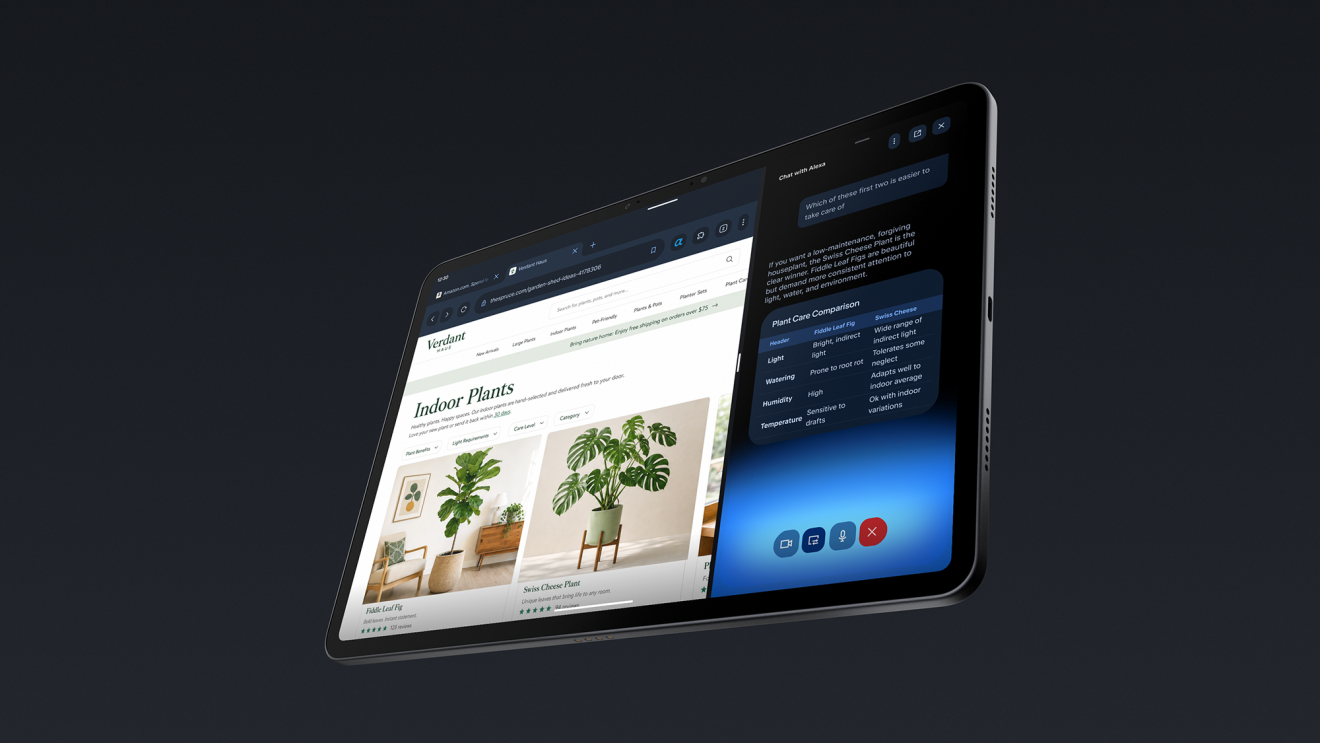
Amazon’s demonstration of contextual Alexa assistance beside a webpage. On-Screen Intelligence capabilities are company-reported. Product render: Amazon. Source: Amazon tablet announcement.
Earlier Fire tablets relied on Amazon’s app store, leaving gaps in the software available without workarounds. The new model runs Android 16 with Google Play and Google services; the software test found Amazon’s own app store was no longer preinstalled. YouTube, Gmail, Chrome and Google Docs can be installed normally.
This is a more meaningful departure than a keyboard or metal case alone. Amazon had already launched the Fire Max 11 in May 2023 with an aluminum design, a $229.99 starting price and a $329.99 keyboard-and-stylus bundle, according to its original announcement. Productivity accessories have precedent; access to Google’s app ecosystem addresses an older limitation.
The Fire Max 11 also already offered hands-free Alexa and a dashboard for controlling compatible smart-home devices. Those functions alone do not explain the new branding. The overhaul comes under Panos Panay, Amazon’s senior vice president overseeing devices and Alexa, who joined from Microsoft in 2023 after serving as chief product officer. He previously led Microsoft’s Surface division, as the hardware review notes. That review suggests his influence helped drive the change.
Amazon nevertheless keeps its own services close at hand. Home-screen shortcuts and widgets foreground its content and assistant. That can feel useful to an existing customer or like clutter to someone seeking a general Android tablet.
One reviewer successfully controlled smart lights and an Echo Dot speaker but ultimately said they rarely needed Alexa+. Buyers can also choose Google’s Gemini assistant rather than Alexa, as the Android software review notes.
Alexa+ adds generative AI to Amazon’s earlier voice assistant, and its economics depend on membership. Amazon says its full US service costs $19.99 a month or comes at no additional cost with Prime. Nonmembers can try a free chat tier through Alexa.com and the Alexa app. Built-in access therefore should not be confused with a universal free subscription to the full service.
Screen awareness adds a different capability—and a permission decision. Amazon says in its tablet announcement that Alexa’s On-Screen Intelligence can read displayed content for contextual help, such as adding a team’s fixtures to a calendar and flagging conflicts. The company says the feature requires opt-in, is disabled by default and shows a visible indicator when active. These are company-described capabilities and controls, not proof that every proposed task worked in the independent tests.
Kindle integration offers a more concrete everyday benefit. Reading modes adjust warmth and color, reduce blue light and mute notifications when enabled; pen annotations can sync to supported Kindle devices. Even the enthusiastic reading assessment stops short of matching the comfort of an E Ink Kindle. Another review found the 550g tablet tiring to hold unsupported for long reading sessions.
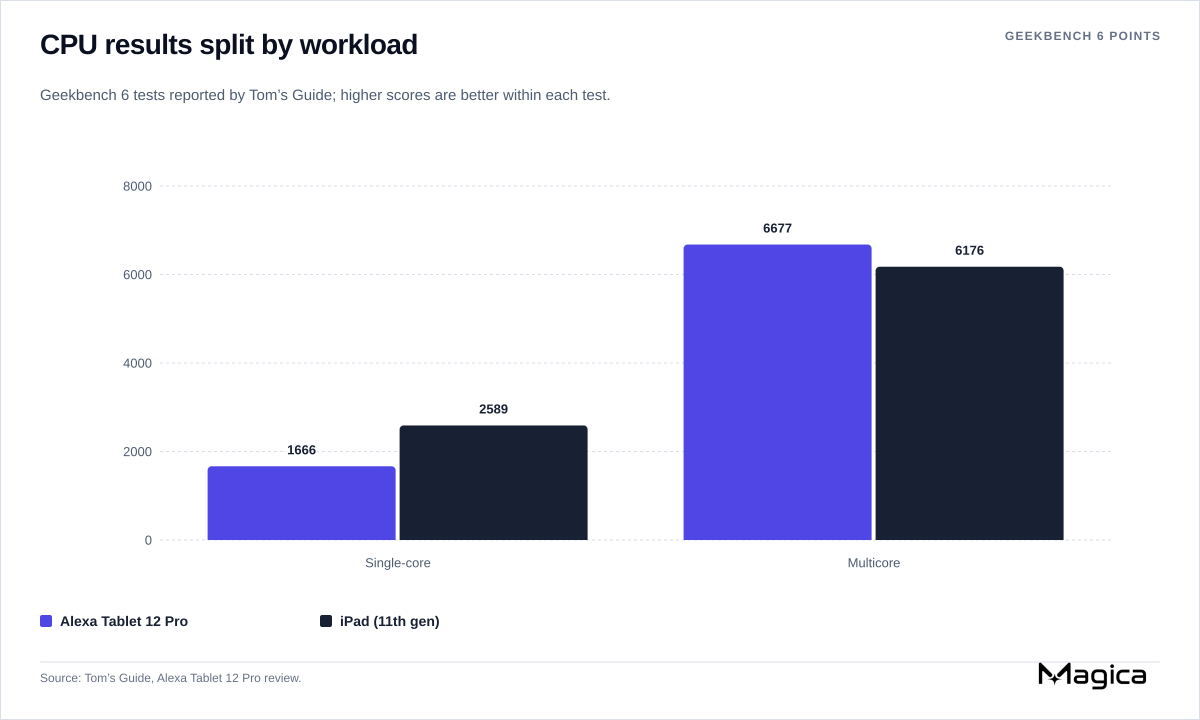
Tom’s Guide’s Geekbench 6 tests put the Alexa Tablet 12 Pro behind the iPad in single-core scoring and ahead in multicore scoring. Chart: Magica. Source: Tom’s Guide.
The MediaTek Dimensity 8400 processor is capable of browsing, streaming and light work, rather than a guarantee of laptop-class performance. In one Geekbench 6 comparison, the 12 Pro scored 1666 in single-core and 6677 in multicore testing, against 2589 and 6176 for the 11th-generation iPad. Amazon was ahead on multicore performance and substantially behind on single-core performance; a single claim that they perform alike would obscure that split.
Against Amazon’s own previous hardware, the gain is much larger. The German benchmark suite recorded 3164 points for the 12 Pro against 310 for the Fire Max 11 in 3DMark Wild Life Extreme Unlimited—roughly ten times the score. That is a synthetic graphics result, not a tenfold increase in overall speed. The same suite put the new tablet ahead of Huawei’s compared models in that graphics test, but behind Samsung’s Galaxy Tab S11 and Apple’s recent Air and Pro tablets.
Everyday work was not uniformly disappointing. The 8GB/128GB test ran six overlapping apps without major difficulty, though app switching could lag and some apps stopped responding. The 16GB/256GB German test found Android generally fluid and multitasking trouble-free, alongside intermittent touchscreen freezes. Another reviewer took the 8GB/128GB model on vacation instead of a laptop and was satisfied with writing, browsing and general productivity, despite specific accessory faults.
App design remains another constraint: some applications still stretch phone interfaces across the large screen, although the first test found Google’s apps, Lightroom and Todoist well adapted. Other tests encountered delayed scrolling or crashes. Hardware limits matter for work and travel, too: there is no cellular option or microSD expansion, and the USB-C video output mirrors the tablet rather than extending its desktop onto a second screen.
Battery findings likewise resist a single verdict:
| Review test | Method | 12 Pro result |
|---|---|---|
| Web browsing | Continuous surfing over Wi-Fi at 150 nits | 13 hours 17 minutes |
| Video and work tests | YouTube over Wi-Fi / PCMark 3.0, both at 200 cd/m² | 15 hours 28 minutes / 10 hours 36 minutes |
| Mixed use | viSer simulated mixed usage | 10 hours 58 minutes |
These are different workloads and brightness settings, not interchangeable measurements. In the web test, Amazon outlasted the iPad’s 11 hours 25 minutes. But in the same German test suite, the older Fire Max 11 lasted 18 hours 8 minutes on YouTube and 14 hours 16 minutes in PCMark, exceeding the new model in both. The hardware upgrade does not deliver an across-the-board endurance improvement.
The mixed-use review found the cheaper matte Huawei MatePad 11.5 S lasted almost twice as long and reproduced colors more accurately, although Amazon’s screen was brighter and offered native Google services. Samsung’s Galaxy Tab S10 FE+ also lasted longer, had better-calibrated colors and included a pen, although its screen suffered from reflections. Charging is limited to 27W; the mixed-use review needed 2 hours 28 minutes for a full recharge, and a power adapter is not included.

Engadget’s October 15, 2026 prices for the same 8GB/128GB Nanomatte configuration and accessory bundles. These are historical reported prices. Chart: Magica. Source: Engadget.
Accessories make the productivity proposition more expensive and less settled, but bundle discounts matter. The October 15 review priced the 8GB/128GB Nanomatte model at $550 alone, $650 with a keyboard or $700 with both keyboard and pen. Its reviewer wrote the entire assessment on the keyboard, finding it useful on a desk but awkward on a lap; the Alexa key also disrupted familiar shortcuts. Other reviewers liked that key.
Pen experiences ranged from precise, comfortable input to intermittent failures and poor palm rejection. That review also found 1Password autofill missing with the physical keyboard attached. It listed the keyboard and pen separately at $149.99 and $89.99, while pricing its glossy-model productivity bundle at $599.99 and a keyboard-only bundle at $529.99.
Prices need configuration and date checks, too. The November 18 glossy-model review listed a $399.99 starting price, below Amazon’s launch price. The November 12 German review listed the base Nanomatte model at €499 against a €559.99 list price. These dated prices do not establish the current cost of every screen, memory and accessory combination.
Amazon had told the reviewer who encountered touchscreen freezes that an update was planned. The review, citing Amazon’s support page, also reports company promises of seven years of Android upgrades and six years of security updates, alongside a minimum four-year security commitment measured from purchase through Amazon. Those promises make support relevant to the purchase, but do not establish that the observed bugs have been fixed.
For readers and viewers, the matte display and Google Play access already provide reasons to consider the tablet. Buyers paying extra to work on it need to compare the complete bundle price and check their own apps and accessories. Follow-up tests of Amazon’s update would resolve the sharper remaining question: whether the freezes, pen failures and keyboard workflow problems persist. The current reviews establish useful light-work capability, with uneven reliability rather than a settled laptop replacement.
Dell’s Alienware AW2725DF is reported at $379 on Amazon for Black Friday. The discount brings a once-$899.99 gaming monitor below $400, but its full 360Hz requires DisplayPort and cheaper OLED alternatives temper the bargain.
The FCC has overridden California approval requirements that stood in the way of AT&T ending legacy phone service in parts of the state. AT&T retains a duty to offer basic service, but California must accept the replacement the federal regulator approved.

Sony’s WH-1000XM6 headphones were reported at $348 on Amazon, about 24% below the deal listings’ reference price but about 23% below Sony’s original US launch price. Earlier cheaper offers and a stated November 20 deadline qualify the buying case.
Amazon's Black Friday prices start at $1,049 for the 13-inch M5 MacBook Air and $1,249 for the 15-inch. That is $250 below current list prices, but only $50 below their March launch prices. The 13-inch Starlight model costs 99 cents more.
State prisons and local jails can seek FCC permission to jam contraband cellphones, but deployments must pass interference tests amid industry-reported pilot failures and questions over who pays.
A reported agreement in principle would pay thousands of US school districts around $3 billion over addiction claims and add teen protections. District participation, individual payouts and the substance of the product changes remain unresolved.
Teenage Engineering’s first CD player combines an exposed disc, variable-speed playback and wireless streaming. Its case for a premium rests on hands-on controls and integration with the company’s other audio gear, in a market with cheaper connected players.
Apple is reportedly reviewing an OLED iMac with Samsung Display over panel costs while seeking LCD panels for a launch around 2029. Talks are said to focus on delay, leaving both cancellation and the eventual display choice unresolved.
Purported iPhone Air 2 mockups show two rear cameras, lending support to a longstanding upgrade rumor. An Ultra Wide lens could narrow a gap with the cheaper iPhone 17, but the replicas cannot confirm specifications.
Motorola says nine existing phones are receiving Android 17 and 20 more are due in coming months. The Brazilian list restores previously omitted models, but does not establish worldwide availability.

Amazon’s entry Alexa Tablet 8 is advertised at $149.99 for Black Friday. Google Play expands app choice beyond older Fire tablets, but removing lock-screen ads costs $20, and the base hardware suits modest tasks.
Uber Kids is piloting parent-booked rides in Austin, Nashville and Madison, extending Uber’s teen service to younger children. Drivers get $7 more per completed trip than on UberX and take on pickup, recording and drop-off duties; passenger pricing and pilot safety results remain unresolved.
Microsoft is expanding automatic Windows 11 26H2 delivery to eligible unmanaged PCs running 24H2 and 25H2. The small upgrade resets edition-specific support periods, while performance claims require care about workloads, app updates and comparison builds.
WhatsApp is reportedly lifting its group limit from 1,024 to 1,500 people in a gradual rollout on Android and iPhone, giving community administrators more room without splitting conversations. Official confirmation and a universal availability date remain outstanding.
Google will begin expanding Android developer verification worldwide in January, with other app stores covered by March. Sideloading survives, but ordinary installation on certified devices will depend on a Google-managed identity and app registry.
SK hynix plans to take full ownership of a vehicle holding about 14.1% of Kioxia. Conversion would let it exercise shareholder votes through the vehicle, while the company says existing limits on management participation remain.
Elon Musk pledged further Tesla production growth in China without a target or timetable, then visited its Shanghai factory. The plant’s shipments are rising as exports more than offset declining domestic retail sales.
Samsung appointed memory development chief Hwang Sang-joon and mobile COO Choi Won-joon to run its memory and smartphone businesses. Its co-CEOs retain their division posts as record chip earnings contrast with losses in consumer electronics.
Microsoft has acknowledged application failures on enterprise PCs receiving November’s Windows 11 hotpatch. Its temporary registry workaround requires a restart, interrupting a security-update method designed to reduce reboots.