Editorial Team
6 min read
Microsoft is expanding automatic Windows 11 26H2 delivery to eligible unmanaged PCs running 24H2 and 25H2. The small upgrade resets edition-specific support periods, while performance claims require care about workloads, app updates and comparison builds.
Microsoft, which develops and distributes the Windows PC operating system, began expanding automatic delivery of the Windows 11 2026 Update on November 18. Eligible PCs can receive version 26H2 without users checking for updates or initiating the download, shifting more of the decision about when to upgrade to Windows Update.
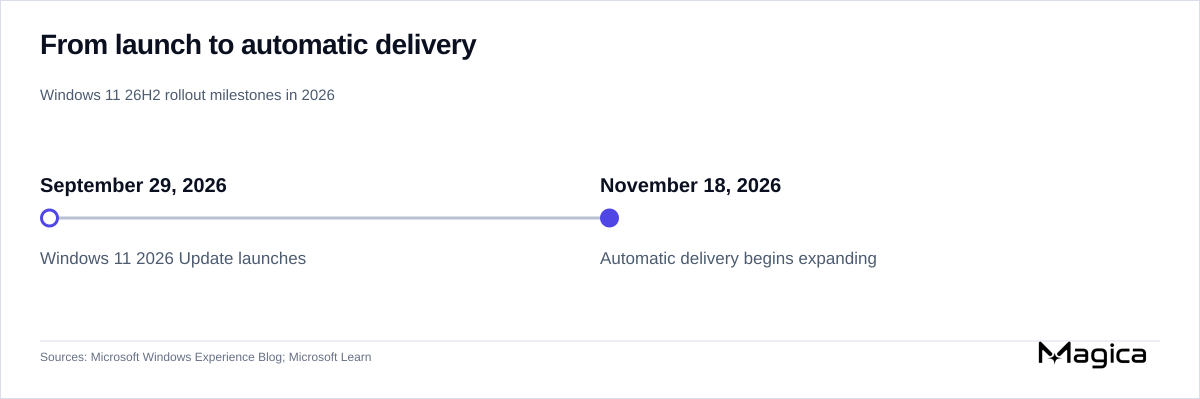
Microsoft launched 26H2 on September 29 and began expanding automatic delivery to eligible unmanaged PCs on November 18. Source: Microsoft Windows Experience Blog — rollout.
Microsoft’s release-health notice says the expansion starts with Windows 11 versions 24H2 and 25H2 on devices that are not managed by IT departments. It includes personal computers and unmanaged business PCs, with delivery dependent on Windows Update settings. Using a computer for work does not by itself exclude it; this announcement does not direct automatic upgrades across IT-managed fleets.
This is a new distribution phase for an existing release. Microsoft launched 26H2 on September 29, and says all eligible devices have been able to obtain it by manually checking since late October. Automatic delivery is expanding gradually, so availability does not mean every eligible PC will install it immediately.
Compatibility can still interrupt delivery. Microsoft said in its launch announcement that it could apply safeguard holds where it detects known compatibility problems. Commercial and education customers can continue using their management tools, update policies and deployment practices; Microsoft recommends testing applications, devices and critical workflows in targeted deployments before expanding them.
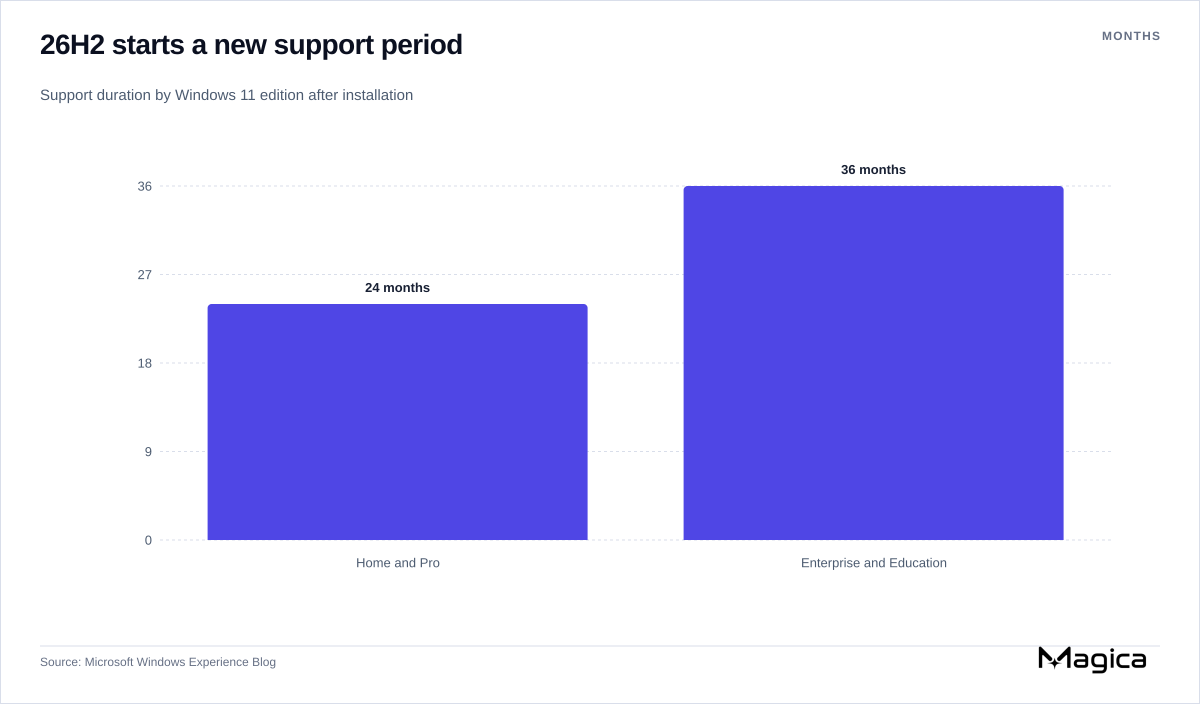
Microsoft says installing 26H2 resets support to 24 months for Home and Pro and 36 months for Enterprise and Education. Source: Microsoft Windows Experience Blog — rollout.
Version 26H2 is the annual Windows 11 feature release for 2026. For eligible PCs running 24H2 or 25H2, Microsoft delivers it as an enablement package: a small update that activates features already placed on the computer through monthly servicing. All three releases share an underlying codebase and servicing branch. Microsoft says the transition requires a small download and a single restart, reducing installation work compared with a traditional operating-system upgrade.
Sharing that foundation does not make the version change inconsequential. Microsoft says installing 26H2 resets support to 24 months for Home and Pro editions and 36 months for Enterprise and Education. The company also says selected features disabled by default in 25H2 become enabled by default in 26H2, without enumerating them in the launch announcement.
The shared codebase nevertheless limits the performance case for the version number alone. Improvements already delivered through monthly updates are not necessarily exclusive to 26H2.
A published laptop test reported that Task Manager showed around 5GB of RAM in use after restarting an 8GB laptop on 25H2, versus around 3.3GB after updating to 26H2 and restarting. That is an observation from one machine. It does not establish a typical saving or isolate the version change from other changes delivered with the update.
Microsoft’s performance explanation cautions that high memory use does not necessarily indicate pressure: Windows retains useful data in spare RAM and reclaims capacity when needed. The company says compression tuning lets it retain up to 2GB more active data in memory instead of moving it to slower storage. That measures a different benefit from a lower idle RAM reading.
The company offers two more direct measures of responsiveness, with different methods:
Those comparisons measure cumulative improvements against older builds, not a controlled test of the enablement package alone. Microsoft also reports up to 900MB less growth in committed memory during September multitasking tests on 8GB Windows PCs, comparing builds 26300.9550 and 26200.7628 with corresponding Microsoft 365 app versions. That is growth from the test’s starting state to its ending state, not a guaranteed reduction in memory used immediately after startup.
Some gains depend on applications as well as Windows. Microsoft tells users seeking the latest improvements to install 26H2 build 26300.9818 or later and keep Edge, Microsoft 365 and Teams updated, because some changes arrive through app updates or the Microsoft Store. It also says demanding work such as advanced video editing, 3D modeling and large-scale data processing benefits from 16GB or more; the optimizations do not erase workload requirements.
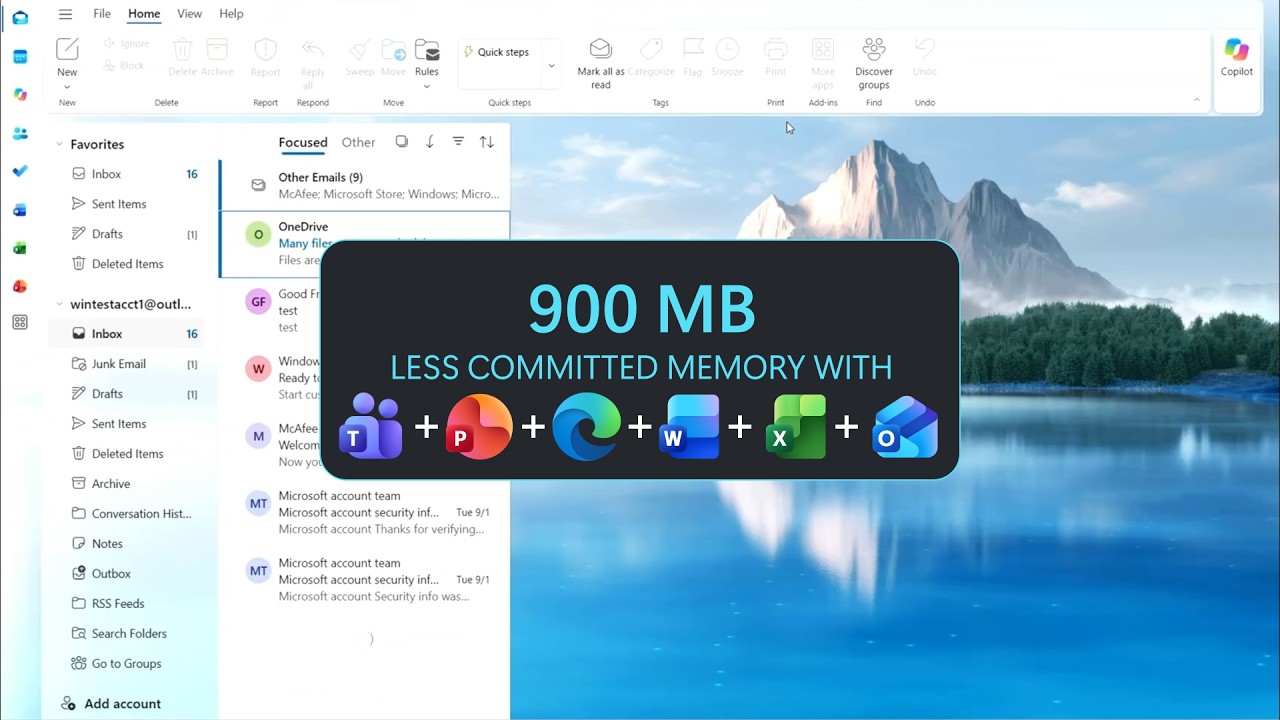
Microsoft’s company-reported tests found up to 900MB less committed-memory growth during multitasking on 8GB PCs. Results depend on Windows builds, app versions and configuration; this is not an idle-RAM measurement. Source: Microsoft Windows Experience Blog — performance.
A wider rollout does not establish that all problems are resolved. Microsoft’s release-health dashboard still lists a confirmed problem after October 13 updates in which SQL Server queries can leave connections to external databases open, degrading performance over time. The described fault concerns linked-server queries using OLE DB providers, including connections to Oracle and PostgreSQL databases. It spans several Windows client and server releases rather than demonstrating a defect unique to 26H2.
Microsoft says affected enterprises can obtain a mitigation through business support. The dashboard notice promises an out-of-band fix but does not confirm its release. It separately marks the USB Audio Class 1.0 fault as resolved by the November 10 update and the Remote Desktop connection failure for non-admin users with Administrator protection enabled as resolved by the October 28 update.
There are other update-specific risks: a separate report says Microsoft confirmed installation and launch problems affecting Office and third-party apps after November’s hotpatch on Windows 11 24H2 and later. That is a report about a particular update, not evidence that the 26H2 enablement package caused those failures.
For users considering a manual installation, the practical choice remains whether to seek the release now or let phased delivery reach their machine. A published assessment favors waiting for the rollout and checking compatibility rather than rushing because availability has expanded. Users who do seek it can open Settings → Windows Update, check for updates and select Download & install if 26H2 is offered.
Microsoft has not given a completion date or a device count in the automatic-delivery notice. The rollout’s progress and any compatibility holds will determine when individual PCs receive it. Independent tests across more configurations would need to separate Windows changes from app updates to show how much performance benefit comes from moving to 26H2 itself.
Google’s $899 standard flagship brings more storage, a larger main camera sensor and useful software tools. Reviews make a strong case for buying it instead of a Pro, but a weaker one for replacing last year’s Pixel 10.
Dell’s Alienware AW2725DF is reported at $379 on Amazon for Black Friday. The discount brings a once-$899.99 gaming monitor below $400, but its full 360Hz requires DisplayPort and cheaper OLED alternatives temper the bargain.
Amazon’s new flagship tablet earns praise for its optional matte display and Google Play access. The reviews make a stronger case for reading and entertainment than for Alexa-led computing or replacing a laptop.
The FCC has overridden California approval requirements that stood in the way of AT&T ending legacy phone service in parts of the state. AT&T retains a duty to offer basic service, but California must accept the replacement the federal regulator approved.

Sony’s WH-1000XM6 headphones were reported at $348 on Amazon, about 24% below the deal listings’ reference price but about 23% below Sony’s original US launch price. Earlier cheaper offers and a stated November 20 deadline qualify the buying case.
Amazon's Black Friday prices start at $1,049 for the 13-inch M5 MacBook Air and $1,249 for the 15-inch. That is $250 below current list prices, but only $50 below their March launch prices. The 13-inch Starlight model costs 99 cents more.
State prisons and local jails can seek FCC permission to jam contraband cellphones, but deployments must pass interference tests amid industry-reported pilot failures and questions over who pays.
A reported agreement in principle would pay thousands of US school districts around $3 billion over addiction claims and add teen protections. District participation, individual payouts and the substance of the product changes remain unresolved.
Teenage Engineering’s first CD player combines an exposed disc, variable-speed playback and wireless streaming. Its case for a premium rests on hands-on controls and integration with the company’s other audio gear, in a market with cheaper connected players.
Apple is reportedly reviewing an OLED iMac with Samsung Display over panel costs while seeking LCD panels for a launch around 2029. Talks are said to focus on delay, leaving both cancellation and the eventual display choice unresolved.
Purported iPhone Air 2 mockups show two rear cameras, lending support to a longstanding upgrade rumor. An Ultra Wide lens could narrow a gap with the cheaper iPhone 17, but the replicas cannot confirm specifications.
Motorola says nine existing phones are receiving Android 17 and 20 more are due in coming months. The Brazilian list restores previously omitted models, but does not establish worldwide availability.

Amazon’s entry Alexa Tablet 8 is advertised at $149.99 for Black Friday. Google Play expands app choice beyond older Fire tablets, but removing lock-screen ads costs $20, and the base hardware suits modest tasks.
Uber Kids is piloting parent-booked rides in Austin, Nashville and Madison, extending Uber’s teen service to younger children. Drivers get $7 more per completed trip than on UberX and take on pickup, recording and drop-off duties; passenger pricing and pilot safety results remain unresolved.
WhatsApp is reportedly lifting its group limit from 1,024 to 1,500 people in a gradual rollout on Android and iPhone, giving community administrators more room without splitting conversations. Official confirmation and a universal availability date remain outstanding.
Google will begin expanding Android developer verification worldwide in January, with other app stores covered by March. Sideloading survives, but ordinary installation on certified devices will depend on a Google-managed identity and app registry.
SK hynix plans to take full ownership of a vehicle holding about 14.1% of Kioxia. Conversion would let it exercise shareholder votes through the vehicle, while the company says existing limits on management participation remain.
Elon Musk pledged further Tesla production growth in China without a target or timetable, then visited its Shanghai factory. The plant’s shipments are rising as exports more than offset declining domestic retail sales.
Samsung appointed memory development chief Hwang Sang-joon and mobile COO Choi Won-joon to run its memory and smartphone businesses. Its co-CEOs retain their division posts as record chip earnings contrast with losses in consumer electronics.
Microsoft has acknowledged application failures on enterprise PCs receiving November’s Windows 11 hotpatch. Its temporary registry workaround requires a restart, interrupting a security-update method designed to reduce reboots.