Editorial Team
9 min read
The FCC has overridden California approval requirements that stood in the way of AT&T ending legacy phone service in parts of the state. AT&T retains a duty to offer basic service, but California must accept the replacement the federal regulator approved.
The Federal Communications Commission, the federal telecommunications regulator, has ordered California to stop enforcing requirements that block AT&T’s approved withdrawal of legacy telephone service in parts of the state. The November 20 decision shifts control over the transition toward the federal regulator while leaving a consequential question for customers: how the replacement will perform where they live, particularly during emergencies.
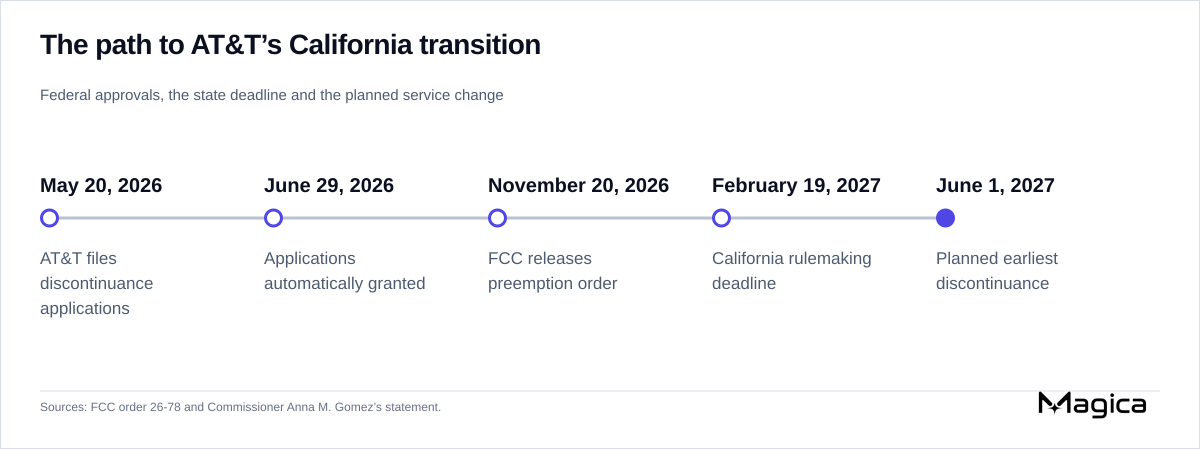
Federal approval preceded preemption. AT&T’s company-reported plan places discontinuance no earlier than June 1, 2027. Graphic: Magica; sources: FCC order and Gomez statement. Source: Declaratory Ruling, Order on Reconsideration, and Order on Review, FCC 26-78.
The order grants part of AT&T’s preemption petition and upholds federal authorization to discontinue residential and business legacy voice service in areas served by 360 California wire centers, the local facilities connecting telephone lines to the network. It was adopted November 13 and released November 20, when it took effect.
AT&T filed its discontinuance applications and preemption petition on May 20. The applications were automatically granted June 29 under a review framework established in 2016. The new order removes state barriers to acting on that earlier authorization; it also follows the FCC’s March 2026 invitation for carriers to seek preemption of conflicting state requirements. The discontinuance applications themselves were approved under older rules, before the relevant March changes took effect.
AT&T’s California affiliate, Pacific Bell Telephone Company, is the incumbent local telephone provider in those areas and a designated carrier of last resort. That status requires it to offer basic telephone service throughout its designated territory, including places that are costly or difficult to serve. The California Public Utilities Commission, the state regulator responsible for those obligations, has required its approval before a carrier withdraws basic service or substitutes certain new services.
The FCC now bars California from using those approvals, tariff procedures and customer-migration requirements to stop the discontinuances it authorized. It also overrides requirements for functions absent from AT&T’s approved replacement, including directory and operator services. But the order does not eliminate the carrier-of-last-resort obligation wholesale: it says AT&T must still offer basic service, California can enforce other compatible requirements and impose penalties, and AT&T would need further FCC authorization to discontinue the replacement service.
The dispute has a longer history than this network-retirement plan. AT&T sought state relief from its carrier-of-last-resort obligations in 2023. In explaining its rejection on June 20, 2024, the CPUC said the company had failed to demonstrate that replacement providers were willing and able to assume the same obligation. The distinction matters: another company selling phone service does not necessarily undertake a legal duty to serve everyone requesting it.
The FCC’s latest decision instead allows AT&T to meet its continuing obligation through AT&T Phone–Advanced, the replacement federal officials have accepted. The commission declined to eliminate all state tariffing requirements for that replacement.
The residential replacement, AT&T Phone–Advanced, connects traditional telephone handsets through an internet-protocol device whose default connection is AT&T’s LTE wireless network. It can also use a separate broadband connection, including as a backup, but customers do not have to buy broadband to use it. The device includes 24-hour backup power; AT&T can supply a professionally installed external antenna when needed, at no additional cost, according to the order.
The business counterpart is AT&T Phone for Business–Advanced. The FCC says the service supports 911 with programmed address and GPS location information, medical monitoring devices, alarm systems and accessibility functions. It rejected objections that California’s terrain and disaster risks made approvals elsewhere insufficient, relying on coverage information in its National Broadband Map, AT&T’s sworn certification and earlier performance testing. The commission cited prior approvals across 18 states and a 30-day performance study associated with an Oklahoma application, measuring latency, packet loss, trouble reports, repair intervals and availability.
The CPUC disputed whether that evidence established adequate service for all affected California customers. The FCC concluded opponents had not supplied substantial evidence that the replacement would perform differently or that earlier certifications were unreliable. That is the evidentiary judgment behind the approval; it does not provide a record of how every affected California household has experienced the replacement.
The old network has reliability problems, too. The order cites a 2025 CPUC decision documenting increases in the number and duration of traditional phone-service outages since 2018. The FCC argues that copper is vulnerable to weather, theft and slow repairs involving obsolete equipment. Unlike copper, fiber does not carry power to the handset and also requires customer backup power during an outage.
California already allows copper retirement when comparable service is offered over fiber. It also says wireless can satisfy its basic-service rules if the required standards are met. The fight therefore concerns the adequacy of the replacement and authority to approve it, rather than a categorical state ban on newer technology.
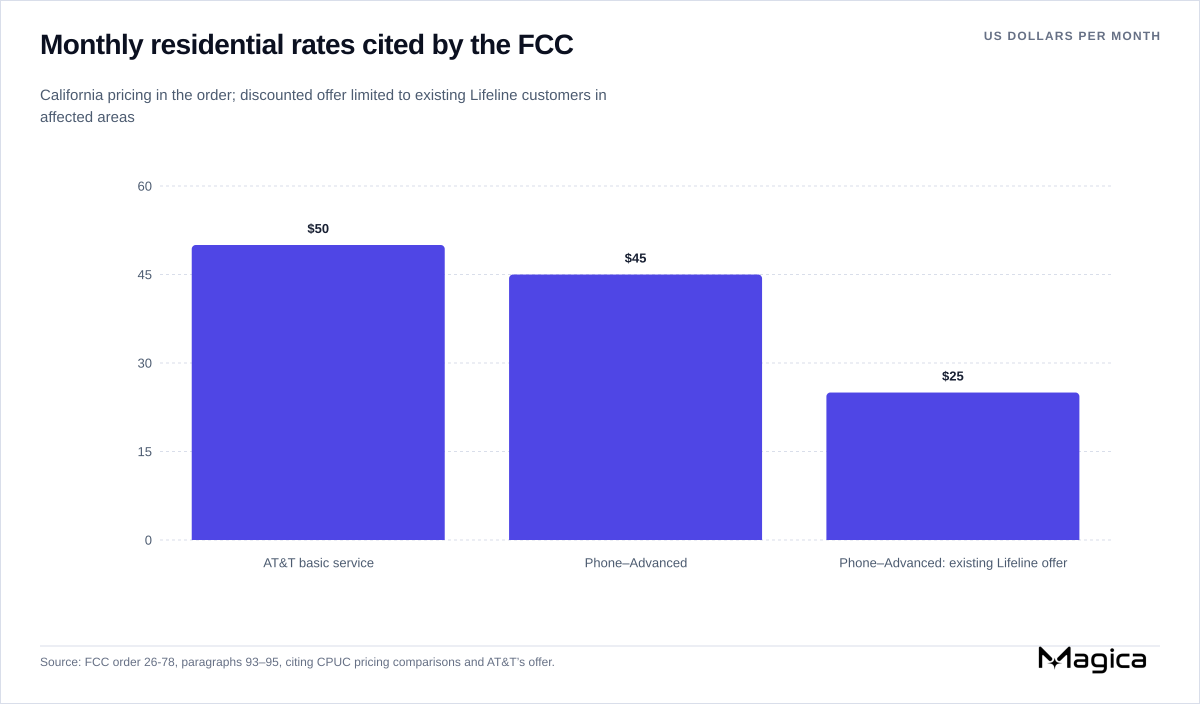
Monthly rates cited by the FCC. The company-reported $25 offer applies to existing Lifeline customers in affected areas; installation and temporary free months are excluded. Graphic: Magica. Source: Declaratory Ruling, Order on Reconsideration, and Order on Review, FCC 26-78.
Price is another contested issue. The FCC cited monthly residential rates of $45 for Phone–Advanced against $50 for AT&T basic service, and an AT&T offer of $25 a month for existing Lifeline customers in the affected areas. Lifeline provides discounted telephone service for eligible low-income customers. The order also cites a promotional $0 installation charge for Phone–Advanced against a $49 one-time installation charge for the old service, and AT&T’s offer of three free months for affected California customers. It rejected the argument that a separate internet subscription was necessarily an additional expense, citing the included LTE connection and AT&T’s reception measures.
AT&T also says customers have competing options. In the record summarized by the order, it said more than 99% of affected customers were covered by Verizon or T-Mobile wireless networks. It identified cable, fiber, fixed wireless and voice services using satellite broadband as alternatives. Those availability claims support its case for retirement; they do not establish that each competitor assumes AT&T’s legal obligation to serve everyone requesting service.
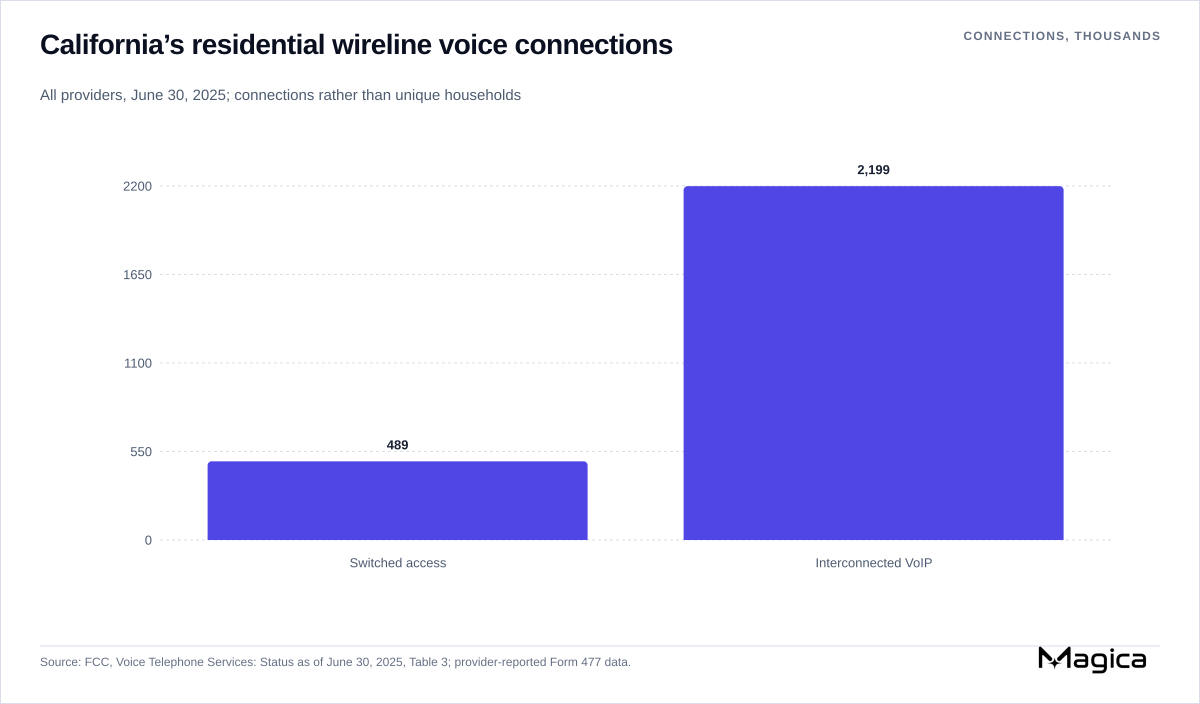
FCC provider-reported counts measure connections, not unique households. Categories do not directly distinguish copper from fiber or establish replacement coverage at affected homes. Graphic: Magica. Source: FCC Voice Telephone Services, June 2025 data.
AT&T told the FCC in the record summarized by the order that only 3% of households in its California service territory subscribed to its copper-based traditional phone service when it filed its petition. It said operating and maintaining its legacy network cost $1 billion in 2025. The company also told regulators that shutting down the copper network in California could recover approximately $800 million in copper value. These are company figures explaining its financial stake in retirement, rather than independently established savings from this particular authorization.
The broader shift is visible in the FCC’s provider-reported subscription data. Across all providers in California, there were about 489,000 residential switched-access connections and 2.199 million residential interconnected internet-based voice connections on June 30, 2025. Dividing the latter by the reported total of 2.689 million residential wireline connections gives about 82%. These count service connections, not unique households, and the technology categories do not map directly onto copper versus fiber. Those statewide figures describe adoption, not a test of replacement coverage at the AT&T homes involved here.
Retiring the old service also does not guarantee fiber to each affected customer. AT&T announced a $19 billion California fiber-expansion commitment through 2030 that it said would reach an additional 4 million homes, according to the report on the decision. The approved replacement can operate over wireless.
The FCC argues that maintaining parallel legacy infrastructure diverts resources from modern networks. It also points to the loss of caller-authentication information when calls traverse older network segments. Consumer advocates and state officials focus on people who retain landlines as emergency backups, especially in rural areas and places exposed to wildfires or power shutoffs.
The FCC grounds its preemption in Section 214 of the Communications Act, arguing that federal authorization to discontinue a service cannot be frustrated by additional state approvals when interstate and intrastate service cannot be separated. California disputes the commission’s authority to override its rules. AT&T had already sought relief in federal court, where a judge rejected its request in July, according to the account of the earlier litigation.
The CPUC said it would evaluate the new order and review its legal options. It called the decision particularly concerning for rural communities and areas at high fire risk, while affirming support for network modernization, according to the report carrying its response.
FCC Commissioner Anna M. Gomez, the agency’s lone Democrat, dissented despite having supported its unanimous March network-modernization order. Gomez opposed overriding California before its own rulemaking was finished. Her dissent notes that the state proceeding’s deadline is February 19, 2027, ahead of AT&T’s planned June start. The majority declined to wait, saying the deadline could be extended again and the substance of California’s eventual changes remained uncertain.
AT&T said in its response that no customer would be left without access to voice or 911 service. The FCC’s order also records a company commitment to ensure continued reliable service for affected customers whose Phone–Advanced service does not work as expected. Gomez points consumers toward FCC docket WC 26-214 to report concerns about technology transitions.
Before disconnections begin, the unresolved practical question is how AT&T will fulfill that commitment where the replacement fails, including during prolonged power or network outages. California retains some enforcement powers, but the FCC has taken responsibility for accepting the replacement. Customer experience and the handling of service failures will test the evidence on which that decision rests.
Google’s $899 standard flagship brings more storage, a larger main camera sensor and useful software tools. Reviews make a strong case for buying it instead of a Pro, but a weaker one for replacing last year’s Pixel 10.
Dell’s Alienware AW2725DF is reported at $379 on Amazon for Black Friday. The discount brings a once-$899.99 gaming monitor below $400, but its full 360Hz requires DisplayPort and cheaper OLED alternatives temper the bargain.
Amazon’s new flagship tablet earns praise for its optional matte display and Google Play access. The reviews make a stronger case for reading and entertainment than for Alexa-led computing or replacing a laptop.

Sony’s WH-1000XM6 headphones were reported at $348 on Amazon, about 24% below the deal listings’ reference price but about 23% below Sony’s original US launch price. Earlier cheaper offers and a stated November 20 deadline qualify the buying case.
Amazon's Black Friday prices start at $1,049 for the 13-inch M5 MacBook Air and $1,249 for the 15-inch. That is $250 below current list prices, but only $50 below their March launch prices. The 13-inch Starlight model costs 99 cents more.
State prisons and local jails can seek FCC permission to jam contraband cellphones, but deployments must pass interference tests amid industry-reported pilot failures and questions over who pays.
A reported agreement in principle would pay thousands of US school districts around $3 billion over addiction claims and add teen protections. District participation, individual payouts and the substance of the product changes remain unresolved.
Teenage Engineering’s first CD player combines an exposed disc, variable-speed playback and wireless streaming. Its case for a premium rests on hands-on controls and integration with the company’s other audio gear, in a market with cheaper connected players.
Apple is reportedly reviewing an OLED iMac with Samsung Display over panel costs while seeking LCD panels for a launch around 2029. Talks are said to focus on delay, leaving both cancellation and the eventual display choice unresolved.
Purported iPhone Air 2 mockups show two rear cameras, lending support to a longstanding upgrade rumor. An Ultra Wide lens could narrow a gap with the cheaper iPhone 17, but the replicas cannot confirm specifications.
Motorola says nine existing phones are receiving Android 17 and 20 more are due in coming months. The Brazilian list restores previously omitted models, but does not establish worldwide availability.

Amazon’s entry Alexa Tablet 8 is advertised at $149.99 for Black Friday. Google Play expands app choice beyond older Fire tablets, but removing lock-screen ads costs $20, and the base hardware suits modest tasks.
Uber Kids is piloting parent-booked rides in Austin, Nashville and Madison, extending Uber’s teen service to younger children. Drivers get $7 more per completed trip than on UberX and take on pickup, recording and drop-off duties; passenger pricing and pilot safety results remain unresolved.
Microsoft is expanding automatic Windows 11 26H2 delivery to eligible unmanaged PCs running 24H2 and 25H2. The small upgrade resets edition-specific support periods, while performance claims require care about workloads, app updates and comparison builds.
WhatsApp is reportedly lifting its group limit from 1,024 to 1,500 people in a gradual rollout on Android and iPhone, giving community administrators more room without splitting conversations. Official confirmation and a universal availability date remain outstanding.
Google will begin expanding Android developer verification worldwide in January, with other app stores covered by March. Sideloading survives, but ordinary installation on certified devices will depend on a Google-managed identity and app registry.
SK hynix plans to take full ownership of a vehicle holding about 14.1% of Kioxia. Conversion would let it exercise shareholder votes through the vehicle, while the company says existing limits on management participation remain.
Elon Musk pledged further Tesla production growth in China without a target or timetable, then visited its Shanghai factory. The plant’s shipments are rising as exports more than offset declining domestic retail sales.
Samsung appointed memory development chief Hwang Sang-joon and mobile COO Choi Won-joon to run its memory and smartphone businesses. Its co-CEOs retain their division posts as record chip earnings contrast with losses in consumer electronics.
Microsoft has acknowledged application failures on enterprise PCs receiving November’s Windows 11 hotpatch. Its temporary registry workaround requires a restart, interrupting a security-update method designed to reduce reboots.