Editorial Team
4 min read
Google has fixed an actively exploited XML vulnerability in its Chrome desktop browser. The update brings this year’s exploited zero-day tally to eight, while details of the attacks remain undisclosed.
Google released security updates on November 9 for Chrome, its web browser, to fix the eighth zero-day vulnerability known to have been exploited in attacks this year. The immediate task for desktop users is to get the corrected version running: a released patch does not protect a browser still running vulnerable code.
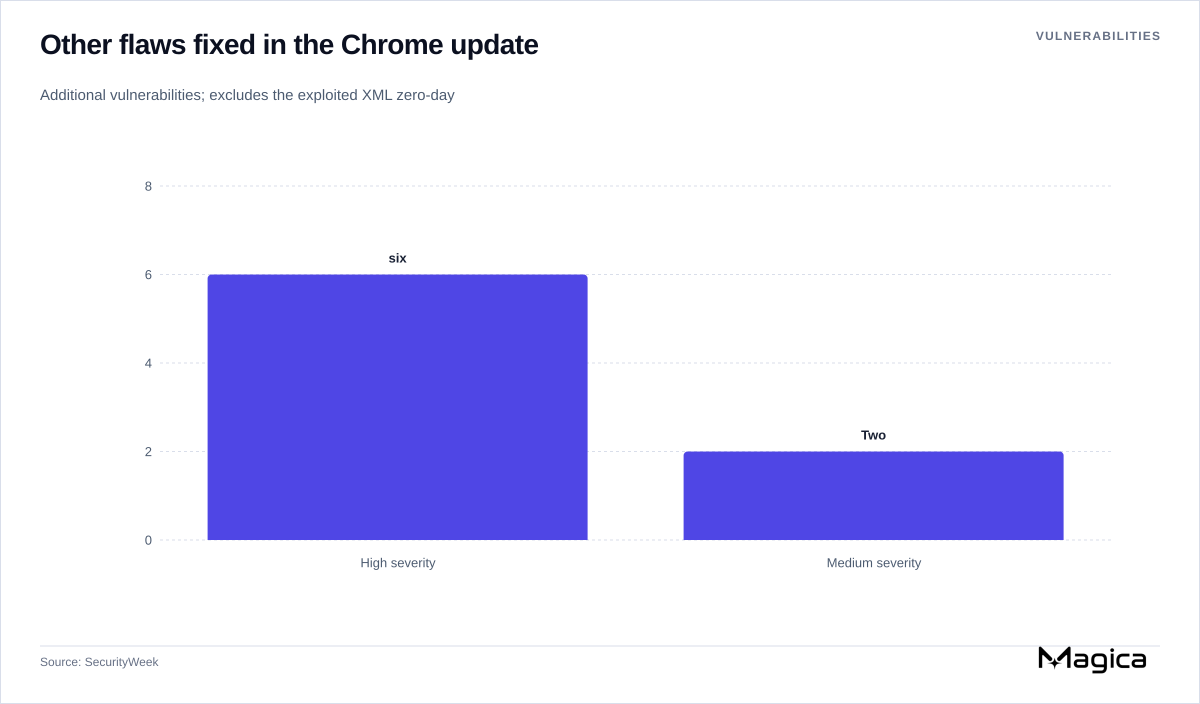
Beyond the exploited XML zero-day, the update fixes six high-severity flaws and two medium-severity GPU issues. Source: SecurityWeek.
The vulnerability is a use-after-free defect in Chrome’s XML component. Such a flaw leaves a reference to memory after an object has been deleted; subsequent use of that memory can let an attacker manipulate it and execute malicious code, according to the technical account of the update.
Google acknowledged in its Monday advisory that an exploit exists in the wild, the technical account reports. A researcher who requested anonymity reported the flaw on November 6, according to the report on the release. The accounts do not identify the attackers, their targets, the delivery method or when exploitation began. The warning establishes that attacks have occurred, without establishing how widespread they are.
Google says access to bug details may remain restricted until a majority of users have updated. It may also retain restrictions when a vulnerable third-party library is used by other projects that have yet to fix it. That is its stated disclosure policy; the available reporting does not establish that this particular flaw affects other browsers.
The November 10 security bulletin rates the overall risk as extremely high because CVE-2026-125350 is being exploited. That bulletin-level assessment differs from the individual flaw’s high-severity rating. It lists remote code execution, denial of service and security restriction bypass as potential consequences across the vulnerabilities covered by the update; those are not disclosed outcomes of these attacks.
N-able says its latest N-central hotfix patches all identified vulnerabilities exploitable without authentication and hosted servers are back online. Further patches, customer-side upgrades and checks for compromise remain necessary after public exploit code prompted a precautionary shutdown.
The earlier seven exploited Chrome vulnerabilities patched in 2026 spanned font handling, graphics, WebGPU and the V8 JavaScript engine. The latest XML defect extends that record into another browser component. The tally counts vulnerabilities, however, and gives no measure of the number of attacks or affected users.
The year-by-year account also puts Google’s 2025 total at eight patched zero-days exploited in attacks. Reaching that number again by November is a useful baseline, but cannot establish a change in attack frequency or individual users’ risk.
This Stable release also fixes six other high-severity vulnerabilities across WebGL, FileSystem, Compositing, GPU, V8 and XML, plus two medium-severity uninitialized-resource issues in GPU. Google discovered most of those other flaws internally, the release report says. The available reporting identifies active exploitation specifically for CVE-2026-125350.
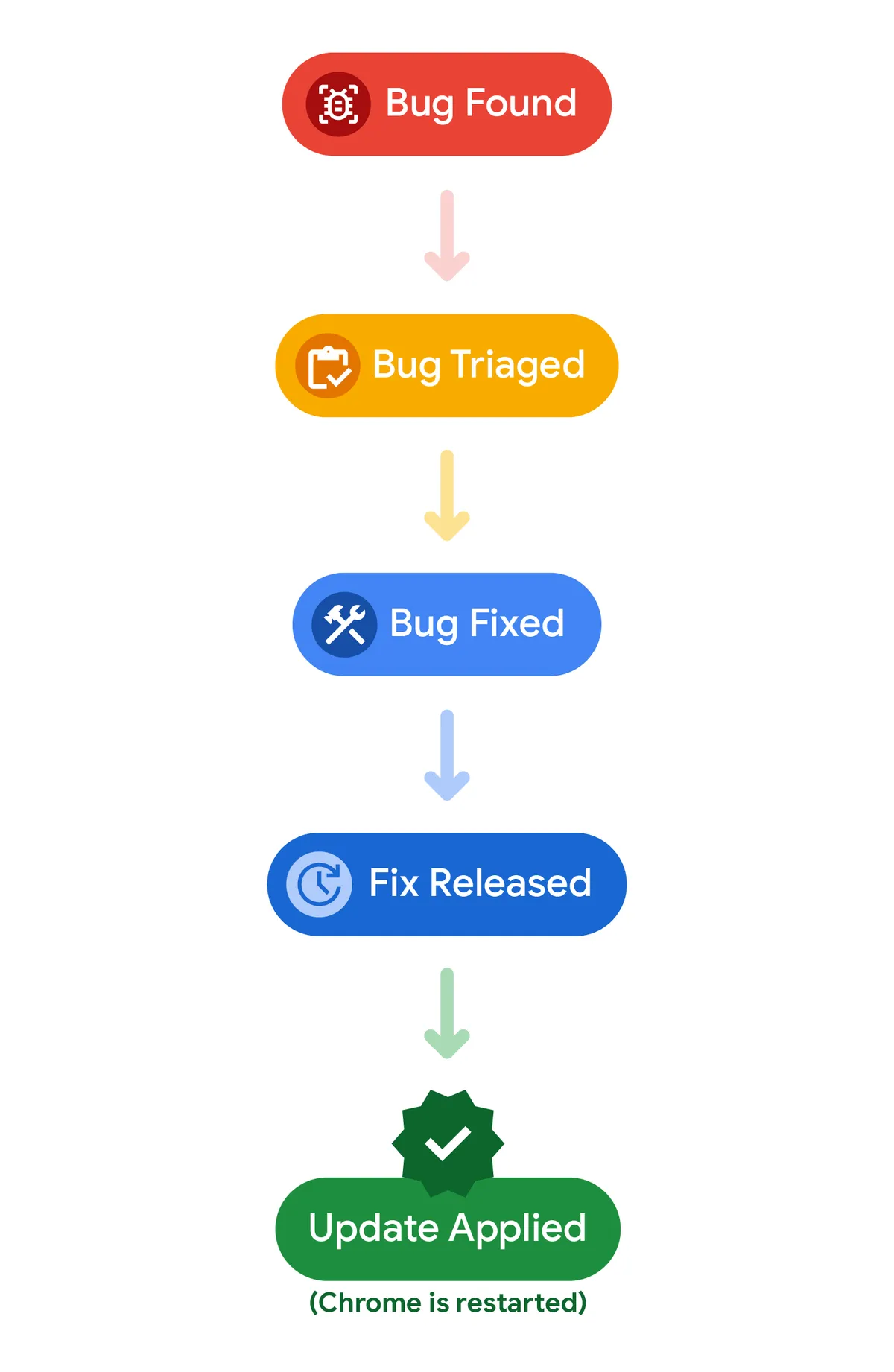
Google’s Chrome Security Team illustrates the vulnerability lifecycle, ending with a browser restart to apply the update. Source: Google Chrome Security Team.
The corrected Stable desktop versions are:
| Operating system | Patched Stable version |
|---|---|
| Windows | 157.0.8103.50/.51 |
| Mac | 157.0.8103.50/.51 |
| Linux | 157.0.8103.50 |
There is also a separate fix for Extended Stable, the channel Google recommends for sensitive environments that need software changes vetted. Google’s November 9 release listing gives version 156.0.8078.96 for Windows and Mac and includes CVE-2026-125350 among its fixes. Administrators should check the browser’s channel as well as its version, rather than treating the Stable version number as the only evidence of remediation.
Google says distribution can take days or weeks, although the Stable update was already available during a reported check on November 10. Chrome can download updates in the background; restarting applies the staged update.
In a July 30 explanation of its security process, Google’s Chrome Security Team told users to click the update message in the top-right corner. It recommended that enterprise administrators use its relaunch-notification policy to prompt or require restarts. Google said delayed restarts contribute to exposure even after fixes have shipped.
The team also described how public fixes can let attackers reverse-engineer a vulnerability before the correction reaches users. It called this interval the patch gap and said it was piloting two security releases a week. These are distinct deployment steps: releasing corrected software and getting it running on users’ devices.
That earlier initiative does not reveal how these attacks began or how quickly this fix will reach every device. For users and administrators, the verifiable next step is to apply the appropriate channel’s update and confirm that the corrected browser is running. Assessing the attacks will require further disclosure about targeting, exploit delivery and the duration of exploitation.
Vates has patched an exploited Xen Orchestra login bypass, while its November 10 advisory leaves a separate VM import flaw unfixed. Administrators must also review delegated permissions and investigate possible host compromise.
CISA has listed exploited flaws in Openwave’s webmail document converter and Cisco’s BroadWorks communications platform, setting a November 24 federal remediation deadline. Openwave dates its fix to 2021; a separate research account links Cisco’s flaw to theft of telecom authentication keys.
Maersk confirms data theft from an acquired legacy system and disputes WhiteArmor’s password claims. The group demands $5 million while Maersk says it has found no impact on wider systems and expects no customer disruption.
Binance warns that malicious iPhone apps could use worse_query to read other apps’ files. A file manager built on the public code demonstrates cross-app access, but no cryptocurrency losses have been confirmed and the latest Apple updates have not been linked conclusively to a fix.
Microsoft fixed an actively exploited Outlook flaw that can disclose authentication information when a user opens a malicious file. The moderate-rated bug warrants priority within a November release exceeding 1,000 vulnerabilities, but the attackers and scale of abuse remain undisclosed.
Vanderbilt University allowed students and employees to resume using university devices Tuesday after ordering a shutdown Monday. Key services were available, but wider restrictions persisted and attackers’ claims of extensive data theft remained unconfirmed.
Barracuda says exploitation of recently disclosed vulnerabilities has affected a small number of organizations. Patches are available, and the two-flaw chain can give attackers root access to Email Security Gateway appliances with reachable administrative interfaces.
SAP’s November release addresses four flaws rated 10.0, including ICM2SHELL and PROXYGATE. Customers face unauthenticated routes into core business systems, and Gateway remediation can require configuration changes alongside patches.
Compromised Qubole credentials let an attacker assume customer AWS roles, harvest secrets and download data in October. Dormant integrations extended the exposure, while gaps in storage logs complicated efforts to establish what was stolen.
N-able took hosted N-central offline and urged customers running their own servers to do the same after public exploit disclosures. The shutdown interrupts a platform used to manage customer networks, while the scope of the flaws and a safe restoration date remain unresolved.
Trump nominated Palantir security chief Michael LoSapio to lead CISA, where workforce losses and a proposed funding reduction complicate the job as Senate control is set to change.
Iris Plaza says an intrusion into an external cloud service may have exposed data on 5.8 million current and former members and 1.9 million non-members. Its official shopping site remains suspended, while the actual extent of any leak is still under investigation.
France attributes October attacks on roughly 700 retail sites to an Iranian Revolutionary Guard cyber unit. Fires and spoiled food have turned exposed refrigeration controls into a diplomatic and criminal case, while responsibility for later attacks remains unresolved.
Apple says three macOS updates stop bundled command-line tools from accepting compromised eMudhra certificates, extending protections already delivered to Safari and Mail. Apps with their own certificate lists still require separate checks.
Elliptic estimates that responders froze or seized 44% of the $6.43 billion stolen from Binance. Cross-chain services and screening gaps kept other funds moving, but most remaining value was still parked and little had likely been cashed out.
Researchers observed public proxy traffic exiting six addresses registered to the Executive Office of the President. The findings expose a possible route for outsiders to borrow government network identities, but do not establish access to internal systems.
Alpine Linux has patched a password-authentication bypass reachable through OpenSSH on systems using musl without PAM authentication. Under specific account and server settings, attackers can enter key-only accounts; some cloud instances can then give them root access.
Sekoia uncovered mobile data-theft tools delivered through compromised websites, cloned portals and Plerdy's analytics tracker. The analyzed attacks used already-patched flaws, and the report does not establish how many phones were infected.
Ryan James Roach has been extradited to face charges over alleged intrusions targeting US universities with supercomputers. Prosecutors allege credential theft and the diversion of university processing power for cryptocurrency mining; a second defendant remains in Canadian extradition proceedings.