Editorial Team
5 min read
Maersk confirms data theft from an acquired legacy system and disputes WhiteArmor’s password claims. The group demands $5 million while Maersk says it has found no impact on wider systems and expects no customer disruption.
A.P. Moller–Maersk, the Danish shipping and logistics group, has confirmed data theft from a legacy system inherited through an acquisition after WhiteArmor, a recently emerged cyber-extortion group targeting transport businesses, threatened to release information unless it receives $5 million. Maersk says customers can continue booking and managing shipments as usual, but the scope of the stolen information remains disputed.
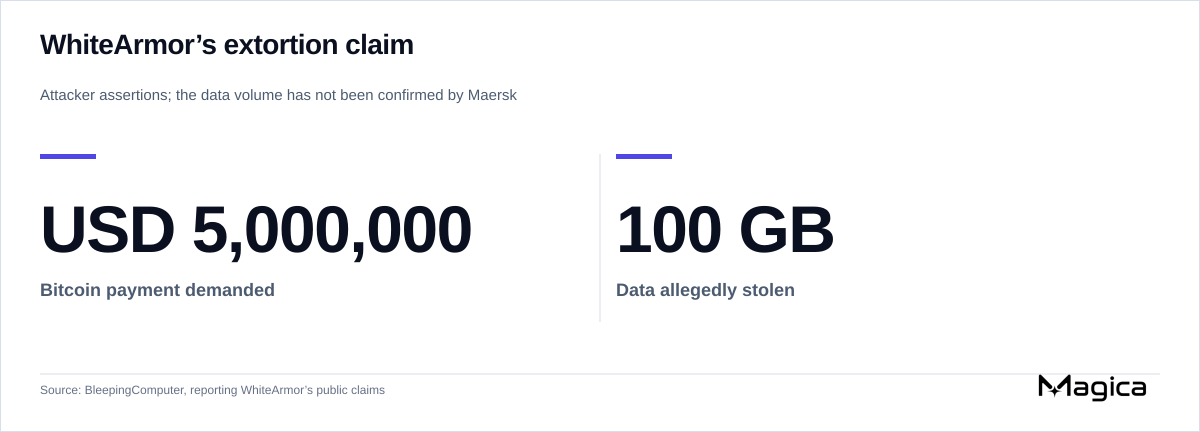
WhiteArmor demanded $5 million in bitcoin and claimed approximately 100 GB of stolen data. The volume remains unconfirmed. Graphic: Magica. Source: BleepingComputer.
WhiteArmor listed Maersk on its leak site over the weekend before the company’s November 11 disclosure. The group claimed to hold about 100GB from the OCF/LF Logistics platform, developed by LF Logistics, the Hong Kong-based contract logistics provider Maersk acquired in 2022. It gave Maersk 30 days to contact it and pay in bitcoin, according to the report detailing its demand.
The group’s claimed haul includes nearly 30,000 driver records, plaintext passwords, 33 accounts with the highest administrative privileges, signed delivery receipts and inventory and shipping documents. It also claims mobile-device logs containing phone numbers, email addresses and device identifiers. Those quantities and descriptions are the attackers’ assertions, rather than confirmed findings from Maersk’s investigation.
The credential claim has drawn a specific rebuttal. In a response reproduced in the report examining the breach, Maersk confirmed that its disclosure concerns the incident claimed by the group and said system passwords are stored in protected form. A spokesperson said the stolen codes were single-use and had expired. That response followed claims that more than 16,000 drivers’ passwords had been taken in plaintext.
N-able says its latest N-central hotfix patches all identified vulnerabilities exploitable without authentication and hosted servers are back online. Further patches, customer-side upgrades and checks for compromise remain necessary after public exploit code prompted a precautionary shutdown.
Researchers for that report linked the breach to LF Logistics and said the platform mainly holds data from other logistics companies. They described the ability to manipulate customer accounts and create or delete orders through administrative accounts. That describes a potential consequence of privileged access; it does not establish that attackers changed orders or retained working access.
WhiteArmor has a recent record of targeting transport businesses. In a November 11 report on the group, Ben Wilkens, director of cybersecurity at the National Motor Freight Traffic Association, said it emerged in October and had targeted transportation companies ranging from large national fleets to smaller regional operators. That account does not establish how the attackers entered Maersk’s system. The reporting on this incident also does not establish that Maersk’s systems were encrypted.

Archival LF Logistics photograph from Maersk’s August 2022 acquisition announcement. It does not depict the affected IT system. Credit: Maersk. Source: Maersk.
Maersk operates shipping, terminals, warehousing and land and air transport across roughly 130 countries. LF Logistics served retail, wholesale and e-commerce customers in Asia-Pacific.
Maersk’s August 31, 2022 acquisition announcement said the purchase would expand its ability to serve Asian consumer markets and fulfil orders across sales channels. Its Asian business had historically focused on ocean transport out of the region and related logistics services. Maersk said LF Logistics would be rebranded under its name.
The announcement valued the transaction at $3.6 billion in enterprise value after IFRS 16 lease liabilities. It said LF Logistics would add 223 warehouses, its total at the end of 2021, bringing Maersk’s global portfolio to 549 facilities. Those are acquisition-era figures, not a measure of the systems or customers affected by this breach.
The acquisition explains why a local logistics platform sits within a much larger shipping group. It does not establish how attackers entered, whether an integration failed, or whether the age of the system caused the compromise. Maersk has not publicly supplied that technical account.
The company also has a costly cyberattack precedent. It expected the destructive 2017 NotPetya attack to cost about $300 million. Jim Hagemann Snabe, Maersk’s chairman at the time, said in 2018 that recovery involved rebuilding 4,000 servers, 45,000 PCs and 2,500 applications over ten days, as recounted in the account of its recovery. That history explains the significance of operational containment, but the current disclosure offers no basis to equate the two incidents’ severity.
Maersk says it secured the affected local system and has found no indication of impact on its other systems or on customer and partner systems connected through application programming interfaces or electronic data interchange. It says customers can continue booking and managing shipments as usual.
Its assessment of disclosure remains provisional. In its statement reproduced in the incident report, Maersk said: “Our findings so far strongly suggest no sensitive data has been disclosed.” That assurance accompanies an ongoing investigation, rather than a complete public inventory of the extracted records.
The unresolved questions are which records were extracted, whose information they contain, when access occurred and whether the administrative-account claims are substantiated. Maersk’s account of expired codes addresses one disputed risk; it does not by itself resolve the claims about personal information and logistics documents.
Maersk says it will update customers as relevant information becomes available and notify affected parties if further findings require it. It also advises customers to verify unexpected messages about the incident through their usual Maersk contact. A clearer accounting of the extracted data will determine who needs to act despite the company’s assurance that shipments can continue.
Vates has patched an exploited Xen Orchestra login bypass, while its November 10 advisory leaves a separate VM import flaw unfixed. Administrators must also review delegated permissions and investigate possible host compromise.
CISA has listed exploited flaws in Openwave’s webmail document converter and Cisco’s BroadWorks communications platform, setting a November 24 federal remediation deadline. Openwave dates its fix to 2021; a separate research account links Cisco’s flaw to theft of telecom authentication keys.
Binance warns that malicious iPhone apps could use worse_query to read other apps’ files. A file manager built on the public code demonstrates cross-app access, but no cryptocurrency losses have been confirmed and the latest Apple updates have not been linked conclusively to a fix.
Microsoft fixed an actively exploited Outlook flaw that can disclose authentication information when a user opens a malicious file. The moderate-rated bug warrants priority within a November release exceeding 1,000 vulnerabilities, but the attackers and scale of abuse remain undisclosed.
Vanderbilt University allowed students and employees to resume using university devices Tuesday after ordering a shutdown Monday. Key services were available, but wider restrictions persisted and attackers’ claims of extensive data theft remained unconfirmed.
Barracuda says exploitation of recently disclosed vulnerabilities has affected a small number of organizations. Patches are available, and the two-flaw chain can give attackers root access to Email Security Gateway appliances with reachable administrative interfaces.
SAP’s November release addresses four flaws rated 10.0, including ICM2SHELL and PROXYGATE. Customers face unauthenticated routes into core business systems, and Gateway remediation can require configuration changes alongside patches.
Compromised Qubole credentials let an attacker assume customer AWS roles, harvest secrets and download data in October. Dormant integrations extended the exposure, while gaps in storage logs complicated efforts to establish what was stolen.
Google has fixed an actively exploited XML vulnerability in its Chrome desktop browser. The update brings this year’s exploited zero-day tally to eight, while details of the attacks remain undisclosed.
N-able took hosted N-central offline and urged customers running their own servers to do the same after public exploit disclosures. The shutdown interrupts a platform used to manage customer networks, while the scope of the flaws and a safe restoration date remain unresolved.
Trump nominated Palantir security chief Michael LoSapio to lead CISA, where workforce losses and a proposed funding reduction complicate the job as Senate control is set to change.
Iris Plaza says an intrusion into an external cloud service may have exposed data on 5.8 million current and former members and 1.9 million non-members. Its official shopping site remains suspended, while the actual extent of any leak is still under investigation.
France attributes October attacks on roughly 700 retail sites to an Iranian Revolutionary Guard cyber unit. Fires and spoiled food have turned exposed refrigeration controls into a diplomatic and criminal case, while responsibility for later attacks remains unresolved.
Apple says three macOS updates stop bundled command-line tools from accepting compromised eMudhra certificates, extending protections already delivered to Safari and Mail. Apps with their own certificate lists still require separate checks.
Elliptic estimates that responders froze or seized 44% of the $6.43 billion stolen from Binance. Cross-chain services and screening gaps kept other funds moving, but most remaining value was still parked and little had likely been cashed out.
Researchers observed public proxy traffic exiting six addresses registered to the Executive Office of the President. The findings expose a possible route for outsiders to borrow government network identities, but do not establish access to internal systems.
Alpine Linux has patched a password-authentication bypass reachable through OpenSSH on systems using musl without PAM authentication. Under specific account and server settings, attackers can enter key-only accounts; some cloud instances can then give them root access.
Sekoia uncovered mobile data-theft tools delivered through compromised websites, cloned portals and Plerdy's analytics tracker. The analyzed attacks used already-patched flaws, and the report does not establish how many phones were infected.
Ryan James Roach has been extradited to face charges over alleged intrusions targeting US universities with supercomputers. Prosecutors allege credential theft and the diversion of university processing power for cryptocurrency mining; a second defendant remains in Canadian extradition proceedings.