Editorial Team
5 min read
Vates has patched an exploited Xen Orchestra login bypass, while its November 10 advisory leaves a separate VM import flaw unfixed. Administrators must also review delegated permissions and investigate possible host compromise.
Vates, the French software company behind Xen Orchestra, has patched a login bypass being exploited against its web-based virtualization management platform. A separate VM import path used by the attacker remained unfixed in the company’s November 10 advisory, leaving administrators with a permissions review as well as an urgent update.
Xen Orchestra manages virtual machines, hosts, storage and pools, and provides backup and disaster recovery for XCP-ng and XenServer virtualization environments. The Xen Orchestra Appliance packages the platform. Vates warns that compromise can lead to arbitrary code execution on managed pools and takeover of an XCP-ng host as root, its most privileged account, as relayed in the report on the attacks.
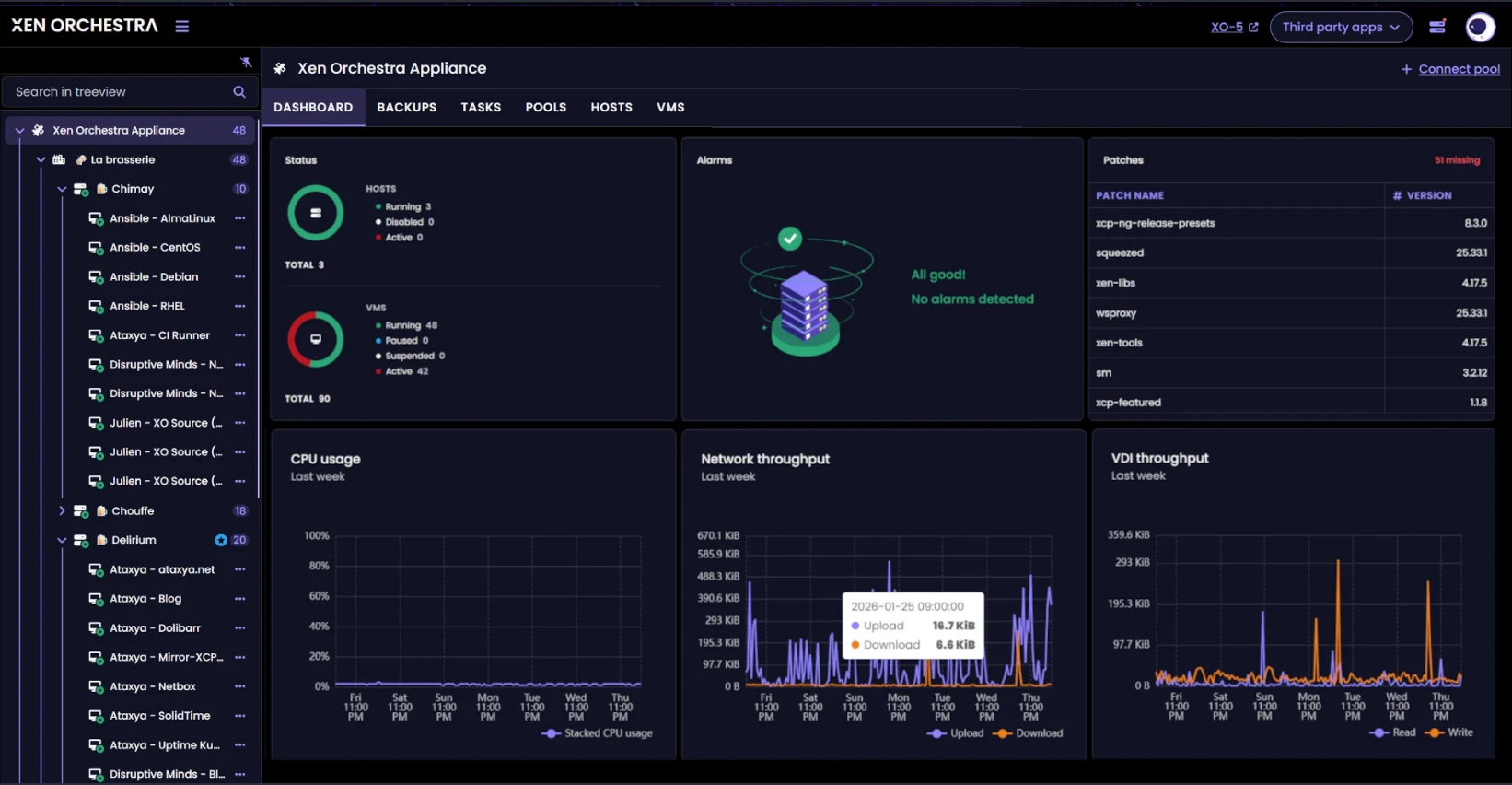
Xen Orchestra’s dashboard in Vates’s documentation. This product example does not depict an affected deployment. Source: Vates VMS Documentation.
The authentication bypass, tracked as VSA-2026-062, turns a malformed login token into access through a failure to enforce the expected data type. According to Vates’s advisory, REST cookie parsing can produce an empty object instead of a string. The token collection then treats that object as an unrestricted lookup and returns its first token.
There is a consequential condition: the returned token must be unexpired for the provider to authenticate the requester as its owner. Once authenticated, the requester can reach an endpoint that returns reusable login token IDs. The flaw therefore concerns both entry and the ability to obtain credentials for further access.
An attacker needs network access to the management interface, as the initial report explains. Vates’s instruction to keep Xen Orchestra off the public internet and on a dedicated management network addresses that exposure directly.
N-able says its latest N-central hotfix patches all identified vulnerabilities exploitable without authentication and hosted servers are back online. Further patches, customer-side upgrades and checks for compromise remain necessary after public exploit code prompted a precautionary shutdown.
The vendor lists Xen Orchestra releases before 6.9.2 on the stable channel and 6.10.1 on the latest channel as affected, along with Xen Orchestra Appliance. It identifies those releases as containing the fix as of November 10, with patched xo-server packages 5.211.2 and 5.213.1 respectively. Source installations should update to the latest master branch, Vates says.
The November 10 initial report names different Xen Orchestra releases, 6.9.1 and 6.10.0, although it lists the same fixed xo-server package versions. Vates’s advisory names 6.9.2 and 6.10.1. Administrators should use the vendor’s release guidance when checking whether their deployment is fixed.
Vates’s separate VSA-2026-063 advisory, dated November 10, says the VM import issue is unfixed in both release channels and affects Xen Orchestra 6.10.1 and earlier, plus the appliance. A release that fixes the login bypass can therefore still be affected by the import flaw.
Xen Orchestra forwards imports to XAPI, the host-management API, as the fully privileged pool-admin without inspecting the import’s ova.xml metadata. The advisory links crafted VM settings to previously documented XAPI issues, XSA-489 and XSA-530.
Vates says the observed attacker abused this path with administrator privileges, linking it to the login-bypass advisory. But its technical description also says a lower-privileged user can import a malicious VM and compromise a host with any of these permissions:
vm.import through JSON-RPC;sr/import:vm through the REST API;network/action:create or network/action:update.The distinction matters for deployments that delegate work to users without granting administrator access. Vates’s interim instruction is to reserve VM import for administrators and disable users holding those permissions while it develops a fix.
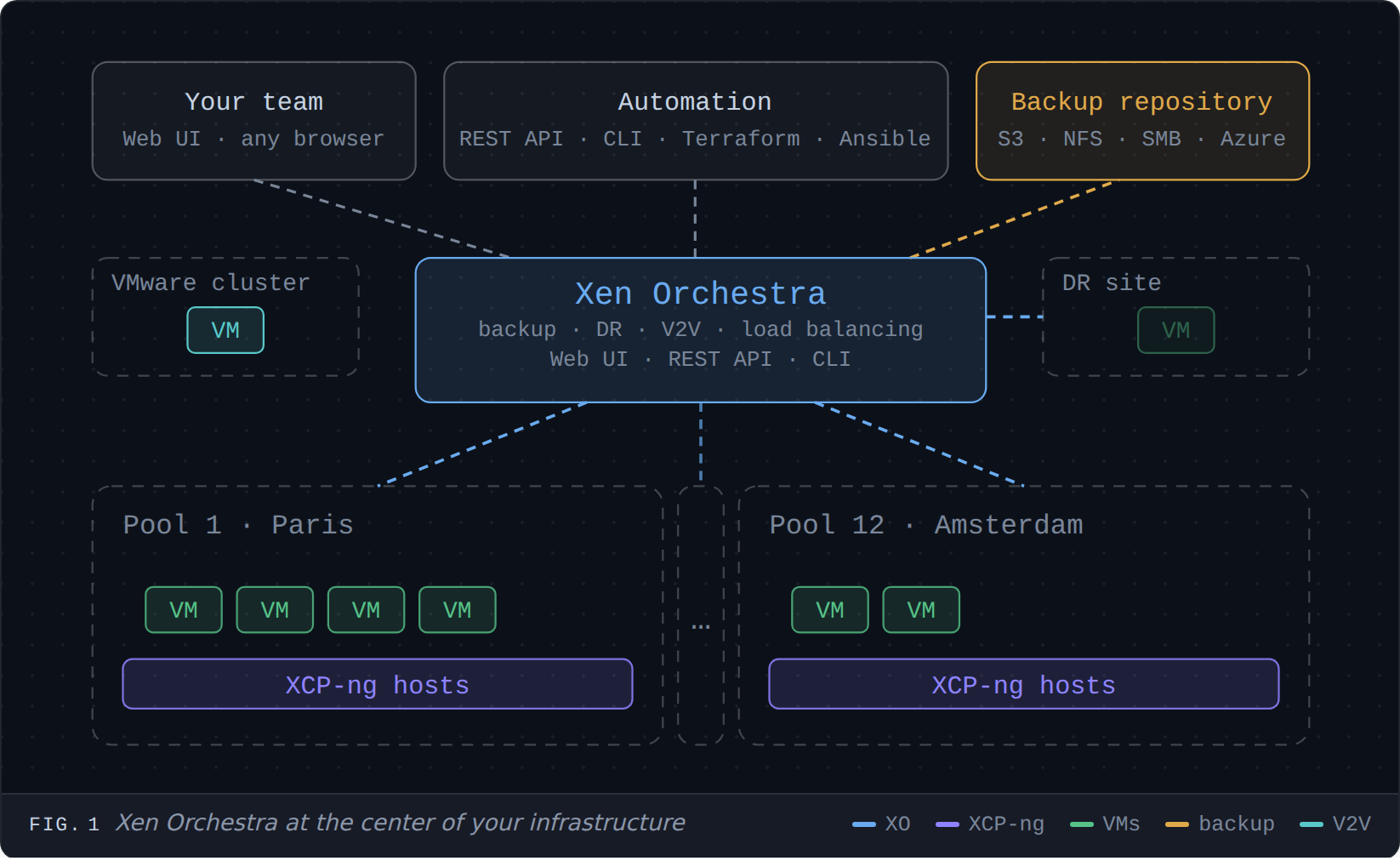
Vates’s architecture diagram shows Xen Orchestra’s connections to managed hosts, virtual machines, backup storage and disaster recovery. Source: Vates VMS Documentation.
The immediate decisions are to update, restrict management access and review delegated permissions. Establishing whether an exposed system was already compromised is harder.
Vates says successful login-bypass exploitation produces no log that detects the unauthenticated access. Captured HTTP requests can reveal the empty-object token pattern. Its campaign indicators include a VM named pivot2, VM configurations using hvm_serial: file, and host files such as /etc/cron.d/zz-ustar, /etc/cron.d/zz-ustar2, /.ustar5 and /.ustar6. The login-bypass advisory also lists attacker infrastructure to block in both traffic directions.
Those checks have limits. Vates explicitly says its indicators cover only the campaign identified so far; other attackers could use different techniques or infrastructure. An absence of matches cannot establish an absence of compromise. Likewise, a reverse-proxy or web application firewall rule matching the known cookie patterns is a mitigation with potential formatting bypasses, rather than a substitute for the update.
For compromised deployments, the recovery scope extends beyond Xen Orchestra login credentials. Vates says configuration theft and credential harvesting cannot be ruled out and calls for rotating passwords and secrets across the virtualization stack, including backup destinations, host root accounts, pool secrets, user accounts and one-time-password secrets.
For confirmed compromise, it recommends a full reinstallation because cleanup cannot guarantee removal of every backdoor. Administrators still need a vendor fix for the import path and evidence to assess prior intrusion. Installing the login-bypass update alone cannot establish that an exposed host is clean.
CISA has listed exploited flaws in Openwave’s webmail document converter and Cisco’s BroadWorks communications platform, setting a November 24 federal remediation deadline. Openwave dates its fix to 2021; a separate research account links Cisco’s flaw to theft of telecom authentication keys.
Maersk confirms data theft from an acquired legacy system and disputes WhiteArmor’s password claims. The group demands $5 million while Maersk says it has found no impact on wider systems and expects no customer disruption.
Binance warns that malicious iPhone apps could use worse_query to read other apps’ files. A file manager built on the public code demonstrates cross-app access, but no cryptocurrency losses have been confirmed and the latest Apple updates have not been linked conclusively to a fix.
Microsoft fixed an actively exploited Outlook flaw that can disclose authentication information when a user opens a malicious file. The moderate-rated bug warrants priority within a November release exceeding 1,000 vulnerabilities, but the attackers and scale of abuse remain undisclosed.
Vanderbilt University allowed students and employees to resume using university devices Tuesday after ordering a shutdown Monday. Key services were available, but wider restrictions persisted and attackers’ claims of extensive data theft remained unconfirmed.
Barracuda says exploitation of recently disclosed vulnerabilities has affected a small number of organizations. Patches are available, and the two-flaw chain can give attackers root access to Email Security Gateway appliances with reachable administrative interfaces.
SAP’s November release addresses four flaws rated 10.0, including ICM2SHELL and PROXYGATE. Customers face unauthenticated routes into core business systems, and Gateway remediation can require configuration changes alongside patches.
Compromised Qubole credentials let an attacker assume customer AWS roles, harvest secrets and download data in October. Dormant integrations extended the exposure, while gaps in storage logs complicated efforts to establish what was stolen.
Google has fixed an actively exploited XML vulnerability in its Chrome desktop browser. The update brings this year’s exploited zero-day tally to eight, while details of the attacks remain undisclosed.
N-able took hosted N-central offline and urged customers running their own servers to do the same after public exploit disclosures. The shutdown interrupts a platform used to manage customer networks, while the scope of the flaws and a safe restoration date remain unresolved.
Trump nominated Palantir security chief Michael LoSapio to lead CISA, where workforce losses and a proposed funding reduction complicate the job as Senate control is set to change.
Iris Plaza says an intrusion into an external cloud service may have exposed data on 5.8 million current and former members and 1.9 million non-members. Its official shopping site remains suspended, while the actual extent of any leak is still under investigation.
France attributes October attacks on roughly 700 retail sites to an Iranian Revolutionary Guard cyber unit. Fires and spoiled food have turned exposed refrigeration controls into a diplomatic and criminal case, while responsibility for later attacks remains unresolved.
Apple says three macOS updates stop bundled command-line tools from accepting compromised eMudhra certificates, extending protections already delivered to Safari and Mail. Apps with their own certificate lists still require separate checks.
Elliptic estimates that responders froze or seized 44% of the $6.43 billion stolen from Binance. Cross-chain services and screening gaps kept other funds moving, but most remaining value was still parked and little had likely been cashed out.
Researchers observed public proxy traffic exiting six addresses registered to the Executive Office of the President. The findings expose a possible route for outsiders to borrow government network identities, but do not establish access to internal systems.
Alpine Linux has patched a password-authentication bypass reachable through OpenSSH on systems using musl without PAM authentication. Under specific account and server settings, attackers can enter key-only accounts; some cloud instances can then give them root access.
Sekoia uncovered mobile data-theft tools delivered through compromised websites, cloned portals and Plerdy's analytics tracker. The analyzed attacks used already-patched flaws, and the report does not establish how many phones were infected.
Ryan James Roach has been extradited to face charges over alleged intrusions targeting US universities with supercomputers. Prosecutors allege credential theft and the diversion of university processing power for cryptocurrency mining; a second defendant remains in Canadian extradition proceedings.