Editorial Team
7 min read
Meituan posted RMB1.85 billion in adjusted September-quarter profit as lower incentive spending helped reverse last year’s losses. Core margins narrowed from June, while smaller expansion losses and substantial liquidity supported continued investment.
Meituan, the Chinese food-delivery and local-services platform, remained profitable in the three months ended September 30, 2026, reversing a deep year-earlier loss. The recovery is substantial, but its core business generated little additional operating profit from the summer sales increase, leaving the cost of retaining customers and fulfilling deliveries central to its next earnings test.
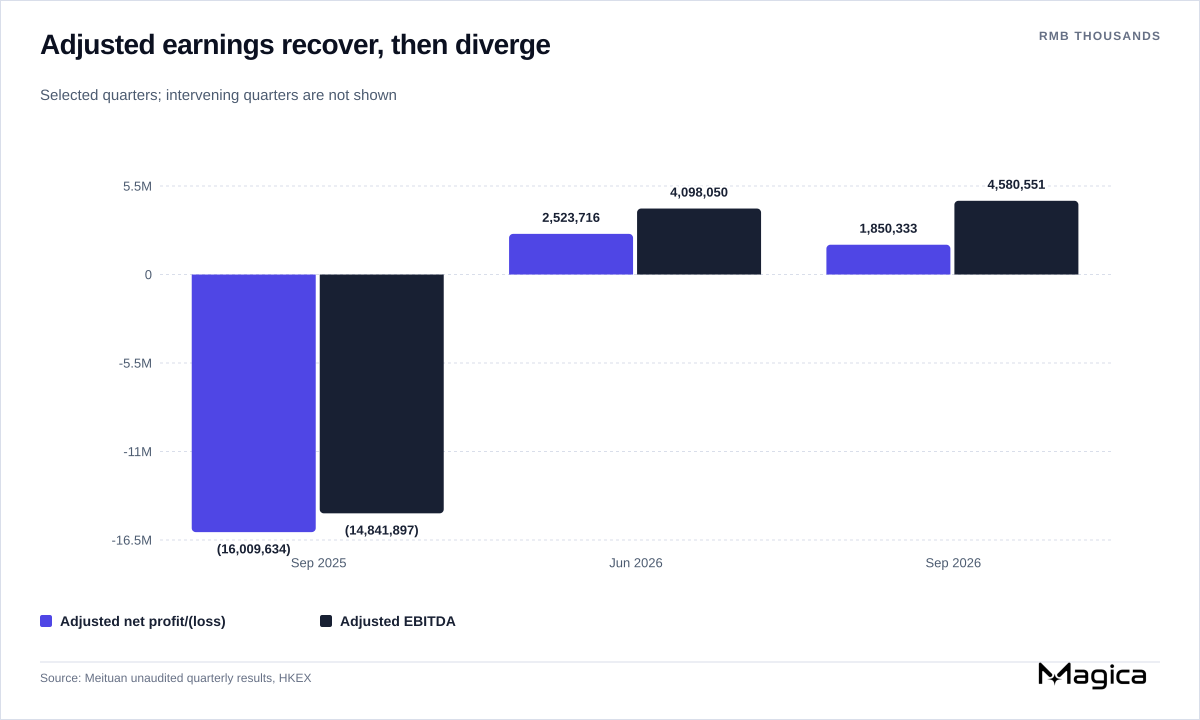
Company-reported adjusted net profit and adjusted EBITDA for selected quarters. Both are non-IFRS measures. Chart: Magica. Source: Meituan quarterly results — HKEX.
Meituan reported revenue of RMB115.56 billion, up 21.6% year on year, and adjusted net profit of RMB1.85 billion against an adjusted loss of RMB16.01 billion a year earlier in its unaudited quarterly results. Statutory net profit was RMB2.07 billion. A separate results report also recorded the revenue and adjusted-income totals.
The company connects consumers with restaurant meals, goods delivered on demand, local services, and hotel and travel bookings. Its Core Local Commerce segment combines food delivery and Instashopping, its on-demand retail service, with in-store, hotel and travel businesses. The segment’s earnings therefore cover considerably more than restaurant delivery.
Meituan is an established operator rebuilding profitability after a subsidy contest with Chinese e-commerce groups Alibaba and JD.com. It returned to adjusted profit in the June quarter after three consecutive losing quarters, according to coverage of the results. That report put the September-quarter adjusted-profit consensus at RMB2.2 billion, above the result, and cited a Bloomberg-compiled revenue estimate of RMB113.37 billion, below actual sales.
The filing shows several measures moving in different directions:
| Measure | September quarter 2025 | June quarter 2026 | September quarter 2026 |
|---|---|---|---|
| Revenue | RMB95.06bn | RMB104.64bn | RMB115.56bn |
| Adjusted net profit/(loss) | −RMB16.01bn | RMB2.52bn | RMB1.85bn |
| Adjusted EBITDA | −RMB14.84bn | RMB4.10bn | RMB4.58bn |
| Core Local Commerce operating profit/(loss) | −RMB14.07bn | RMB5.67bn | RMB5.70bn |
| Core Local Commerce operating margin | −21.0% | 7.9% | 7.3% |
Revenue rose 10.4% from June, while adjusted net profit fell 26.7%, calculated from the filing’s unrounded totals. Yet adjusted EBITDA, which also excludes items such as depreciation and certain treasury-investment gains, rose 11.8%. The decline in adjusted net profit does not describe every aspect of operating performance.
Core operating profit increased just 0.6%. Meituan attributed the segment’s revenue growth from June to seasonal transaction activity and merchant advertising spending, and its lower margin to seasonal increases in user and courier incentives and marketing campaigns. The summer quarter brought more sales with almost no increase in core operating profit.
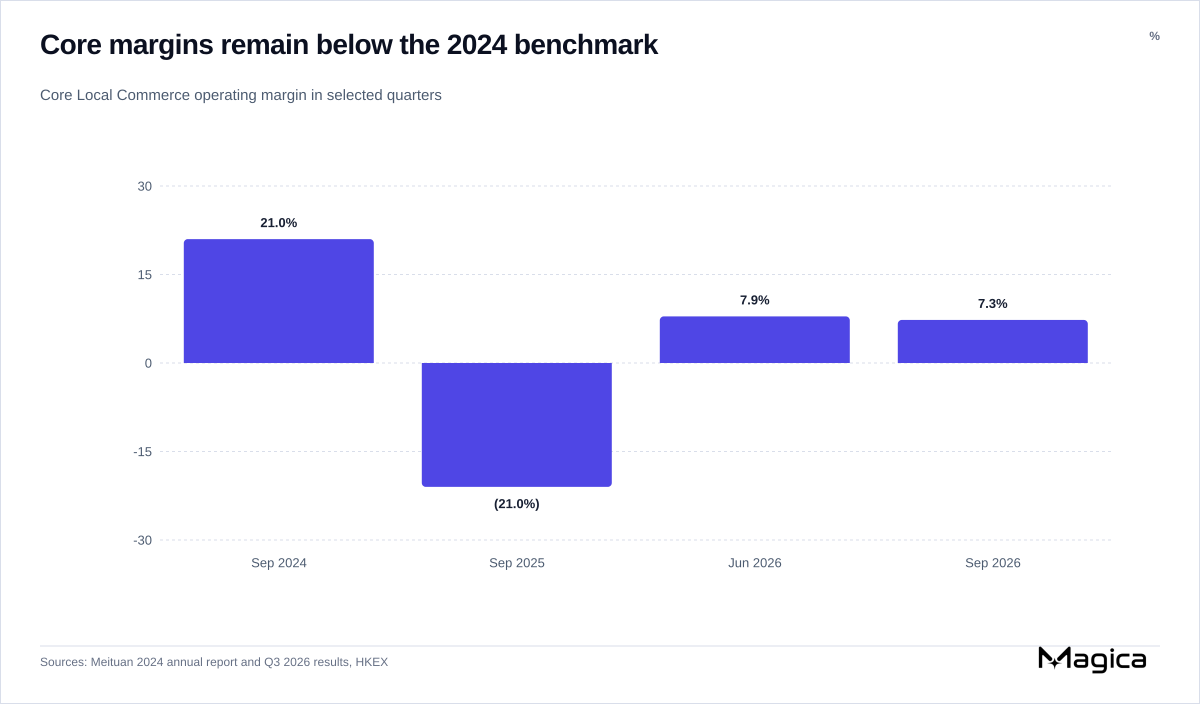
Company-reported Core Local Commerce margins in selected quarters; changes in business mix and competition are not isolated. Chart: Magica. Source: Meituan 2024 annual report.
Selling and marketing expenses fell 20.1% year on year to RMB27.02 billion, from 35.6% to 23.4% of group revenue. Meituan attributed the reduction primarily to disciplined marketing spending, partly offset by grocery and overseas expansion. Against June, however, those expenses increased 9.3% during the summer peak.
The recovery also runs through the revenue line. Core delivery-services revenue rose 25.3% year on year to RMB28.87 billion, which Meituan primarily attributed to tighter incentive spending. Its annual-report accounting policies explain that some customer incentives are deducted from revenue, while others enter selling and marketing expenses. Consequently, delivery-revenue growth cannot be read as an equivalent increase in orders.
Meituan said higher revenue per order and lower delivery cost per order reduced its cost-of-revenue ratio from a year earlier. It also described a rebound in average order value, fewer low-priced orders and more rational industry subsidies after summer promotions. These are management’s explanations, rather than independently measured evidence that competition has ended.
The company has previously earned much higher margins. Its annual report records Core Local Commerce operating profit of RMB14.58 billion on revenue of RMB69.37 billion in the September 2024 quarter, a 21.0% margin. The latest quarter’s 7.3% is far below that same-season historical benchmark, although the comparison does not isolate subsequent changes in business mix or competitive conditions.
JD entered food delivery in February 2025, according to a July 2025 DBS Bank sector analysis. The researchers described Alibaba, JD and Meituan using delivery traffic to bring customers into other businesses. They also judged Meituan the biggest potential earnings beneficiary of a subsidy pullback, given its estimated roughly 60% food-delivery market share at that time. That estimate describes the 2025 competitive starting point, not current market share.
Alibaba’s Taobao Instant Commerce supplies an alternative for on-demand purchases across food, groceries, electronics and apparel. Alibaba’s August 2025 results presentation dates its launch within the Taobao app to late April 2025. The company described a strategy of sharing supply chains, users and membership benefits between quick commerce and its wider businesses. Delivery profitability alone therefore offers an incomplete explanation of rivals’ incentives to invest.
Meituan is pursuing its own links between services. It said higher-tier membership exceeded 40 million and joint memberships spanned more than 2,000 brands. It also reported wider use of paid One-on-One Express Delivery. The quarterly filing does not separate those services’ contributions to earnings.
Delivering that service has continuing costs. Alongside seasonal courier incentives, Meituan said it was advancing nationwide occupational-injury insurance and pension-subsidy programs. It did not separately quantify their financial effect in the results.
New Initiatives, which includes grocery retail and overseas food delivery, increased revenue 32.9% year on year to RMB37.27 billion. Its operating loss narrowed from RMB1.74 billion in June to RMB1.31 billion, an improvement that partly offset pressure elsewhere. Compared with a year earlier, the loss increased slightly from RMB1.28 billion even as the loss margin improved from 4.6% to 3.5%.
Meituan said its Xiaoxiang Supermarket grocery business operated in 85 cities at quarter-end, with more cities reaching operational maturity and profitability. Its overseas delivery brand Keeta had improved its Hong Kong profit margin and achieved profitability in Saudi Arabia for the entire quarter, the company said in the results filing. Neither milestone establishes profitability for all overseas operations or the wider segment.
Research and development expenses rose 11.3% year on year to RMB7.72 billion, mainly because of increased corporate investment in AI. Meituan described consumer software that places orders and bookings and merchant software that diagnoses operational problems and performs tasks. The filing did not quantify their financial returns.
Meituan has substantial resources to fund that investment. At September 30, it held RMB104.14 billion in cash and cash equivalents and RMB53.38 billion in short-term treasury investments. Borrowings and notes payable across current and non-current liabilities totalled RMB79.88 billion, calculated from the balance sheet; that debt total excludes lease liabilities and other obligations.
The company generated RMB4.78 billion in operating cash inflow during the quarter, helped by seasonal working-capital movements. Financing cash outflow was RMB9.96 billion, mainly for borrowing repayments. In November it completed RMB8 billion of senior-note issuance: RMB4.5 billion at 2.50% due in 2031 and RMB3.5 billion at 3.10% due in 2036. That is additional debt financing, distinct from the earnings recovery.
Profit measures also leave out different investment effects. Statutory earnings included RMB2.35 billion of fair-value gains through profit or loss. The adjusted measure removes certain investment gains and adds back expenses including share-based compensation. Separately, RMB12.2 billion in investment valuation losses entered other comprehensive income, outside the profit-and-loss statement.
The next results must show whether Meituan can improve core margins while retaining customers, and reduce absolute expansion losses as grocery and overseas sales grow. Positive cash generation and access to financing give it room to pursue those goals. Two profitable quarters establish a recovery from the subsidy-driven losses; sustained earnings growth still requires more revenue to translate into profit after incentives, delivery costs and new investment.
Reported plans would extend the TV licence to homes watching only on-demand subscription services, widening the BBC’s funding base. Ministers say no final decision has been made, and reports disagree over whether YouTube would be covered.
Govee’s Permanent Outdoor Lights 2 start at $125.99 in holiday promotions, but length, model names and installation limits matter more than the headline discount. The 100-foot kit offers the lowest price per foot among the three advertised sizes.
Apple keeps older iPhones on iOS 27, but Siri AI, voice upgrades and camera tools require different hardware. Paid AI allowances add regional restrictions and a shared usage pool.
Intel’s proposed Razor Lake-AX configurations would challenge AMD’s large integrated processors in compact PCs and local AI. Reports describe 96GB and 192GB memory layouts, but the 52-core option remains unsettled and a supply warning concerns still higher capacities.
Telegram is warning users on older iOS versions to update, but Pavel Durov has not identified an exploit, affected-version cutoff or victim count. Documented website attacks support the precaution without proving his claim of mass hacking.
Unofficial projects can reportedly run GTA 6 scenes on Windows, with some claiming about 20 fps. Inconsistent tests, reduced graphics settings and Take-Two’s copyright enforcement leave sustained play and distribution unresolved.
DWP says regular benefits and pensions are unaffected, but public portals remain disrupted after a cyber incident. Staff face a possible manual-payment backlog, while the cause and restoration timetable remain unresolved.
Dell lists the Alienware AW3226Q 32-inch-class 4K OLED monitor at $549.99. The 165Hz display costs $200 more than its smaller QHD OLED alternative, while Dell’s advertised $150 saving uses an estimated-value baseline.
A photo supports reports of a (PRODUCT)RED edition of Apple’s $149 smart speaker around December 1. The store location is unknown, a second image is disputed, and Apple has not confirmed availability or donation terms.
Iran reportedly used SpaceX’s satellite internet network for military communications and drone operations. Tighter controls could curb unauthorized use, but a broad shutdown could also disconnect Iranian civilians and dissidents.
Amazon lists Samsung’s dual-4K gaming monitor $750 below its reference price. The established model offers more pixels than cheaper 49-inch ultrawides, but full-resolution 240Hz operation depends on graphics compatibility, and OLED alternatives undercut its price.
Microsoft plans to remove the WSUS role from Windows Server 2028 while preserving support on earlier releases. Organizations can keep distributing updates from older servers, but the long-term path for disconnected networks remains unfinished.
Amazon’s Black Friday offer puts the ad-supported 2024 Kindle Paperwhite at $129.99. That is $70 below its successor, but only $30 below the older reader’s original launch price.
NVIDIA’s latest GeForce driver adds a fix for excessive background SSD writes after an incomplete hotfix, but users report black screens and lost display signals. The reports leave both the scale and cause of the display problems unresolved.
Microsoft has deprecated Windows’ optional Telnet Client and committed to removing it in a future release, without naming one. The practical task is separating legacy remote access from the network checks that kept telnet.exe useful.
India’s reported Black Friday offers put the 256GB iPhone 17 Pro at ₹1,18,307 and the iPhone 18 Pro at ₹1,46,490 with different banks’ credit card instalment plans. Most of the generation gap exists before those offers; financing charges, exchange values and rewards still need separate checks.

The unlocked 256GB Pixel 11 Pro is $350 below its regular price and just $57 above the standard Pixel 11 in reported Amazon deals. Google reportedly matches the discount, making seller, stock and return terms part of the buying decision.
Google Play will display trader developers’ contact details worldwide from March 1, 2027. Public addresses have a history on Play, but individual traders face renewed questions about protecting home addresses while keeping apps available in Europe and the UK.
Instamart is reportedly cutting corporate and support jobs amid wider AI adoption while continuing store investment. Swiggy attributes growth partly to pricing incentives and says profitability requires much greater scale.
Apple’s November 27–30 hardware promotion pairs eligible purchases with credit for future spending. Cash discounts elsewhere can be worth more, while exclusions and financing rules complicate the comparison.