Editorial Team
5 min read
Microsoft plans to remove the WSUS role from Windows Server 2028 while preserving support on earlier releases. Organizations can keep distributing updates from older servers, but the long-term path for disconnected networks remains unfinished.
Microsoft plans to remove Windows Server Update Services (WSUS), its centralized service for managing and distributing Microsoft product updates across corporate Windows networks, from Windows Server 2028. Administrators will still be able to use WSUS on earlier supported server releases to update machines running the new operating system.
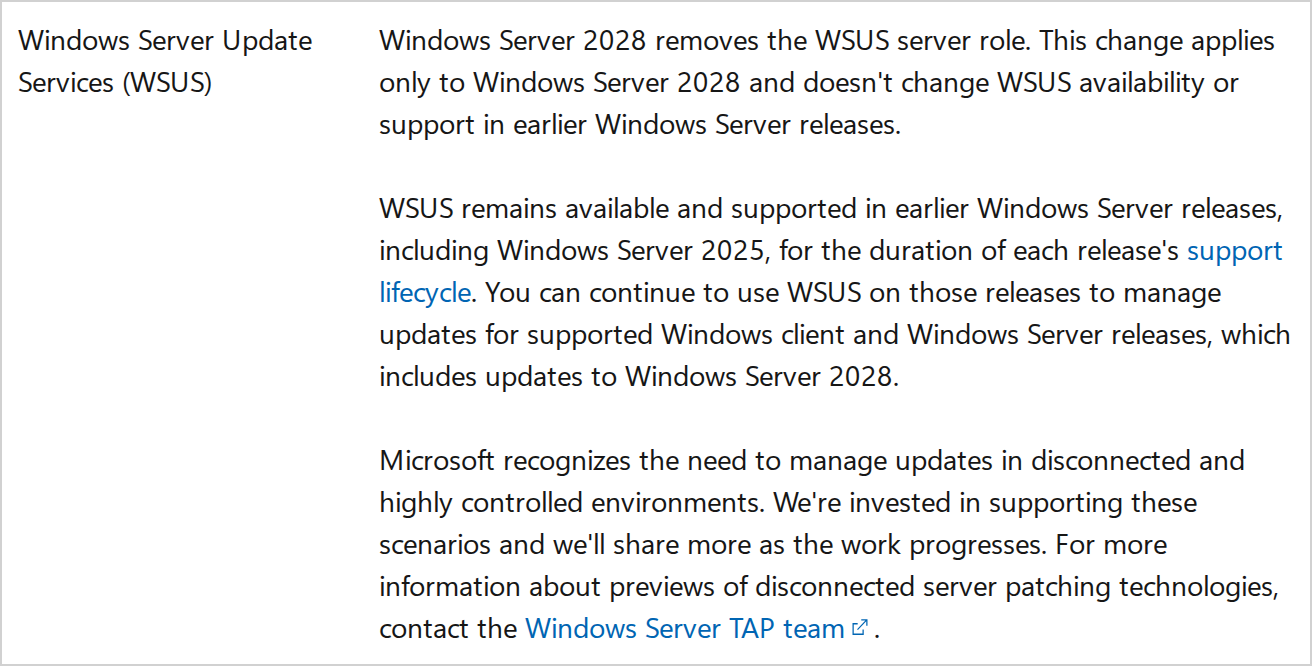
Microsoft's preview documentation preserves WSUS support on earlier server releases, including their ability to distribute Server 2028 updates. Source: Microsoft Learn.
Microsoft's feature-removal documentation makes the scope explicit: the WSUS role is removed from Server 2028, but its availability and support in earlier Windows Server releases do not change. That includes Server 2025, where support continues for the release's lifecycle.
Those older WSUS installations can manage updates for supported Windows clients and servers, including Windows Server 2028. An organization can therefore introduce Server 2028 machines while keeping its WSUS host on an earlier supported operating system.
WSUS gives administrators centralized control over update distribution instead of having every device obtain updates individually from Microsoft's servers.
Microsoft deprecated WSUS in September 2024, stopping active feature development while preserving existing functionality and continued update publication, as described in the report on the removal. The Server 2028 plan moves beyond that earlier freeze to exclude the role from a new release.
Microsoft announced Windows Server 2028, the next major version of its server operating system, at Ignite 2026, according to the same report. This remains a preview roadmap: Microsoft's documentation warns that listed features may still exist in test builds and that removal plans can change before release.
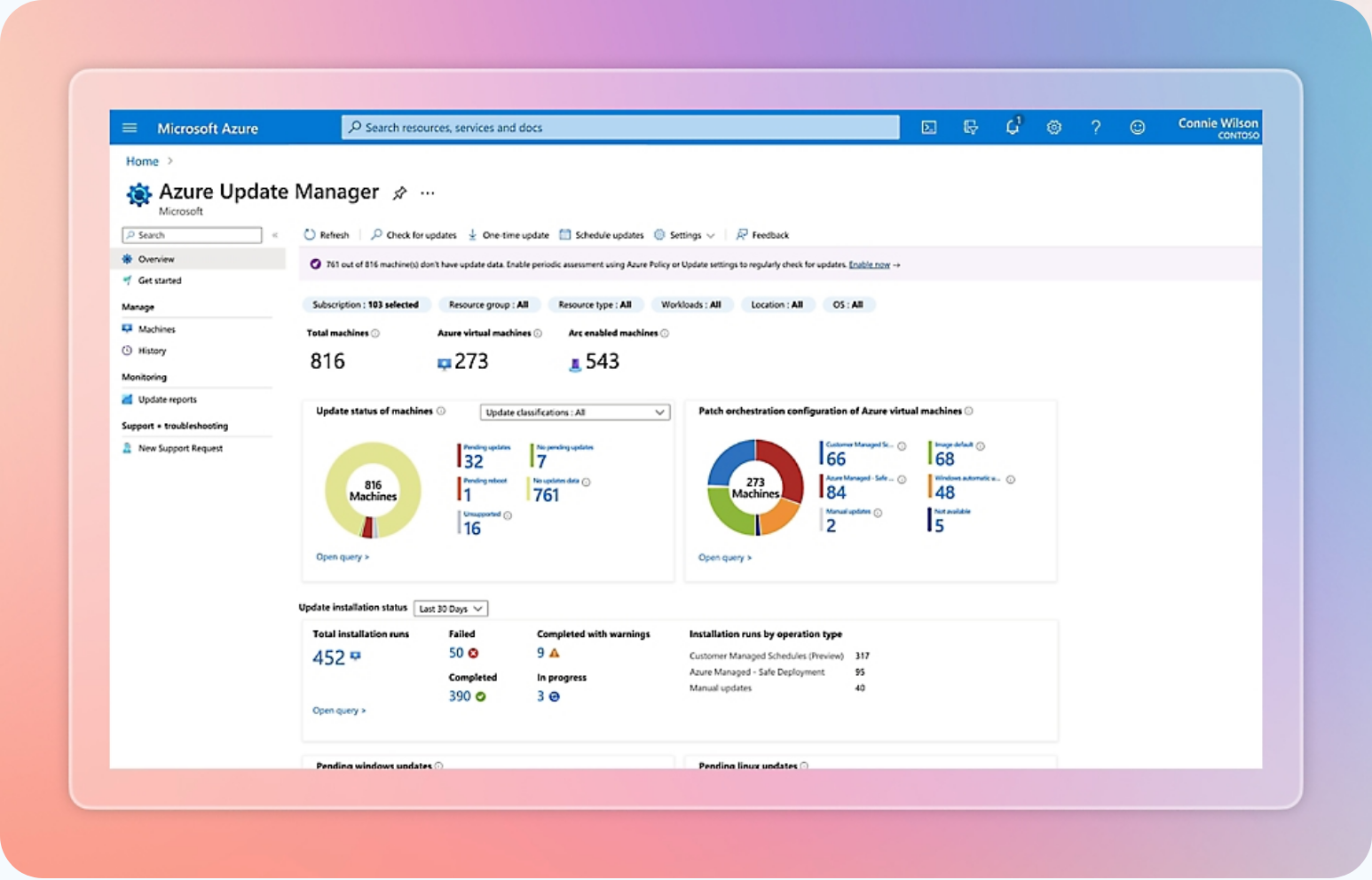
Microsoft's illustrative Azure Update Manager dashboard shows update status for Azure virtual machines and Arc-enabled machines. Source: BleepingComputer.
Microsoft recommended Windows Autopatch and Microsoft Intune for client update management, and Azure Update Manager for server updates, when it deprecated WSUS in 2024. Those recommendations address different parts of a fleet.
Azure Update Manager governs Windows and Linux software updates. Microsoft's technical and billing FAQ says it does not support patching Windows 10 or Windows 11 and recommends Intune for those devices.
For machines outside Azure, Update Manager requires Azure Arc. The service deploys an extension that works with the Azure VM agent or Azure Arc agent to fetch and install updates. That adds a connection and agent requirement to the management arrangement.
Update Manager can also schedule patching while the Windows Update client retrieves updates from Microsoft Update or WSUS. Adopting the management layer need not replace the update repository.
Microsoft says Update Manager carries no extra charge for Azure virtual machines and Azure Arc-enabled Azure Local virtual machines created through an Azure Arc resource bridge. Other Arc-enabled servers generally incur monthly per-server charges, prorated to days connected and managed. A connected machine associated with a patch schedule can qualify as managed even without a patch installation that day.
But location alone does not determine the bill. The FAQ lists exemptions for Arc-enabled servers covered by:
Microsoft also preserves free use for existing Arc-enabled servers that used Automation Update Management free as of September 1, 2023; newly onboarded machines in the same subscription are charged. A migration budget therefore needs to account for existing entitlements as well as which machines become managed.
The WSUS change also sits inside a wider compatibility transition. Microsoft's official list removes VBScript and the WMIC command-line utility, while retaining Windows Management Instrumentation (WMI), the underlying management infrastructure. It also removes legacy BIOS boot support and requires UEFI. Server 2028 guests on Hyper-V require generation 2 virtual machines; generation 1 support for older guest operating systems is unchanged.
Windows PowerShell 5.1 is deprecated, a distinct status from removal. Microsoft advises testing scripts and management workflows for compatibility with PowerShell 7. Teams assessing Server 2028 consequently need to check automation and deployment infrastructure alongside patch distribution.
The unresolved case is organizations whose update infrastructure operates in disconnected or highly controlled environments. Microsoft acknowledges those requirements in its removal documentation and says work to support them is continuing. It directs customers seeking previews of disconnected server patching technologies to the Windows Server Technology Adoption Program team, without specifying a completed replacement or delivery date there.
Administrators can retain WSUS on a supported earlier host while testing Server 2028, or assess a connected management service after checking compatibility and entitlements. For networks that cannot use that connected service, the missing evidence is what Microsoft's disconnected patching previews can deliver and when they will become a supported migration path.
Reported plans would extend the TV licence to homes watching only on-demand subscription services, widening the BBC’s funding base. Ministers say no final decision has been made, and reports disagree over whether YouTube would be covered.
Govee’s Permanent Outdoor Lights 2 start at $125.99 in holiday promotions, but length, model names and installation limits matter more than the headline discount. The 100-foot kit offers the lowest price per foot among the three advertised sizes.
Apple keeps older iPhones on iOS 27, but Siri AI, voice upgrades and camera tools require different hardware. Paid AI allowances add regional restrictions and a shared usage pool.
Intel’s proposed Razor Lake-AX configurations would challenge AMD’s large integrated processors in compact PCs and local AI. Reports describe 96GB and 192GB memory layouts, but the 52-core option remains unsettled and a supply warning concerns still higher capacities.
Telegram is warning users on older iOS versions to update, but Pavel Durov has not identified an exploit, affected-version cutoff or victim count. Documented website attacks support the precaution without proving his claim of mass hacking.
Unofficial projects can reportedly run GTA 6 scenes on Windows, with some claiming about 20 fps. Inconsistent tests, reduced graphics settings and Take-Two’s copyright enforcement leave sustained play and distribution unresolved.
DWP says regular benefits and pensions are unaffected, but public portals remain disrupted after a cyber incident. Staff face a possible manual-payment backlog, while the cause and restoration timetable remain unresolved.
Dell lists the Alienware AW3226Q 32-inch-class 4K OLED monitor at $549.99. The 165Hz display costs $200 more than its smaller QHD OLED alternative, while Dell’s advertised $150 saving uses an estimated-value baseline.
A photo supports reports of a (PRODUCT)RED edition of Apple’s $149 smart speaker around December 1. The store location is unknown, a second image is disputed, and Apple has not confirmed availability or donation terms.
Iran reportedly used SpaceX’s satellite internet network for military communications and drone operations. Tighter controls could curb unauthorized use, but a broad shutdown could also disconnect Iranian civilians and dissidents.
Amazon lists Samsung’s dual-4K gaming monitor $750 below its reference price. The established model offers more pixels than cheaper 49-inch ultrawides, but full-resolution 240Hz operation depends on graphics compatibility, and OLED alternatives undercut its price.
Amazon’s Black Friday offer puts the ad-supported 2024 Kindle Paperwhite at $129.99. That is $70 below its successor, but only $30 below the older reader’s original launch price.
NVIDIA’s latest GeForce driver adds a fix for excessive background SSD writes after an incomplete hotfix, but users report black screens and lost display signals. The reports leave both the scale and cause of the display problems unresolved.
Microsoft has deprecated Windows’ optional Telnet Client and committed to removing it in a future release, without naming one. The practical task is separating legacy remote access from the network checks that kept telnet.exe useful.
Meituan posted RMB1.85 billion in adjusted September-quarter profit as lower incentive spending helped reverse last year’s losses. Core margins narrowed from June, while smaller expansion losses and substantial liquidity supported continued investment.
India’s reported Black Friday offers put the 256GB iPhone 17 Pro at ₹1,18,307 and the iPhone 18 Pro at ₹1,46,490 with different banks’ credit card instalment plans. Most of the generation gap exists before those offers; financing charges, exchange values and rewards still need separate checks.

The unlocked 256GB Pixel 11 Pro is $350 below its regular price and just $57 above the standard Pixel 11 in reported Amazon deals. Google reportedly matches the discount, making seller, stock and return terms part of the buying decision.
Google Play will display trader developers’ contact details worldwide from March 1, 2027. Public addresses have a history on Play, but individual traders face renewed questions about protecting home addresses while keeping apps available in Europe and the UK.
Instamart is reportedly cutting corporate and support jobs amid wider AI adoption while continuing store investment. Swiggy attributes growth partly to pricing incentives and says profitability requires much greater scale.
Apple’s November 27–30 hardware promotion pairs eligible purchases with credit for future spending. Cash discounts elsewhere can be worth more, while exclusions and financing rules complicate the comparison.