Editorial Team
4 min read
Microsoft has deprecated Windows’ optional Telnet Client and committed to removing it in a future release, without naming one. The practical task is separating legacy remote access from the network checks that kept telnet.exe useful.
telnet.exe, but has named neither a release nor a deadline.Microsoft, the maker of Windows, has put the operating system’s Telnet Client on its removal path. Its November 2026 deprecation entry says telnet.exe will disappear in a future Windows release, without identifying which one.
Telnet is a network protocol for connecting to another computer and operating it through a text session. Windows’ telnet.exe is the local client that makes that connection. It is currently an optional component, disabled by default and enabled through Windows Features, as described in the report on the change. Deprecation means it is no longer being actively developed; the notice does not announce its immediate removal.
The client has been disabled by default since Windows Vista, according to the account of its Windows history.
Telnet dates to 1969; its standard specification appeared in 1983. Its security weakness is equally established: ordinary Telnet connections transmit data, including login credentials, without encryption. SSH, or Secure Shell, largely displaced it for secure remote administration. Yet reporting on its remaining uses identifies older network equipment and connectivity troubleshooting as reasons the client still matters.
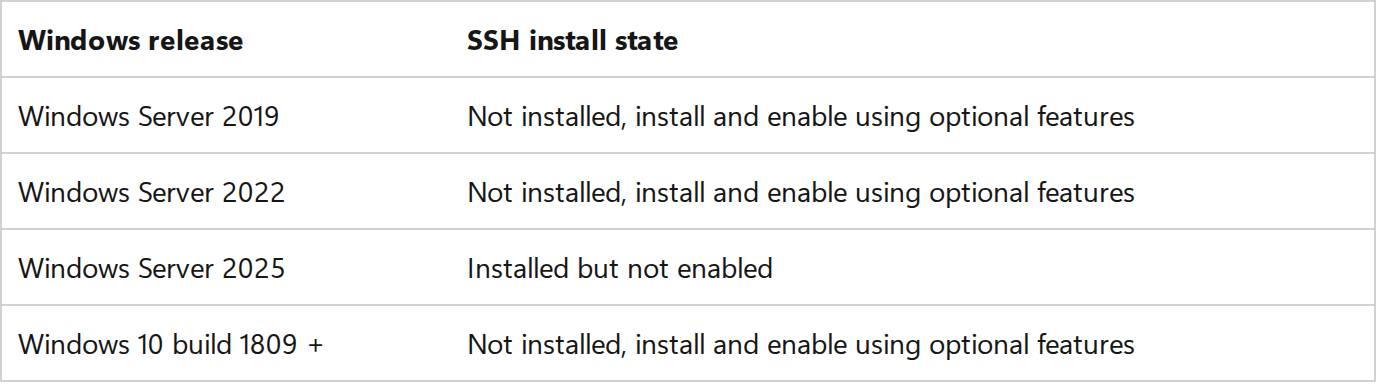
Microsoft’s OpenSSH documentation lists installation states for selected Windows releases, including Server 2025 as installed but not enabled. Source: Microsoft OpenSSH documentation.
Reported plans would extend the TV licence to homes watching only on-demand subscription services, widening the BBC’s funding base. Ministers say no final decision has been made, and reports disagree over whether YouTube would be covered.
Windows already offers alternatives for both jobs, but the remote system determines whether a secure login is possible. OpenSSH, an open-source implementation of SSH, has been available as a Windows feature on demand since Windows 10 version 1809. Microsoft’s OpenSSH documentation distinguishes the local ssh client from the sshd server that must run on the remotely managed system. Installing a client alone cannot convert a device that only accepts Telnet into an SSH server.
For a port check, PowerShell’s Test-NetConnection provides a TcpTestSucceeded result. A successful TCP connection establishes reachability; it does not establish that every function of the application behind that port works. That makes it a substitute for a connectivity test, rather than for an interactive remote session.
There is also an alternative for retaining Telnet access itself. The PuTTY project supplies a free SSH and Telnet implementation for Windows and Unix. Microsoft’s decision therefore does not force the disappearance of Telnet from Windows computers. It withdraws the client supplied as part of the operating system. Choosing another Telnet client preserves access, but does not by itself change the protocol’s encryption weakness.
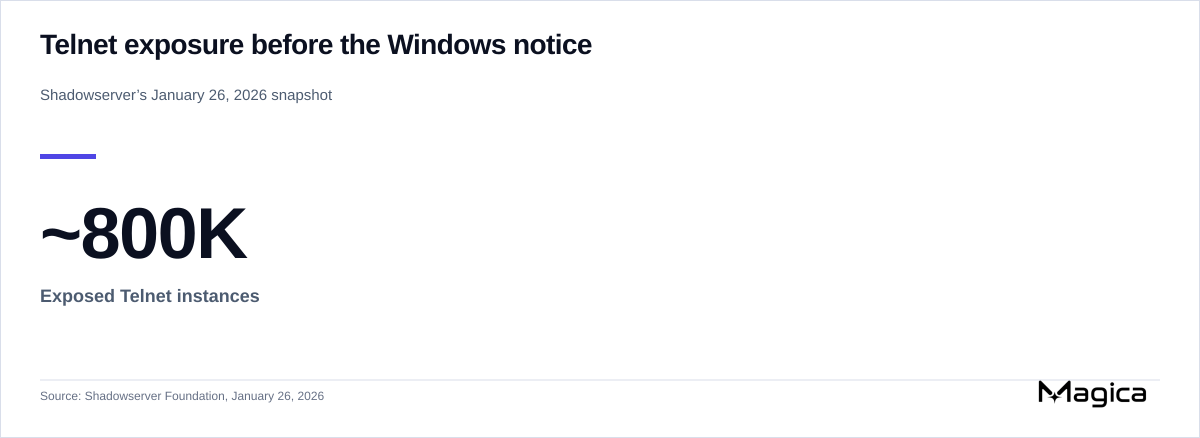
Shadowserver reported roughly 800,000 exposed Telnet instances on January 26, 2026. This counts exposed services, not Windows client installations or confirmed vulnerable systems. Source: Shadowserver Foundation.
Telnet services remain accessible on the public Internet. On January 26, 2026, the Shadowserver Foundation, which monitors Internet security and has shared Telnet exposure data for years, reported roughly 800,000 exposed Telnet instances. Its measurement description covers hosts with Telnet instances reachable from the Internet on TCP port 23 and other ports. The figure predates the deprecation notice by months and counts exposed services, not Windows client installations. Shadowserver also said it was not explicitly testing for the Telnet-server vulnerability discussed in that post, so the figure must not be read as a count of confirmed vulnerable systems.
Microsoft’s Telnet entry specifies neither a removal release nor a recommended replacement. It also provides no usage count or estimate of the work required to migrate. The evidence supports a dependency review, not a claim that a large share of Windows users faces disruption.
For administrators, the useful preparation is to identify where instructions or scripts invoke telnet.exe, separate port tests from interactive logins, and check how each remote device can be managed. The release Microsoft chooses for removal will determine when those replacements must be ready for an upgrade.
Govee’s Permanent Outdoor Lights 2 start at $125.99 in holiday promotions, but length, model names and installation limits matter more than the headline discount. The 100-foot kit offers the lowest price per foot among the three advertised sizes.
Apple keeps older iPhones on iOS 27, but Siri AI, voice upgrades and camera tools require different hardware. Paid AI allowances add regional restrictions and a shared usage pool.
Intel’s proposed Razor Lake-AX configurations would challenge AMD’s large integrated processors in compact PCs and local AI. Reports describe 96GB and 192GB memory layouts, but the 52-core option remains unsettled and a supply warning concerns still higher capacities.
Telegram is warning users on older iOS versions to update, but Pavel Durov has not identified an exploit, affected-version cutoff or victim count. Documented website attacks support the precaution without proving his claim of mass hacking.
Unofficial projects can reportedly run GTA 6 scenes on Windows, with some claiming about 20 fps. Inconsistent tests, reduced graphics settings and Take-Two’s copyright enforcement leave sustained play and distribution unresolved.
DWP says regular benefits and pensions are unaffected, but public portals remain disrupted after a cyber incident. Staff face a possible manual-payment backlog, while the cause and restoration timetable remain unresolved.
Dell lists the Alienware AW3226Q 32-inch-class 4K OLED monitor at $549.99. The 165Hz display costs $200 more than its smaller QHD OLED alternative, while Dell’s advertised $150 saving uses an estimated-value baseline.
A photo supports reports of a (PRODUCT)RED edition of Apple’s $149 smart speaker around December 1. The store location is unknown, a second image is disputed, and Apple has not confirmed availability or donation terms.
Iran reportedly used SpaceX’s satellite internet network for military communications and drone operations. Tighter controls could curb unauthorized use, but a broad shutdown could also disconnect Iranian civilians and dissidents.
Amazon lists Samsung’s dual-4K gaming monitor $750 below its reference price. The established model offers more pixels than cheaper 49-inch ultrawides, but full-resolution 240Hz operation depends on graphics compatibility, and OLED alternatives undercut its price.
Microsoft plans to remove the WSUS role from Windows Server 2028 while preserving support on earlier releases. Organizations can keep distributing updates from older servers, but the long-term path for disconnected networks remains unfinished.
Amazon’s Black Friday offer puts the ad-supported 2024 Kindle Paperwhite at $129.99. That is $70 below its successor, but only $30 below the older reader’s original launch price.
NVIDIA’s latest GeForce driver adds a fix for excessive background SSD writes after an incomplete hotfix, but users report black screens and lost display signals. The reports leave both the scale and cause of the display problems unresolved.
Meituan posted RMB1.85 billion in adjusted September-quarter profit as lower incentive spending helped reverse last year’s losses. Core margins narrowed from June, while smaller expansion losses and substantial liquidity supported continued investment.
India’s reported Black Friday offers put the 256GB iPhone 17 Pro at ₹1,18,307 and the iPhone 18 Pro at ₹1,46,490 with different banks’ credit card instalment plans. Most of the generation gap exists before those offers; financing charges, exchange values and rewards still need separate checks.

The unlocked 256GB Pixel 11 Pro is $350 below its regular price and just $57 above the standard Pixel 11 in reported Amazon deals. Google reportedly matches the discount, making seller, stock and return terms part of the buying decision.
Google Play will display trader developers’ contact details worldwide from March 1, 2027. Public addresses have a history on Play, but individual traders face renewed questions about protecting home addresses while keeping apps available in Europe and the UK.
Instamart is reportedly cutting corporate and support jobs amid wider AI adoption while continuing store investment. Swiggy attributes growth partly to pricing incentives and says profitability requires much greater scale.
Apple’s November 27–30 hardware promotion pairs eligible purchases with credit for future spending. Cash discounts elsewhere can be worth more, while exclusions and financing rules complicate the comparison.