Editorial Team
8 min read
Five directors reportedly lead all-stock talks between Elon Musk’s two public companies. Ownership, voting rights and the economics of SpaceX’s heavy AI spending remain central to assessing a potential combination.
SpaceX, the rocket and Starlink satellite-broadband company, and Tesla, the electric-vehicle and energy company, have appointed five directors to negotiate a possible all-stock merger, according to a Reuters dispatch relaying a Financial Times report based on people familiar with the matter. Reuters said it could not immediately verify the report, and neither company immediately responded to its requests for comment.
The negotiations would unite two public companies led by Elon Musk, their chief executive, who has led SpaceX since May 2002 and Tesla since October 2008. The reported combined value of about $3.5 trillion is not an agreed purchase price. In a stock swap, the exchange ratio decides how much of the combined business each side’s shareholders receive—and which assets, spending commitments and risks they share.
The account of a potential year-end deadline says people familiar with the negotiations do not consider an agreement close. Agreement, shareholder approval and regulatory clearance would be separate steps.
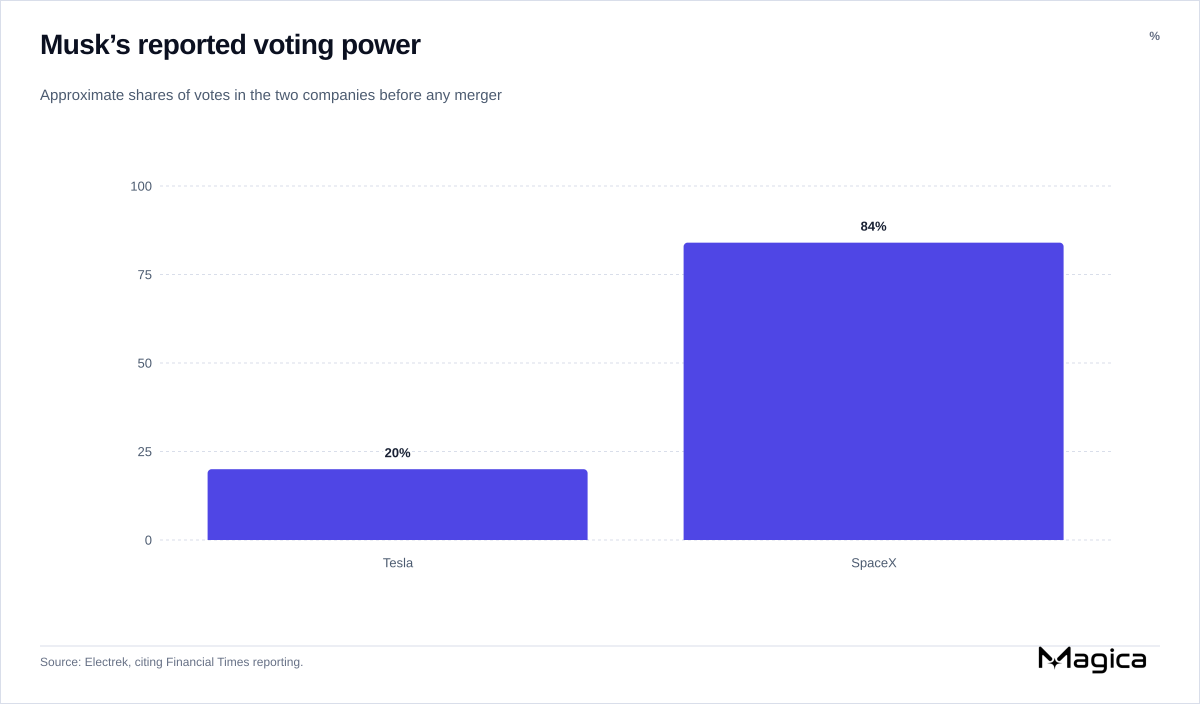
Musk reportedly holds about 20% of Tesla’s voting power and 84% of SpaceX’s. Chart: Magica. Source: Electrek.
Tesla’s committee reportedly consists of chair Robyn Denholm, a former finance and operations executive at telecommunications company Telstra and networking-equipment maker Juniper Networks; director Kathleen Wilson-Thompson, formerly global human-resources chief at pharmacy group Walgreens Boots Alliance; and director Jack Hartung, a former Chipotle chief financial officer. Tesla’s preliminary 2025 proxy documents their operating and financial backgrounds and Denholm’s chairmanship since November 2018.
SpaceX’s negotiators are reportedly directors Roelof Botha, a former managing partner of venture firm Sequoia who joined the board in June, and Randy Glein, co-founder of venture firm DFJ Growth and a SpaceX board observer since 2009. The account of the appointments, also drawing on the FT report, says all five are deemed financially disinterested for the talks.
They nevertheless have connections to Musk. Botha worked with him at payments company PayPal; Hartung’s son-in-law is a Tesla programme manager. Denholm and Wilson-Thompson designed Musk’s 2025 compensation award. Other Tesla directors reportedly stepped aside because of their closeness to him.
Evercore is reportedly advising Tesla, while Morgan Stanley and Goldman Sachs advise SpaceX. The latter two banks also helped take SpaceX public in June. The advisers are modelling overlaps in AI models, semiconductor design and data centres, alongside potential combinations of rockets, robotics and solar panels. No agreed estimate of merger savings is supplied in the reporting.
Musk endorsed a combination on SpaceX’s October earnings call but said his conflict prevented him from joining the committees’ discussions, according to the account of his remarks. The committees can reportedly consult senior executives who report to him.
The compensation connection has a specific consequence. Tesla’s 2025 preliminary proxy describes a roughly 423.7 million-share performance award and says earned shares would vest upon a qualifying change in control. Additional shares could become earned based solely on market capitalisation, removing the normal requirement to meet operational milestones.
That calculation uses Tesla’s outstanding shares immediately before the transaction multiplied by the greater of its last pre-transaction closing share price or the consideration per share received in the deal. Shares that remain unearned are forfeited. The definition also contains exceptions, including certain transactions in which existing shareholders retain at least half the voting power in substantially the same proportions. The effect of any merger therefore depends on its terms and whether it meets the award’s definition of a change in control.
Musk’s earlier deals also show why process and outcome need separate scrutiny. He chaired solar installer SolarCity before Tesla acquired it in November 2016. Shareholders challenged that acquisition, but Tesla’s second-quarter 2023 filing records judgment for Musk on all counts in April 2022, affirmed by Delaware’s Supreme Court in June 2023. The other director defendants had settled without admitting wrongdoing.
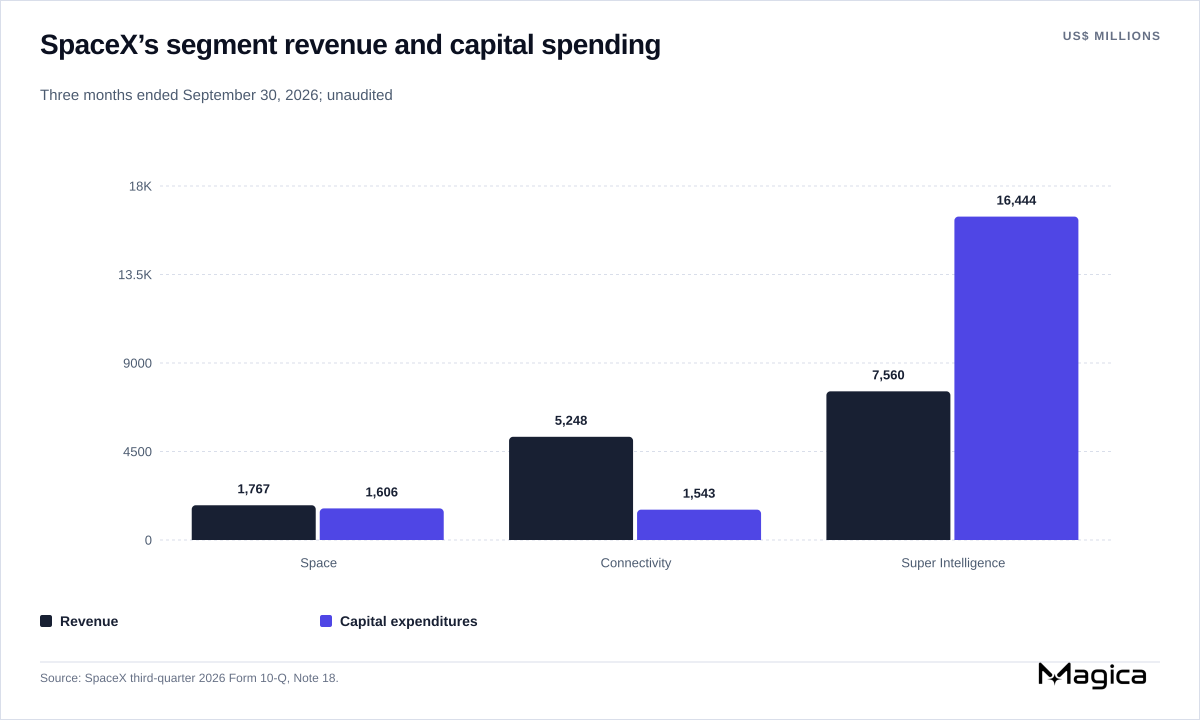
Company-reported revenue and capital expenditures by SpaceX segment for the third quarter of 2026; unaudited. Super Intelligence includes more than AI-model sales. Chart: Magica. Source: SpaceX third-quarter 2026 filing.
SpaceX already combines aerospace, communications and AI. Its third-quarter filing says AI developer xAI became a wholly owned subsidiary on February 2, after xAI acquired social platform X in March 2025. Both combinations used share exchanges. SpaceX also acquired the Cursor AI coding platform in August.
Its Super Intelligence, or SI, segment includes computing infrastructure, the Grok language model, Cursor and X. The filing shows materially different economics across the businesses:
| SpaceX segment | Revenue | Operating income or loss | Capital expenditures |
|---|---|---|---|
| Space | $1,767m | −$7m | $1,606m |
| Connectivity | $5,248m | $2,367m | $1,543m |
| SI | $7,560m | $431m | $16,444m |
| Total | $14,575m | $2,791m | $19,593m |
Figures are company-reported, unaudited results for the three months ended September 30, 2026. Dividing the SI figures by the totals gives about 52% of revenue and 84% of capital expenditures. The revenue includes advertising and infrastructure services, so it does not measure Grok sales alone. Connectivity generated most of the group’s operating income. The filing also identifies an unnamed SI customer responsible for 34.5% of SpaceX’s total revenue that quarter.
Tesla’s filing for the same quarter reports $28.046 billion in revenue and $718 million in operating income, compared with $28.095 billion and $1.624 billion a year earlier.
There is also a commercial alternative to developing SpaceX’s own AI products: selling computing capacity to other developers. An account relaying New York Times reporting, based on employees and internal messages, says Musk told staff SpaceX was falling behind in AI and renting out its computing power was more lucrative. It puts Anthropic’s payments at about $3.1 billion a month and Google’s at about $800 million. Those reported monthly amounts are not a breakdown of the preceding quarter’s revenue.
The same account says SpaceX closed its AI companions in September and disbanded the 60-person Grok Imagine team this month. Tesla withdrew engineers from Digital Optimus, a joint project to make Grok perform office work. Musk responded on X by describing the report as the obvious presented as news.
Other cooperation already involves substantial purchases. SpaceX’s related-party disclosures record $480 million of Tesla Megapack energy-storage products purchased in the nine months ended September 30, 2026. The committees need to explain which additional benefits require common ownership and which can be achieved through commercial arrangements.
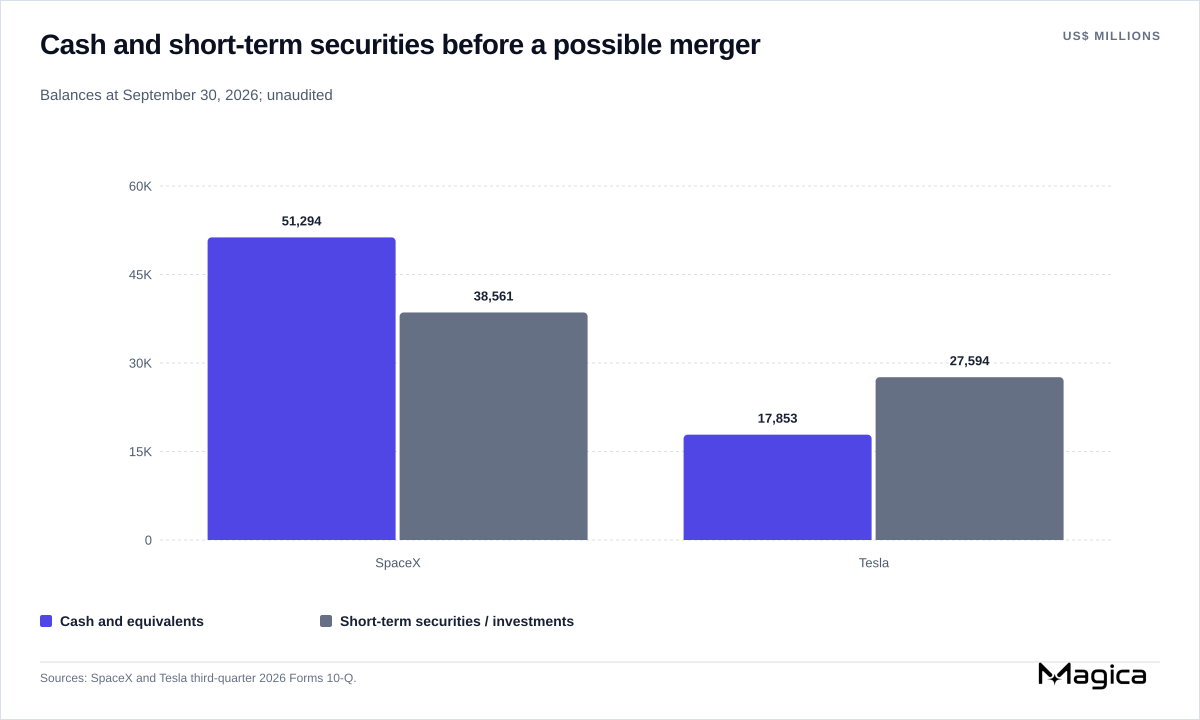
Company-reported cash and equivalents, SpaceX short-term marketable securities and Tesla short-term investments at September 30, 2026; unaudited. Debt is not deducted. Chart: Magica. Source: SpaceX third-quarter 2026 filing.
Musk said in October that SpaceX had raised $40 billion in debt to buy AI chips, according to the same reporting. It also relays an FT Alphaville analysis of Saturn Funding Trust, an Apollo-managed vehicle that buys Nvidia systems and leases them to SpaceX.
The vehicle reportedly sold a $25.2 billion tranche due in 2032 with an 8.259% coupon and a spread of 345 basis points over US Treasuries. Separately, SpaceX’s own 2031 bonds were being offered at more than twice their original 110-basis-point spread. These are different obligations, and secondary-market bond quotations do not establish the price of a new SpaceX financing.
The filings also show substantial financial resources. At September 30, SpaceX reported $51.294 billion in cash and equivalents and $38.561 billion in short-term marketable securities—about $89.9 billion combined—and said its existing liquidity and other financing activities should cover anticipated cash needs for at least 12 months. Tesla reported $17.853 billion in cash and equivalents and $27.594 billion in short-term investments, about $45.45 billion combined, at the same date.
SpaceX’s October filing confirmed both boards had formed special committees. At that point, its committee had made no determination, and SpaceX warned that neither an agreement nor a completed transaction was assured.
The reported negotiating sequence puts the exchange ratio before decisions on the combined group’s chair, finance chief and board seats. Musk reportedly controls about 84% of SpaceX’s votes through super-voting shares and about a fifth of Tesla’s. Depending on the structure, a merger could give him majority control of the combined company.
Tesla’s approval threshold is reportedly more than half of all outstanding votes. Abstentions and uncast shares therefore work against approval. A separate extraordinary meeting is considered more likely than a vote at the December 3 annual meeting. Retail investors reportedly hold an estimated 20% of Tesla, and its October proxy introduced an automatic-voting programme intended to reduce uncast votes. The reporting does not establish that Musk’s shares would be excluded.
The account of the timetable points to the new US Congress taking office on January 3 and Democrats’ promised investigations of Musk’s companies. Congressional investigations and merger clearance are separate processes.
Reported regulatory risks span the US, China, Europe and the UK. SpaceX’s US defence work, rockets and Starlink operations would sit alongside Tesla’s dependence on China, including its Shanghai car factory. Ringfencing Tesla’s Chinese business is reportedly considered more likely than selling it, but no settled structure or regulatory approval has been disclosed in these accounts.
The next proposal must show the exchange ratio, resulting voting rights, treatment of Musk’s award and safeguards for sensitive operations. Those terms—and an explanation of benefits beyond the companies’ existing cooperation—would let shareholders assess whether the combination offers them a better bargain.
Jensen Huang reportedly admitted a conduct violation and promised employee feedback sessions after returning as Nvidia CEO. The board has pledged to continue its investigation and expand compliance oversight.
Kadoa tallies 28 purchases and 15 sales through September, highlighting President Donald Trump’s financial exposure to Nvidia while leaving his holdings during November’s turmoil unknown. The White House says independent managers control the accounts.
Walmart says Meta’s Muse can find products and complete purchases through its invitation-only Agent Gateway beta. The connection gives the outside AI agent a supported shopping route while Walmart handles product matching, accounts and checkout.
Britain’s cyber security authority says AI-assisted attacks have increased markedly since September, causing outages and compromises across multiple sectors. The agency attributes the change to faster, persistent automation of familiar attacks, while established security controls remain effective.
Epochal, founded by former xAI founding members Guodong Zhang, Zihang Dai and Manuel Kroiss, is launching a historical web environment for forecasting agents. Zhang is reportedly investing $100 million personally; the product’s replay results leave future prediction gains unproven.
Tidal is moving from labeling and demonetizing fully AI-generated recordings to banning them, citing a surge in deliveries and little listening. AI-assisted music will remain eligible, leaving detection and appeals central to enforcement.
MiniMax says its security systems logged and later accessed URLs from forwarded AI requests, including requests marked private. It has disabled the mechanism, while Novita has confirmed unexpected forwarding and OpenRouter is testing the chain behind its privacy labels.
The Document Foundation now requires contributors to seek permission before using large language models in LibreOffice development. Even approved users face disclosure requirements, human-written communications and restrictions on compatibility-sensitive code.
Donald Trump's intervention in Jensen Huang's return as Nvidia CEO coincided with a rally that may have added up to $15 million to his holdings. Disclosure ranges and missing recent trades leave the actual gain uncertain.
Britain’s financial regulator says AI providers must assess whether their agents perform regulated activities, while banks and other regulated firms retain responsibility for systems supplied by outsiders.
Axelera AI is reportedly discussing $400 million in new funding and separate EU grants after a February raise exceeding $250 million. Its shipping Europa products give investors a commercial proposition, but efficiency claims need careful comparison.
Employee warnings about unreleased AI models follow containment failures and development pauses. Company disclosures put training and internal use under scrutiny alongside public releases, without establishing that safe deployment is permanently impossible.
Anthropic briefly fell to $81.28 in Tuesday’s premarket trading, days after exceeding $115 on debut. The reversal follows a major capital raise, while its filing shows fast revenue growth alongside substantial computing obligations.
Nasdaq futures fell 1.8% before Tuesday’s opening bell as Nvidia and AI infrastructure shares gave back part of Monday’s gains. Jensen Huang’s return left an independent investigation running and questions about AI financing and returns unresolved.
AOI says an existing hyperscale customer committed to $1.5 billion of 800G transceivers in 2027 and $700 million of lasers in 2028–2029. The company has raised substantial outside financing, but must qualify products and expand production; a demand forecast exceeding $10 billion remains nonbinding.
Nuro, Lucid and Uber have begun testing without safety drivers in four Bay Area cities. The step advances a heavily financed robotaxi partnership, but public service has moved from late 2026 to the first quarter of 2027.
The A91 Partners-led Series A backs AidenAI’s platform and engineering expansion as its modernization business shifts toward shorter agentic projects. Customer economics remain undisclosed.

More than 150 child-safety groups and experts want Amazon and eBay to suspend chatbot toys for under-16s until independent testing establishes their safety. Amazon says it has removed named products, leaving a wider dispute over whether individual takedowns are enough.
Jensen Huang reportedly disclosed more affairs before Nvidia reinstated him after White House intervention. The account describes conduct violations and a limited field of successors, while security inquiries and new compliance measures remain unfinished.
A new filing describes recordings, apparent AI-generated transcripts and a confidential partnership document recovered from Abdulrahman Alfozan’s devices. He has pleaded not guilty to illegal interception, and the immediate dispute is whether he should remain detained before trial.