Editorial Team
6 min read
A new filing describes recordings, apparent AI-generated transcripts and a confidential partnership document recovered from Abdulrahman Alfozan’s devices. He has pleaded not guilty to illegal interception, and the immediate dispute is whether he should remain detained before trial.
Federal prosecutors say Abdulrahman Alfozan, a Saudi national and former OpenAI engineer who joined the ChatGPT developer in July 2025, kept dozens of recordings of company conversations on a personal computer, including discussions they believe likely contained trade secrets. The allegations appear in a November 23 filing opposing his renewed request for release before trial.
The filing describes an archive extending beyond the hidden device discovered in an executive conference room: dated audio, apparent AI-generated transcripts and photographs of a confidential partnership document. Prosecutors also say cloud accounts may leave sensitive company material within Alfozan’s reach. But they acknowledge that what he did or intended to do with the recordings remains under investigation. He has pleaded not guilty to the sole charge of illegal interception of oral communications.
According to the complaint described in the Justice Department’s October announcement, OpenAI personnel discovered an encrypted recording device in a USB port behind a television in a San Francisco executive conference room on September 30. OpenAI determined it had been installed around September 28. The complaint says Alfozan had no authority to access the room or participate in its meetings.
The complaint also alleges that a camera captured him looking behind the television on October 5, and that security personnel found a second, similar recording device in his unattended bag elsewhere in an OpenAI building that day. He was arrested on October 9.
The newer filing says investigators recovered hundreds of audio files from a personal computer, including dozens of September conversations at OpenAI. Prosecutors identify executive-conference-room meetings on 12 dates between September 9 and 28, as well as at least one meeting with representatives of a foreign government. Those recording dates extend earlier than OpenAI’s estimated installation date for the device discovered behind the television; the filing does not explain whether that device made all the recordings.
Prosecutors say many meetings concerned customers, customer needs and OpenAI’s capabilities, and likely involved trade secrets. OpenAI identified other recordings as containing material protected by attorney-client privilege, the filing says. Neither description is a judicial finding about the contents.
Jensen Huang reportedly disclosed more affairs before Nvidia reinstated him after White House intervention. The account describes conduct violations and a limited field of successors, while security inquiries and new compliance measures remain unfinished.
Investigators also found dozens of apparent AI-generated transcripts. Audio and transcripts occupied 15 dated subfolders spanning September 8–28, with filenames referring to subjects including AI safety research and product activation. The dates and file counts describe the recovered archive; they do not establish a number of trade-secret disclosures.
Separately, prosecutors describe cellphone photographs of every page of what appears to be a confidential strategic-partnership term sheet between OpenAI and another company, signed by an OpenAI attorney on August 13. Metadata and visible objects suggest the photographs were taken at Alfozan’s home early on October 5, they say. The filing neither names the other company nor assigns the information a financial value.
OpenAI’s October statement, quoted here, reported no indications of improper access or exfiltration involving model weights, source code or customer data. That statement concerned different categories of information and preceded the new filing about recorded conversations.
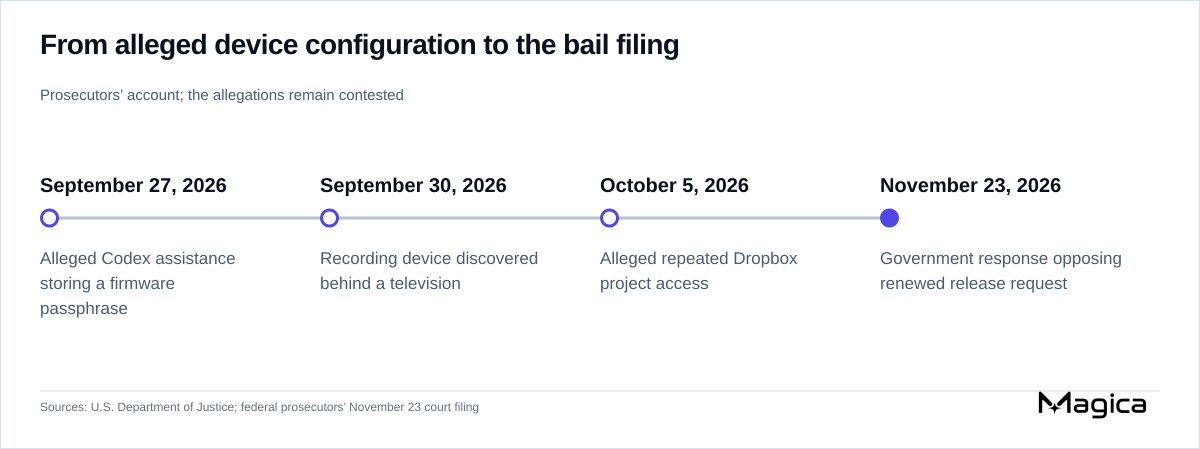
Prosecutors’ account links alleged device configuration and Dropbox access to the November bail filing. Alfozan has pleaded not guilty. Source: U.S. District Court filing.
Prosecutors say records supplied by OpenAI show Alfozan used Codex, the company’s AI coding tool, through his wife’s account to help configure recording equipment and transmit or store audio through Dropbox, a cloud storage and file-sharing service.
On September 27, he allegedly prompted Codex to store a passphrase in firmware for a XIAO ESP32 device—the same kind found behind the television three days later. On September 29, he requested voice detection so the device would record speech. Prosecutors also cite October 5 browsing records showing repeated access to Dropbox materials associated with the project.
The government argues that Alfozan may still have access to confidential OpenAI materials through cloud accounts he controls. If he is released, prosecutors want restrictions barring contact with OpenAI personnel and access to or transmission of company materials, alongside a substantial secured bond, travel restrictions and location monitoring.
Defense lawyer David Rizk sought Alfozan’s release on a $1 million bond, arguing that prosecutors had not presented evidence supporting more serious charges such as espionage or trade-secret theft, according to the account of the competing bail arguments. Four friends, all U.S. citizens, agreed to put up money for the proposed bond.
Prosecutors contend that Alfozan’s resources, Saudi connections and limited remaining U.S. ties create a serious flight risk. They cite his loss of employment and an October 12 trip to Saudi Arabia planned before his arrest, and question whether the proposed sureties would exert sufficient influence over him. The filing notes that the Saudi consulate is no longer part of his proposed bond package, while prosecutors argue its earlier offer still demonstrates Saudi government interest in his release. Rizk said Alfozan’s wife had traveled to Saudi Arabia with their child because her student visa was expiring, and attributed their continued absence to trauma from the FBI raid and subsequent publicity.
The government cites communications with Saudi officials and an October 6 invitation from a royal-family member to join Echelon, a Riyadh-based AI and technology company. Prosecutors say Alfozan suggested he might join “after the IPO.” Those contacts support the government’s argument about his ability and incentive to leave the United States; the filing does not establish that he supplied recordings to a foreign government.
A hearing on the renewed request is scheduled for the morning of November 24 before U.S. Magistrate Judge Alex Tse, who rejected Alfozan’s earlier bid for release. The immediate issue is whether conditions can reasonably assure his appearance in court.
The government says substantially all remaining discovery in its possession is due to be produced by November 24. Trial on the sole count is currently set for January 2027, although prosecutors say Alfozan has indicated he would abandon his demand for a speedy trial if released. The offense carries a maximum prison sentence of five years; the parties dispute the potential sentencing calculation.
The release decision does not resolve whether particular recordings contain trade secrets or whether anyone else received them. Those questions require evidence about the recordings’ contents and use—the part of the investigation prosecutors say remains unfinished.
Nvidia shares rose 31.48% after its board reinstated founder Jensen Huang, delivering a reported record one-day gain in market value while leaving investigations and AI investment risks unresolved.
Meta’s Muse AI agent is available to UK adults with shopping connections and mandatory purchase approvals. The launch follows changes to its consumer terms and a voluntary privacy monitoring commitment, with oversight continuing as users delegate tasks and account access.
Supertake's seed round and former Coinbase AI leaders back a service that turns market opinions into portfolios. Brokerage constraints, unaudited returns and an undefined revenue-sharing model complicate its ambition to reward the best ideas.
South Korean stocks rebounded as Nvidia co-founder Jensen Huang returned as CEO, lifting Samsung Electronics and SK hynix. The rally recovered only part of recent losses, with a board investigation and doubts about AI investment still unresolved.
AWS has released five open-weight decision models that read shared context in both directions and return probabilities rather than generated text. Its results suggest better handling of pivotal details, but deployment savings and confidence scores still need testing on real workloads.
OpenAI is bringing a conversational version of GPT-6.2 Sol to four paid ChatGPT tiers ahead of a reported December 23 retirement of two older models. Its tests show better image understanding and web search, but uneven progress on factuality and instruction steering.
Redwood and Crusoe announced plans to expand their Nevada AI campus after reporting 99.2% microgrid availability. Crusoe separately cites grid backup for cloud reliability, while undisclosed project costs leave the used-battery business case unresolved.
Jensen Huang’s return as Nvidia CEO leaves December congressional questioning intact. Lawmakers want evidence behind the board’s security assurance and answers about chip exports and the administration’s involvement.
The Commerce Department added Singapore-based Megaspeed to its Entity List, imposing a licensing barrier on supplies to a longstanding Nvidia customer while allegations of chip diversion remain unresolved.
Google is rolling out optional Wallet access in Search’s AI Mode, with Drive and Gemini connections to follow. The expansion brings existing personal-finance capabilities into Search, while data-use permissions extend beyond the read-only limit on financial actions.
Anthropic has launched Claude Ship for GitHub repositories, combining code review with new agents that fix problems and apply approval policies. Teams retain control through repository rules, while automation adds token costs and can allow changes to merge without human review.
Google’s patent application describes generating videos from viewing habits, demographics and device context, with optional replicas of the viewer and inserted ads. Existing video tools show parts of the idea are already available; a commercial service and its economics remain unproven.
Google’s Gemini API can slice documents, spreadsheets and recordings on its servers and bill for selected content sent to the model. The controls reduce local preparation work, but upload limits, model defaults and the cost of finding relevant material qualify the savings.
OpenAI's OpenWorks pilot offers free AI assistance to eligible small businesses in 20 U.S. communities, pairing paid local partners with a three-month ChatGPT Business trial. It builds on earlier training efforts, but its total budget is undisclosed and typical business returns are unproven.
Nothing plans to unveil Ear (note) on December 8, pairing call-recording earbuds with a case that captures meetings for AI transcription. Existing recording products, uncertain service costs and unresolved privacy details narrow the novelty of the pitch.
Anthropic’s Enterprise Frontier Safeguards beta lets eligible businesses use its most capable Claude models while keeping encrypted safety records in their own cloud accounts. Automated monitoring remains; customers pay cloud costs and review flagged cases.
Hakeem Jeffries promised an investigation after Nvidia reinstated Jensen Huang following Donald Trump’s intervention. Reports that directors excluded interim CEO Colette Kress sharpen questions about the reversal and its national security assurances.
The European Commission has confirmed a leak affecting users of its public learning platform, while the number affected, the wider exposure of staff data and responsibility for the attack remain unresolved.
Maintainers defend continued distribution of the AI penetration-testing framework after its creator withdrew it. Investigations document data theft and cheap automation, but also failed payouts, blocked attacks and safeguards that vary by version.