Editorial Team
7 min read
Jensen Huang reportedly disclosed more affairs before Nvidia reinstated him after White House intervention. The account describes conduct violations and a limited field of successors, while security inquiries and new compliance measures remain unfinished.
Jensen Huang, Nvidia’s co-founder and returning chief executive, disclosed additional extramarital affairs during hours of discussions with directors before their November 22 reinstatement vote, according to a report citing people familiar with the meeting. The longtime leader of the AI chipmaker returned on November 23, eleven days after resigning amid scrutiny of his relationships and possible national-security risks.
The reversal followed intensive intervention by President Donald Trump’s administration and a sharp fall in Nvidia’s shares. But it also reflected a constrained succession search: the same account says directors found few internal or external executives both able and willing to take the job. Restoring Huang resolved the leadership vacancy while leaving the conduct findings and security questions outstanding.
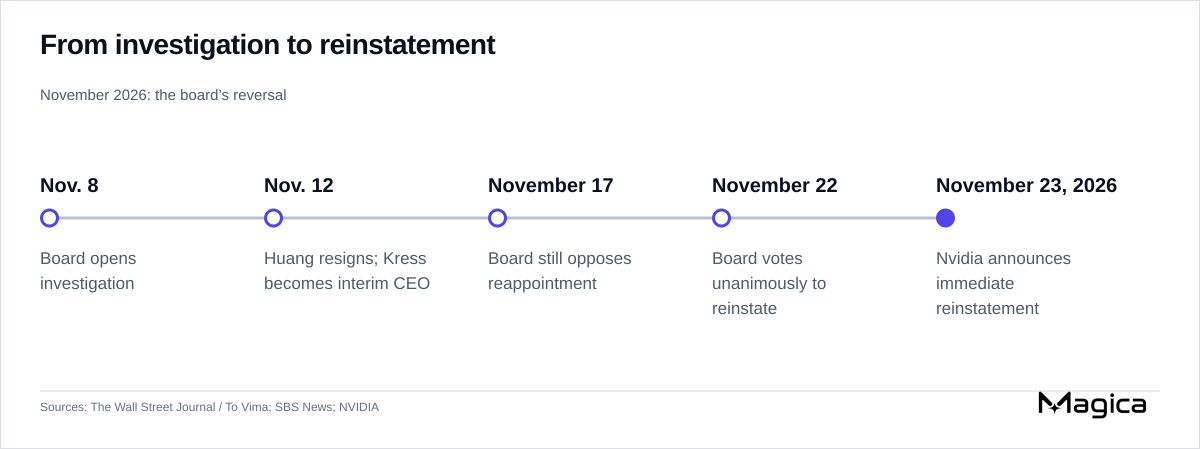
Magica’s timeline traces the leadership reversal. Nvidia said its independent investigation would continue after Huang’s reinstatement. Source: To Vima / The Wall Street Journal.
Huang disclosed relationships beyond the two widely reported and expressed remorse during the Sunday meeting, people familiar with the discussions said. Directors emphasized honesty and candor before concluding that his return was the best course.
The follow-up account gives neither the number of additional relationships nor the identities of those involved. Drawing on the same underlying reporting, it says directors found that his affairs and failure to disclose them violated Nvidia’s code of conduct. Those findings come from accounts of private deliberations; Nvidia’s public reinstatement announcement does not describe the violations.
The previously reported relationships included Alice Huang, a former executive at Singapore-based cloud-computing company Megaspeed, whom U.S. officials suspect of ties to Chinese intelligence, and Kimberly Powell, Nvidia’s vice president of health care. Powell reported directly to Jensen Huang, according to a separate summary of the reporting. Beijing has denied that Alice Huang worked for the Chinese government.
An earlier report, summarized in the follow-up account, also alleged a relationship with an unidentified Nvidia employee. It is unclear whether that relationship was among the additional disclosures on Sunday; the available reporting does not establish a total.
In its November 23 announcement, Nvidia said the board was satisfied with Huang’s candor and ability to lead after a series of meetings. Returning to the office, Huang apologized to employees and promised to be a better CEO, according to a video reviewed in the detailed report.
The board opened its investigation on November 8. Huang resigned on November 12, and Nvidia chief financial officer Colette Kress became interim CEO. As recently as November 17, directors said they did not intend to reappoint him, according to an account of the reversal.
The opening for his return came on Saturday, when Attorney General Todd Blanche told Trump and Vice President JD Vance that Huang was neither a subject nor a target of a Justice Department investigation, U.S. officials told the detailed report. Blanche also said the department had no evidence that Huang had broken laws or posed a national-security risk. The account says Nvidia’s months of cooperation with chip-smuggling investigations under Huang’s leadership underpinned Blanche’s assessment. Administration officials relayed his assurances to directors.
Nvidia’s announcement says input from senior U.S. officials gave the board confidence that Huang’s reinstatement posed no national-security risk. Trump separately described him as exonerated. Yet Nvidia expressly said its independent investigation would proceed to conclusion. An assessment of Huang’s current investigative status does not establish what information, if any, was shared.
The intelligence itself remains qualified. People familiar with U.S. intelligence told the detailed report that Alice Huang had been in contact with China’s Ministry of State Security during the affair, but that the intelligence was inconclusive about whether she had been tasked with collecting information on Jensen Huang. Attempts to reach her were unsuccessful.
The report also says Trump had been briefed at least twice on those intelligence concerns, including before allowing Huang to join his May trip to China. Huang’s supporters countered that U.S. intelligence had never given him a defensive briefing warning that he might be a foreign intelligence target.
Nvidia’s importance extends beyond chip sales. It supplies leading AI model developers and makes models of its own. Huang had helped shape the administration’s AI and chip-export strategy, including lobbying for licenses to sell older chips directly to China, the detailed report says.
Vance, a former venture capitalist, regarded Huang as an important U.S. advocate of open-weight AI models, which officials described as cheaper and easier to customize. He also saw the administration’s relationship with Huang as a means of influencing the chip industry, according to officials cited in that account. Those were policy and strategic arguments for reinstatement, alongside Trump’s concern about markets.
The leadership change also raised a financing question. During her interim tenure, Kress said Nvidia was taking a strong look at the kinds of companies it would help finance. The report linked that remark to concerns about Nvidia’s role financing the wider AI industry. It does not establish how Huang’s return will affect those decisions.
Nvidia shares had fallen roughly 30% since Huang’s resignation despite faster-than-expected sales growth in its November 17 earnings report, according to the detailed account. The follow-up report puts Monday’s rise at more than 31%. Those percentages describe different starting prices and do not imply that the earlier loss was fully recovered. The detailed account says the S&P 500 rose 4.7% on Monday.
Trump cited the market’s response as evidence that reinstatement was the right decision. A letter seeking Huang’s return drew more than 200,000 signatures, while employees warned of talent losses if he stayed out, according to the report.
Directors had hired executive search firm Heidrick & Struggles. Arm Holdings chief executive Rene Haas was considered a front-runner, according to the detailed report. He had worked at Nvidia for about a decade and had known Nvidia board chair Harvey Jones for more than twenty years, including through his work at a firm Jones co-founded.
Haas led a company Huang had previously tried to acquire before regulatory obstacles stopped the deal. His discussions with the search firm had progressed, and Nvidia directors sought other executives’ opinions of him and other candidates. Arm’s management and board also contacted Haas to counter Nvidia’s interest and keep him in his current job, the report says.
The search therefore supports a narrower conclusion than either indispensability or an easy replacement: Nvidia explored other candidates, but directors reportedly considered the available field limited. Nvidia says Kress will continue as chief financial officer and Jones will remain board chair.
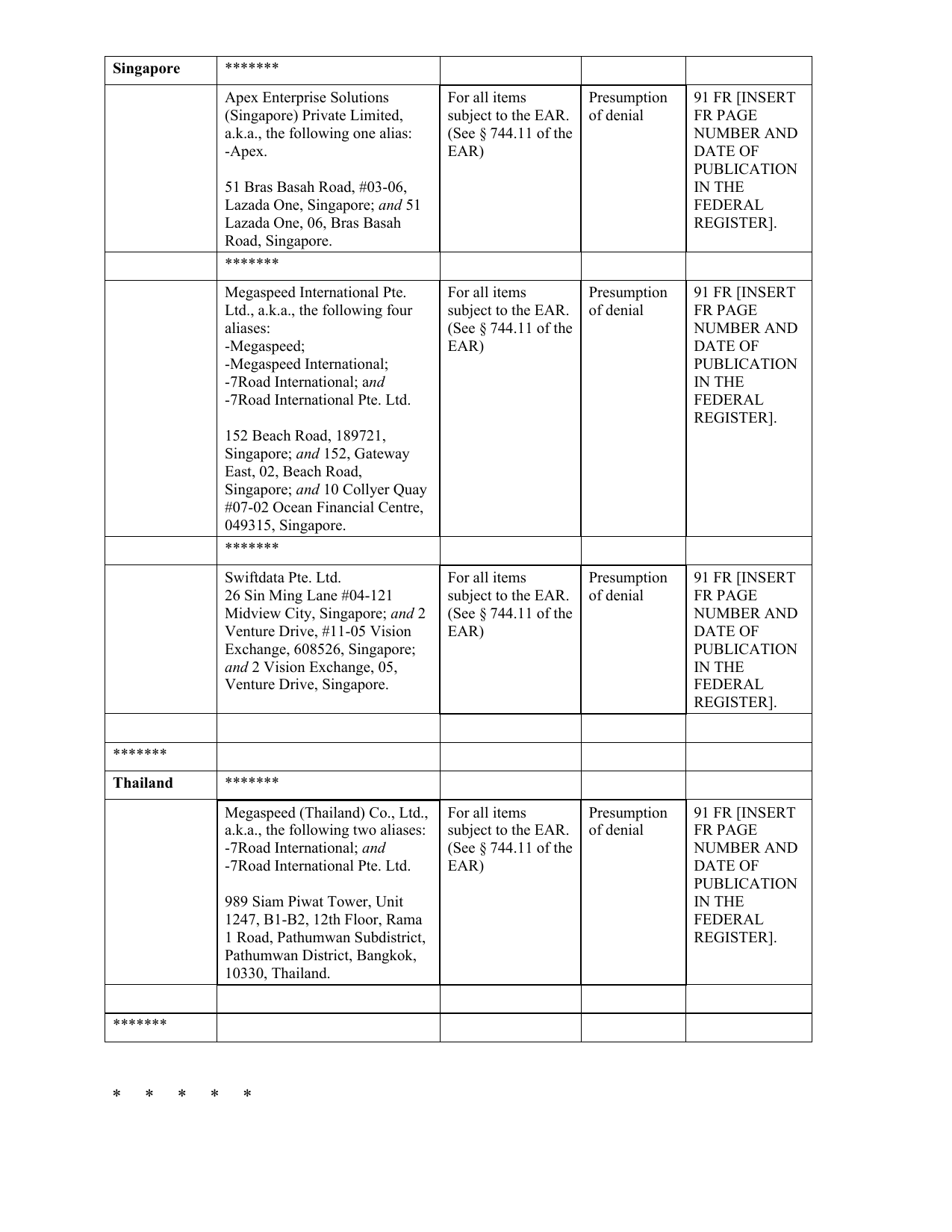
The U.S. Commerce Department’s public-inspection rule lists Megaspeed International Pte. Ltd. with a presumption-of-denial license review policy. Source: public-inspection.federalregister.gov.
An independent committee of Nvidia directors is examining whether Huang shared corporate or national-security information during his relationship with Alice Huang. The board is sharing information with prosecutors, according to the detailed report. Nvidia says the committee has independent counsel and Huang has committed to cooperating.
Separately, the Justice Department is investigating suspected smuggling of AI chips into China involving Nvidia customers Megaspeed International and Super Micro, a maker of data-center servers. Megaspeed said it had retained outside counsel to investigate and described itself as compliant; Super Micro said it was cooperating and had placed accused employees on leave, according to the detailed report.
The Commerce Department added Megaspeed and other firms to its trade blacklist on Monday. That action followed disagreement inside the administration: Treasury Secretary Scott Bessent had publicly accused Commerce of blocking Megaspeed’s listing, according to the detailed account. The same report notes a Securities and Exchange Commission investigation into Nvidia without detailing its scope.
Nvidia’s announcement supplies concrete next steps beyond reinstatement. It says a separate committee of independent directors will oversee national-security risks and trade compliance, and that it is beginning a search for a chief compliance officer who will report to its Nominating and Corporate Governance Committee.
Huang is scheduled to appear before House committees the following week, with lawmakers seeking answers about chip-export practices. The pending tests are what the investigations establish about information sharing and restricted chips, and how the new oversight arrangements operate with Huang back in charge.
A new filing describes recordings, apparent AI-generated transcripts and a confidential partnership document recovered from Abdulrahman Alfozan’s devices. He has pleaded not guilty to illegal interception, and the immediate dispute is whether he should remain detained before trial.
Nvidia shares rose 31.48% after its board reinstated founder Jensen Huang, delivering a reported record one-day gain in market value while leaving investigations and AI investment risks unresolved.
Meta’s Muse AI agent is available to UK adults with shopping connections and mandatory purchase approvals. The launch follows changes to its consumer terms and a voluntary privacy monitoring commitment, with oversight continuing as users delegate tasks and account access.
Supertake's seed round and former Coinbase AI leaders back a service that turns market opinions into portfolios. Brokerage constraints, unaudited returns and an undefined revenue-sharing model complicate its ambition to reward the best ideas.
South Korean stocks rebounded as Nvidia co-founder Jensen Huang returned as CEO, lifting Samsung Electronics and SK hynix. The rally recovered only part of recent losses, with a board investigation and doubts about AI investment still unresolved.
AWS has released five open-weight decision models that read shared context in both directions and return probabilities rather than generated text. Its results suggest better handling of pivotal details, but deployment savings and confidence scores still need testing on real workloads.
OpenAI is bringing a conversational version of GPT-6.2 Sol to four paid ChatGPT tiers ahead of a reported December 23 retirement of two older models. Its tests show better image understanding and web search, but uneven progress on factuality and instruction steering.
Redwood and Crusoe announced plans to expand their Nevada AI campus after reporting 99.2% microgrid availability. Crusoe separately cites grid backup for cloud reliability, while undisclosed project costs leave the used-battery business case unresolved.
Jensen Huang’s return as Nvidia CEO leaves December congressional questioning intact. Lawmakers want evidence behind the board’s security assurance and answers about chip exports and the administration’s involvement.
The Commerce Department added Singapore-based Megaspeed to its Entity List, imposing a licensing barrier on supplies to a longstanding Nvidia customer while allegations of chip diversion remain unresolved.
Google is rolling out optional Wallet access in Search’s AI Mode, with Drive and Gemini connections to follow. The expansion brings existing personal-finance capabilities into Search, while data-use permissions extend beyond the read-only limit on financial actions.
Anthropic has launched Claude Ship for GitHub repositories, combining code review with new agents that fix problems and apply approval policies. Teams retain control through repository rules, while automation adds token costs and can allow changes to merge without human review.
Google’s patent application describes generating videos from viewing habits, demographics and device context, with optional replicas of the viewer and inserted ads. Existing video tools show parts of the idea are already available; a commercial service and its economics remain unproven.
Google’s Gemini API can slice documents, spreadsheets and recordings on its servers and bill for selected content sent to the model. The controls reduce local preparation work, but upload limits, model defaults and the cost of finding relevant material qualify the savings.
OpenAI's OpenWorks pilot offers free AI assistance to eligible small businesses in 20 U.S. communities, pairing paid local partners with a three-month ChatGPT Business trial. It builds on earlier training efforts, but its total budget is undisclosed and typical business returns are unproven.
Nothing plans to unveil Ear (note) on December 8, pairing call-recording earbuds with a case that captures meetings for AI transcription. Existing recording products, uncertain service costs and unresolved privacy details narrow the novelty of the pitch.
Anthropic’s Enterprise Frontier Safeguards beta lets eligible businesses use its most capable Claude models while keeping encrypted safety records in their own cloud accounts. Automated monitoring remains; customers pay cloud costs and review flagged cases.
Hakeem Jeffries promised an investigation after Nvidia reinstated Jensen Huang following Donald Trump’s intervention. Reports that directors excluded interim CEO Colette Kress sharpen questions about the reversal and its national security assurances.
The European Commission has confirmed a leak affecting users of its public learning platform, while the number affected, the wider exposure of staff data and responsibility for the attack remain unresolved.
Maintainers defend continued distribution of the AI penetration-testing framework after its creator withdrew it. Investigations document data theft and cheap automation, but also failed payouts, blocked attacks and safeguards that vary by version.